
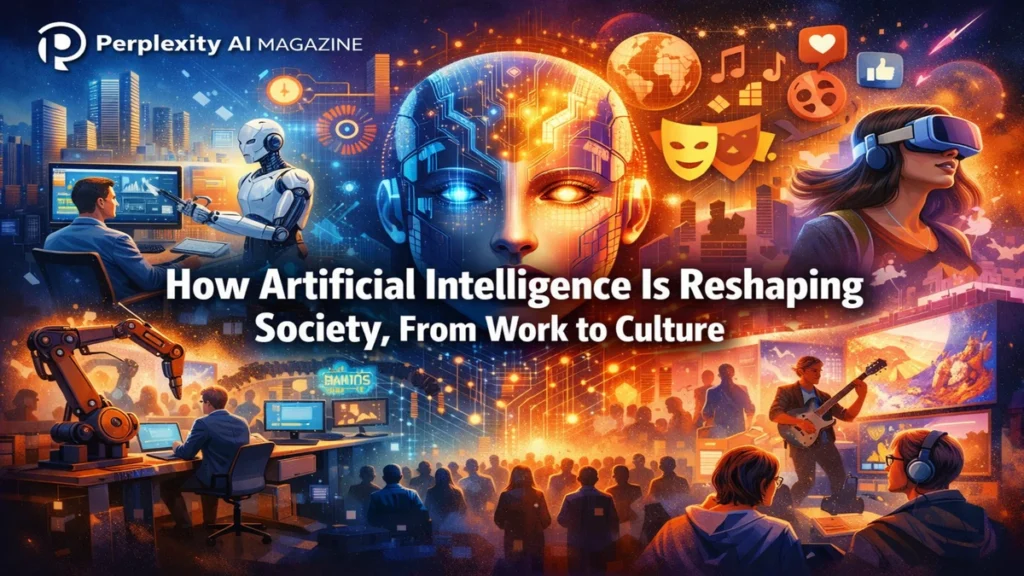
Artificial intelligence is no longer a future concept or a speculative idea confined to research labs and science fiction. It is now embedded in everyday life, shaping how people work, communicate, create, and make decisions. From the software that filters résumés to the algorithms recommending what we watch, read, and buy, AI is becoming an invisible infrastructure of modern society. This transformation is happening unevenly, accelerating opportunity for some while creating anxiety, disruption, and uncertainty for others.
At its core, the societal impact of AI is about power, productivity, and identity. AI systems redistribute labor between humans and machines, shift economic advantage toward those who control data and computational resources, and alter cultural norms around creativity, authorship, and even truth. While AI promises efficiency and innovation, it also raises profound questions about fairness, dignity, autonomy, and the future role of human work.
Understanding how AI is reshaping society requires moving beyond simple narratives of technological progress or decline. It requires examining the subtle ways algorithms reorganize institutions, rewire incentives, and reshape relationships between individuals, employers, governments, and platforms. The story of AI is not only about machines becoming more capable, but about societies adapting to those capabilities in ways that reflect their values, inequalities, and political choices.
The Changing Landscape of Work
One of the most visible impacts of artificial intelligence is its transformation of work. Across industries, AI systems are automating routine tasks such as data entry, scheduling, quality control, and basic analysis. At the same time, they are augmenting higher-skill work by assisting with coding, legal research, medical diagnostics, design, and strategic planning. This dual role of automation and augmentation is reshaping job descriptions rather than simply eliminating jobs outright.
For many workers, this shift means that the nature of their work is changing faster than the number of available jobs. Tasks that once defined entire professions are being broken into components, some handled by humans and others by machines. Accountants spend less time on calculations and more on interpretation. Journalists rely on AI for transcription and research but still provide narrative judgment. Doctors use AI for imaging analysis but remain responsible for diagnosis and patient care.
This restructuring creates both opportunity and risk. Workers who can adapt, learn new tools, and reposition themselves alongside AI often become more productive and valuable. Those whose roles consist mainly of repetitive or easily automated tasks face stagnation or displacement. The result is a labor market that rewards adaptability, education, and digital fluency while penalizing rigidity and limited access to training.
Economic Transformation and Productivity
Beyond individual jobs, AI is reshaping the structure of entire economies. By lowering the cost of prediction, optimization, and coordination, AI enables new business models, faster innovation cycles, and more efficient resource allocation. Companies can scale faster with fewer employees, manage global operations more precisely, and personalize services to millions of users simultaneously.
These productivity gains can fuel economic growth, but they also concentrate power and wealth. Firms that control advanced AI systems, proprietary data, and large computing infrastructures gain disproportionate advantages over smaller competitors and less technologically equipped regions. This creates winner-take-most dynamics in many digital markets, where a small number of platforms dominate advertising, commerce, and information flows.
As a result, economic inequality can widen even as overall output increases. High-skill workers and technology owners capture more value, while wages stagnate in sectors that face automation without parallel investment in reskilling. Without policy intervention, AI risks reinforcing existing inequalities across income, geography, and education.
Cultural Shifts and Human Experience
AI is not only an economic force; it is a cultural one. Algorithms shape what people see, hear, and encounter online, influencing taste, opinion, and identity. Recommendation systems determine which songs become hits, which videos go viral, and which news stories gain attention. Over time, these systems subtly influence cultural norms, language, humor, and even political discourse.
In creative fields, AI challenges traditional ideas about authorship and originality. When a machine can generate a painting, a poem, or a piece of music in seconds, the value of human creativity shifts from production to intention, curation, and meaning. The cultural question becomes not whether machines can create, but what people want creativity to represent in a world where generation is cheap and abundant.
AI also changes how people relate to each other. Chatbots provide companionship, digital assistants mediate daily routines, and algorithmic matching shapes friendships, dating, and professional networking. These systems can reduce loneliness and friction, but they also risk replacing human interaction with optimized simulations of it, raising questions about authenticity, emotional dependence, and social isolation.
AI and Inequality
The benefits and harms of AI are not evenly distributed. Access to high-quality education, digital infrastructure, and stable employment determines whether individuals experience AI as empowerment or threat. Regions with strong institutions and social safety nets can use AI to enhance public services and economic resilience. Regions without them may experience job loss, exploitation, and deepening inequality.
Gender, race, and class intersect with AI in complex ways. Algorithms trained on biased data can reproduce and amplify discrimination in hiring, lending, policing, and healthcare. Meanwhile, groups overrepresented in administrative, clerical, and service roles face higher exposure to automation. Without deliberate correction, AI can encode historical injustice into automated systems that appear neutral but are not.
Addressing these risks requires recognizing that AI is not an autonomous force but a human-designed system shaped by economic incentives and political choices. Inequality is not an inevitable outcome of AI, but a reflection of how societies choose to deploy and regulate it.
Governance, Ethics, and Responsibility
As AI becomes embedded in critical systems, governance becomes central. Decisions about transparency, accountability, privacy, and safety determine whether AI serves the public good or private power. Ethical questions about consent, surveillance, manipulation, and control grow more urgent as AI systems become more capable and more pervasive.
Effective governance requires balancing innovation with protection. Overregulation can stifle beneficial development, while underregulation can allow harm to scale rapidly. The challenge is not to stop AI, but to shape its trajectory so that it aligns with democratic values, human rights, and social well-being.
This means involving diverse voices in AI design, investing in public digital infrastructure, enforcing standards against discrimination and abuse, and ensuring that humans retain meaningful oversight over automated systems that affect their lives.
Takeaways
• AI is transforming work by changing tasks rather than simply eliminating jobs
• Productivity gains coexist with growing inequality and power concentration
• Cultural norms are shifting as algorithms shape attention, creativity, and identity
• Unequal access to skills and infrastructure determines who benefits from AI
• Ethical and governance choices will shape AI’s long-term social impact
Conclusion
Artificial intelligence is not merely a technological development; it is a social transformation. It reshapes how value is created, how culture is formed, how power is distributed, and how people understand their place in the world. Its influence reaches into work, art, politics, education, and relationships, making it one of the most consequential forces of the modern era.
Whether AI deepens inequality or supports shared prosperity depends less on the technology itself and more on the choices societies make about its use. Education, regulation, and collective values will determine whether AI becomes a tool of empowerment or a mechanism of exclusion. The future of AI is ultimately a human future, shaped not by code alone but by the priorities, institutions, and ethics that guide its development.
FAQs
How does AI affect employment?
AI changes job tasks, automates some roles, and creates new ones, making adaptability and lifelong learning increasingly important.
Is AI replacing human creativity?
AI can generate content, but human creativity remains essential for meaning, intention, and cultural context.
Can AI increase inequality?
Yes, if access to skills, data, and technology remains unequal, AI can amplify existing social and economic gaps.
Why is AI regulation important?
Regulation ensures transparency, fairness, safety, and accountability as AI systems affect more areas of life.
What can individuals do to adapt to AI?
Learning digital skills, critical thinking, and adaptability helps individuals remain relevant and empowered in an AI-driven world.
For More AI News Click Here!
