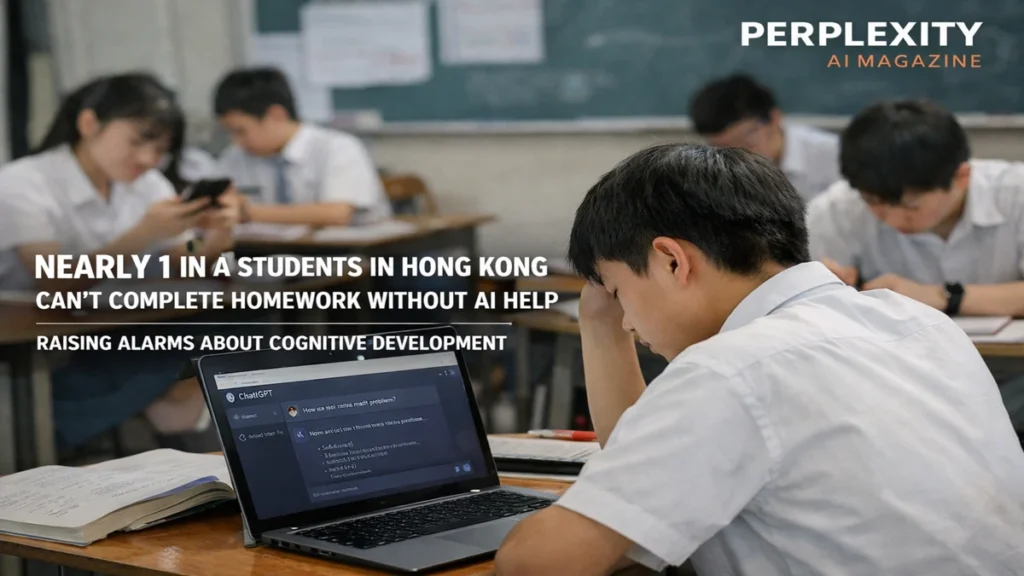
In Hong Kong’s tightly packed apartments, where homework is often completed late at night under fluorescent lights, a quiet but profound shift is underway. For a growing number of students, artificial intelligence is no longer a supplement to learning. It has become a prerequisite. According to a new territory-wide study by Our Hong Kong Foundation, nearly one in four students report that they cannot finish their homework without the help of AI tools. – Hong kong students ai homework.
The finding cuts to the heart of a global debate about education in the age of generative artificial intelligence. Is AI a powerful learning accelerator, or is it subtly eroding the very skills schools are meant to cultivate? In Hong Kong, where academic performance is closely tied to social mobility and family expectations, the question carries particular urgency.
The survey, conducted between July and December 2025 and involving 1,200 primary and secondary teachers and students, reveals near-universal adoption of AI in education. Ninety-five percent of students and 91 percent of teachers reported using AI tools for learning or teaching. Yet beneath this headline figure lies a more troubling pattern: dependence. Twenty-three percent of students said they struggle to complete homework without AI assistance, while a significant proportion admitted to sharing personal data with AI platforms, often without understanding the risks.
Educators are uneasy. A large majority fear that over-reliance on AI is undermining students’ problem-solving and critical thinking abilities. Policymakers, meanwhile, face pressure to respond quickly but carefully, balancing innovation with the preservation of essential human skills. Hong Kong now finds itself at a crossroads, emblematic of a challenge confronting education systems worldwide.
The Study That Sparked Alarm
The Our Hong Kong Foundation study was designed to capture a comprehensive snapshot of AI use across the education system. It surveyed both teachers and students from primary and secondary schools, examining not only whether AI tools were used, but how they were used, for what purposes, and with what perceived consequences.
The results show that AI has penetrated almost every corner of academic life. Students reported using AI to solve mathematics problems, generate essay outlines, summarize reading materials, translate languages, and check homework answers. Teachers, for their part, used AI for lesson planning, grading assistance, administrative paperwork, and creating teaching materials. – Hong kong students ai homework.
What distinguishes this study from earlier research is its focus on dependency rather than access. The finding that 23 percent of students cannot complete homework without AI suggests a qualitative shift: from AI as optional support to AI as cognitive infrastructure. This distinction matters. Educational psychologists have long argued that learning requires struggle, iteration, and error. When AI shortcuts those processes, students may arrive at correct answers without developing the reasoning pathways that make learning durable.
The survey also highlights a stark mismatch between usage and governance. While AI use is widespread, only a tiny fraction of respondents rely on institution-developed tools. Just 7 percent of students and 3 percent of teachers reported using AI platforms provided or regulated by schools. The rest overwhelmingly turned to international, open-source applications, often with opaque data practices and little alignment with local curricula.
Read: Pogs Collectibles, AI Retail Tools, and SEO Insights
How Students Are Using AI
For many students, AI has become an all-purpose academic assistant. Its appeal is easy to understand. Generative AI tools offer instant feedback, polished language, and seemingly authoritative answers. In a competitive academic environment, they can feel like a lifeline. – Hong kong students ai homework.
Students reported using AI most frequently for homework completion rather than enrichment. Instead of asking AI to explain a concept, many ask it to produce an answer. This distinction is subtle but significant. When AI is used as a tutor, it can reinforce understanding. When it is used as a surrogate thinker, it risks displacing learning altogether.
The survey found that AI use spans subjects, but is particularly prevalent in language-based assignments and problem-solving tasks. Writing essays, once a cornerstone of critical thinking development, is increasingly mediated by AI-generated drafts. Mathematics and science homework, traditionally designed to build step-by-step reasoning, is often solved through AI-generated solutions that students may copy without fully understanding.
Equally concerning is students’ handling of personal data. Sixteen percent admitted to sharing personal information with AI tools, including names, school details, and even identifiable academic records. This behavior reflects not malice but ignorance. Many students lack basic understanding of how AI systems collect, store, and potentially misuse data.
Teachers Between Adoption and Anxiety
Teachers in Hong Kong are not resisting AI. On the contrary, 91 percent reported using it themselves. Yet their embrace of the technology is tempered by deep unease about its effects on students.
The most frequently cited concern, expressed by 71 percent of teachers, is the erosion of problem-solving skills. Closely behind is the fear, shared by 63 percent, that AI undermines critical thinking. These are not abstract worries. Teachers report seeing students submit assignments that are technically correct but conceptually shallow, unable to explain how they arrived at an answer. – Hong kong students ai homework
Many educators also acknowledge a confidence gap. Despite using AI regularly, teachers rated their own AI proficiency lower than that of their students. This inversion of expertise complicates classroom dynamics. When students are more fluent in AI tools than their instructors, guidance becomes harder, and meaningful oversight weaker.
Privacy and ethics add another layer of concern. Teachers expressed frustration at the lack of clear institutional guidelines on acceptable AI use. Without shared standards, educators are left to make ad hoc decisions about what constitutes cheating, collaboration, or legitimate assistance. This ambiguity risks uneven enforcement and student confusion.
Usage Patterns at a Glance
| Indicator | Students | Teachers |
|---|---|---|
| Use AI tools for learning/teaching | 95% | 91% |
| Cannot finish homework without AI | 23% | N/A |
| Use institution-developed AI tools | 7% | 3% |
| Concerned about problem-solving impact | N/A | 71% |
| Concerned about critical thinking impact | N/A | 63% |
This table underscores the paradox at the heart of Hong Kong’s AI moment: widespread adoption paired with limited institutional control and growing cognitive concerns.
The Cognitive Cost of Convenience
At the center of the debate is a fundamental question: what happens to thinking when thinking is outsourced? Cognitive science suggests that skills like problem-solving and critical thinking are not innate traits but learned behaviors. They are strengthened through effortful practice, reflection, and failure.
When AI provides immediate solutions, it removes friction from learning. In the short term, this can boost efficiency and confidence. In the long term, it may weaken the mental muscles that students need to navigate complex, unfamiliar problems.
Educators worry that students may develop what some psychologists call “automation bias,” a tendency to trust machine outputs even when they are flawed. Without strong foundational skills, students may lack the capacity to evaluate AI-generated answers critically.
There is also concern about equity. Students with stronger backgrounds may use AI to deepen understanding, while those who struggle academically may rely on it as a replacement for learning. This dynamic risks widening, rather than narrowing, educational gaps.
Privacy in an Unregulated Landscape
The heavy reliance on international AI platforms raises serious privacy questions. Unlike institution-developed tools, many popular AI applications operate under terms of service that allow extensive data collection. Students, particularly younger ones, are often unaware of these policies.
The survey’s finding that 16 percent of students share personal data with AI tools likely understates the true scale of the issue. Even seemingly innocuous inputs, such as homework prompts or writing samples, can reveal sensitive information when aggregated.
Teachers and school administrators report feeling ill-equipped to address these risks. Without centralized platforms or clear regulatory frameworks, schools have limited ability to protect student data or ensure compliance with local privacy standards.
Why Local Adoption Remains Low
Despite high AI usage, local or institution-developed tools remain marginal. Several factors contribute to this gap. Developing robust AI systems requires significant investment, technical expertise, and ongoing maintenance. Schools often lack the resources to compete with well-funded international platforms.
There is also an issue of trust and usability. Students gravitate toward tools that are powerful, intuitive, and widely discussed online. Institution-developed systems, when they exist, are often perceived as limited or outdated.
The result is a fragmented ecosystem in which schools have little visibility into how AI is used, what data is shared, and how learning outcomes are affected.
Recommendations from Our Hong Kong Foundation
In response to its findings, Our Hong Kong Foundation calls for a coordinated policy response rather than piecemeal restrictions. Central to its recommendations is the creation of a centralized AI platform for schools. Such a platform would provide vetted tools aligned with curricular goals and governed by clear data protection standards.
The foundation also urges the development of a comprehensive AI curriculum spanning all academic levels. This curriculum would go beyond technical skills to include ethical use, data literacy, and critical evaluation of AI outputs. The goal is not to ban AI, but to teach students how to use it thoughtfully and responsibly.
Teacher training is another priority. Professional development programs would help educators build confidence in AI tools, understand their limitations, and design assignments that encourage active learning rather than passive consumption.
Proposed Path Forward
| Policy Area | Proposed Action | Intended Outcome |
|---|---|---|
| Infrastructure | Centralized AI platform | Standardized, secure AI access |
| Curriculum | AI literacy across grades | Balanced skill development |
| Teacher Training | Continuous professional development | Confident, informed educators |
| Privacy | Clear data protection protocols | Student data security |
| Assessment | Redesign of homework and exams | Emphasis on reasoning over answers |
A Global Mirror
Hong Kong’s experience is not unique. Around the world, education systems are grappling with similar challenges. What makes Hong Kong’s case distinctive is the speed and scale of adoption, coupled with the intensity of academic pressure.
Internationally, there is growing consensus that AI cannot be treated as a passing trend. It is a structural change that demands structural responses. Countries that fail to adapt risk producing students who are technologically adept but cognitively fragile.
Hong Kong’s policymakers face a narrow window of opportunity. By acting now, they can shape AI’s role in education before habits of dependence become entrenched.
Takeaways
- AI use among Hong Kong students and teachers is nearly universal.
- Almost one in four students struggle to complete homework without AI.
- Teachers are most concerned about impacts on problem-solving and critical thinking.
- International AI tools dominate, while institution-developed platforms remain rare.
- Student data privacy is a significant and underappreciated risk.
- Experts advocate for centralized platforms and comprehensive AI curricula.
- The challenge is not whether to use AI, but how to use it without undermining learning.
Conclusion
The Our Hong Kong Foundation study offers a sobering snapshot of education at a turning point. Artificial intelligence has woven itself into the fabric of learning with astonishing speed, bringing undeniable benefits alongside profound risks. The finding that nearly one in four students cannot finish homework without AI is not merely a statistic. It is a warning.
Yet it is also an opportunity. Hong Kong has the institutional capacity, technological sophistication, and educational ambition to chart a more balanced course. By investing in thoughtful policy, robust infrastructure, and ethical education, the city can harness AI as a tool for empowerment rather than dependence.
The challenge ahead is not to retreat from technology, but to reassert the value of human thinking within it. In doing so, Hong Kong may offer a blueprint for education systems everywhere navigating the uncertain terrain of an AI-driven future.
FAQs
Why are Hong Kong students relying so heavily on AI?
High academic pressure, easy access to powerful tools, and lack of clear guidelines have normalized AI use for homework and study tasks.
Is AI use considered cheating in Hong Kong schools?
Policies vary by school, and many lack clear definitions, creating ambiguity for students and teachers alike.
What skills are most at risk from AI over-reliance?
Teachers are most concerned about problem-solving and critical thinking skills, which require sustained cognitive effort.
Are students aware of AI privacy risks?
Many are not. A significant minority admit to sharing personal data without understanding potential consequences.
What solutions are being proposed?
Experts recommend centralized AI platforms, comprehensive AI education, teacher training, and stronger privacy protections.