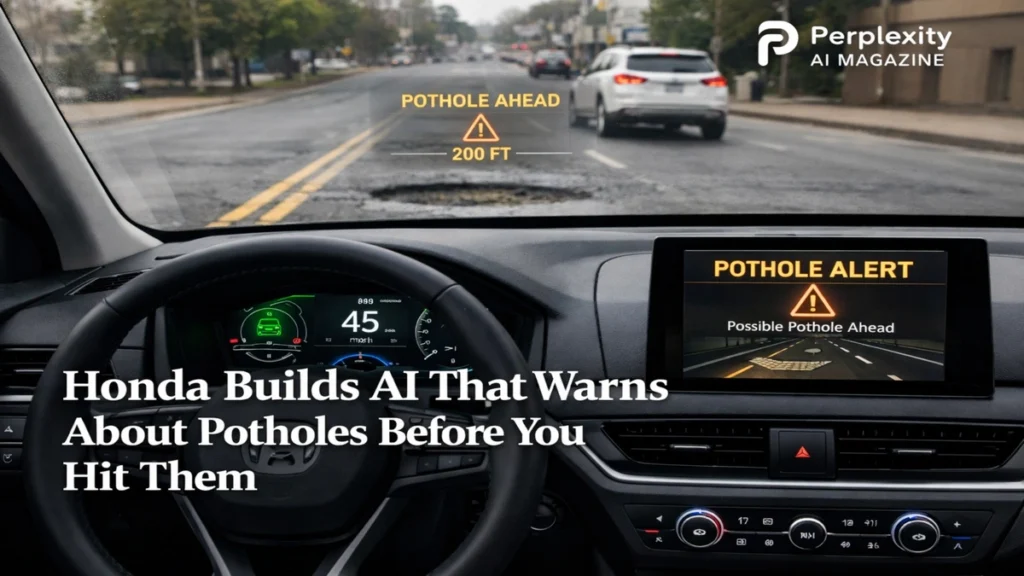
I have driven enough city roads to know that potholes rarely announce themselves. They appear suddenly, often too late to avoid, damaging tires, suspensions, and sometimes confidence itself. That everyday frustration is exactly what Honda is trying to solve with a new artificial intelligence system designed to detect potholes and other roadway hazards before vehicles hit them. – honda ai.
In the first hundred words, the promise is clear. Honda has developed an AI-powered Proactive Roadway Maintenance System that uses cameras and LiDAR already mounted on test vehicles to identify potholes, damaged guardrails, faded lane markings, and obscured road signs. Instead of relying solely on human inspections, the system turns moving vehicles into data collectors, feeding anonymized information to transportation authorities. During a pilot across more than 3,000 miles of Ohio roads, the system showed that machines might notice what humans miss.
I see this as part of a broader shift in how automakers think about safety. For decades, safety technology focused on protecting occupants during or after a crash. Now, the emphasis is increasingly preventative. By identifying road hazards in advance, Honda’s system aims to reduce vehicle damage, improve ride quality, and help governments repair roads more efficiently.
What makes this effort notable is not just the technology, but the collaboration. Working with the Ohio Department of Transportation, the University of Cincinnati, and engineering firm Parsons, Honda has framed AI not as a flashy driver feature, but as civic infrastructure. It is still experimental, not available in consumer vehicles, yet it hints at a future where cars quietly watch the road for everyone’s benefit. – honda ai.
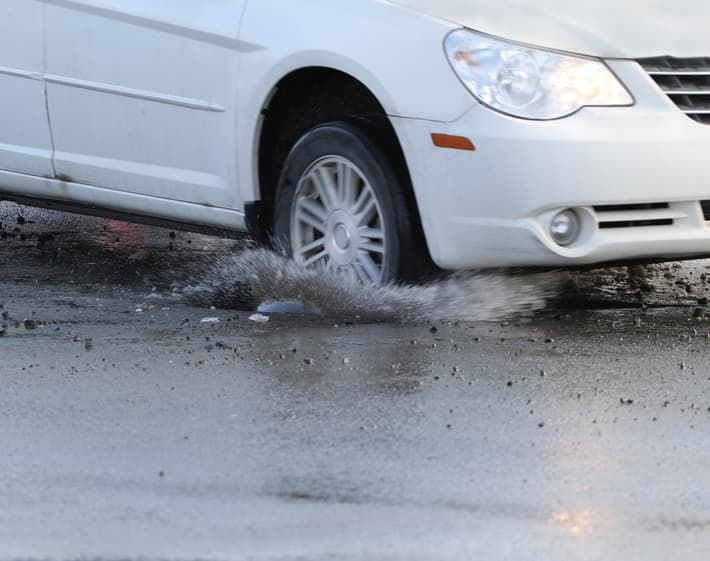
The System Honda Has Built
At the center of this effort is Honda’s Proactive Roadway Maintenance System, an AI platform designed to see the road the way engineers do. I find it striking that Honda did not design new hardware for this pilot. Instead, it relied on sensors already common in advanced driver assistance systems.
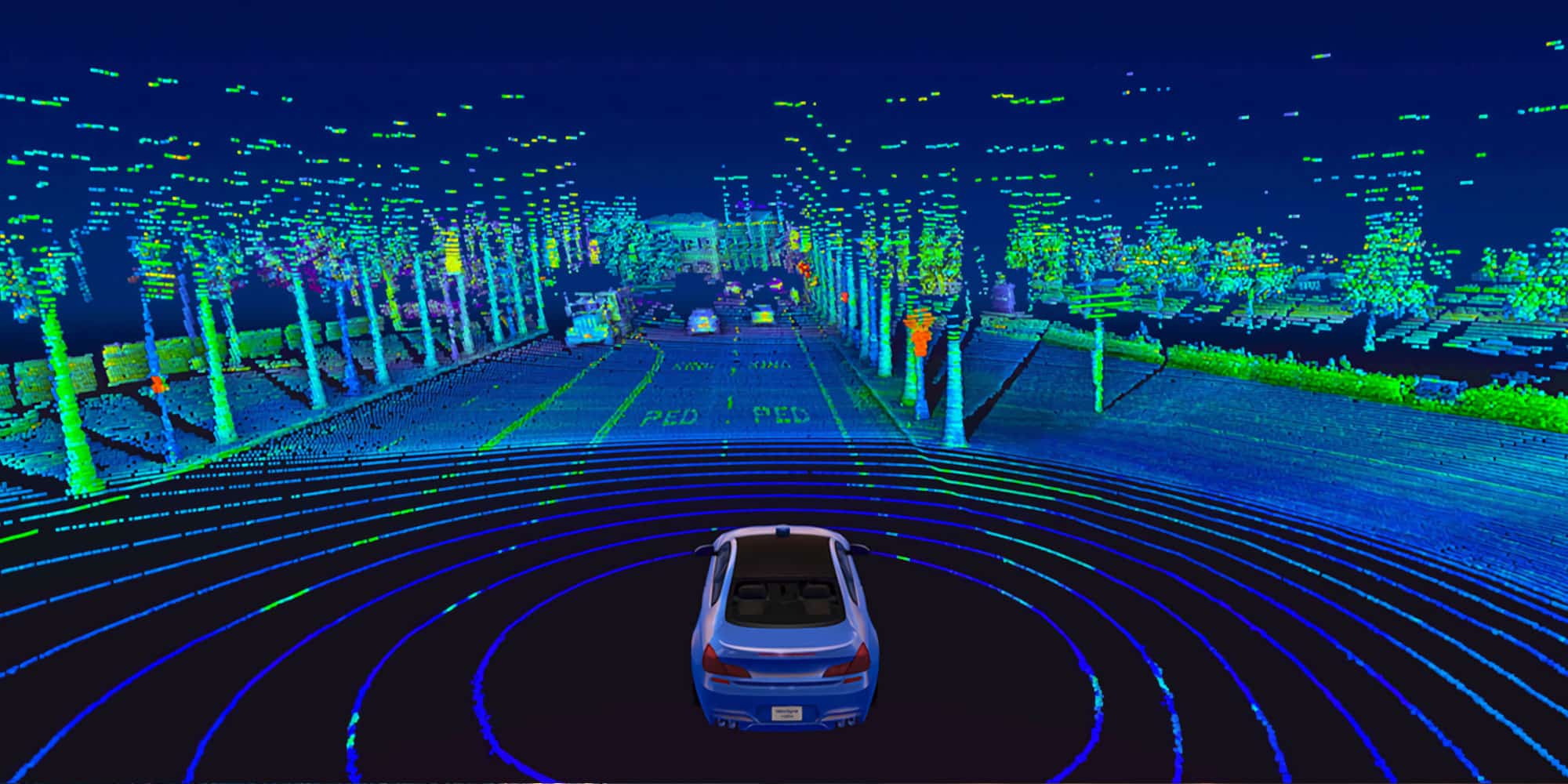
Test vehicles were equipped with forward-facing cameras and LiDAR units. Cameras capture visual detail such as cracks, missing paint, and broken signage. LiDAR emits laser pulses to create three-dimensional maps of the road surface, measuring subtle changes in elevation that indicate potholes. Together, these sensors provide a rich picture of roadway health. – honda ai.
Data collected on the road is transmitted to cloud servers, where AI models analyze it at scale. The system flags hazards, tags them with GPS coordinates, and anonymizes all vehicle information before sharing reports with transportation officials. According to Honda, this approach could reduce the need for manual road inspections, which are expensive and time consuming.
Read: Gemini 3.1 Pro vs Claude 4.6 Sonnet Explained
Testing Across Ohio Roads
Honda chose Ohio as its proving ground, partnering with Ohio Department of Transportation to test the system in real conditions. Over 3,000 miles of urban and rural roads were scanned, exposing the AI to highways, side streets, construction zones, and weather variations.
I appreciate that this was not a closed track experiment. The system had to distinguish real potholes from shadows, oil stains, and temporary debris. Ohio’s seasonal weather added another layer of complexity, with rain, snow residue, and worn asphalt all challenging the models.
ODOT officials reported that the AI-generated data helped prioritize repairs more effectively. Instead of relying on sporadic reports or scheduled inspections, they could see where problems were emerging in near real time. Honda estimates that, if scaled, such systems could save state agencies up to $4.5 million annually by reducing manual inspection costs.
Detection Accuracy and Real World Results
Accuracy determines whether such a system is useful or merely interesting. Honda released specific performance figures from the pilot, which caught my attention because they are unusually detailed for an experimental project.
The AI achieved 89 percent accuracy in identifying potholes, 93 percent accuracy for damaged guardrails, and 99 percent accuracy for signage problems. These numbers reflect real world testing rather than controlled lab conditions. In practice, that means the system correctly identified most hazards while keeping false positives manageable. – honda ai.
Transportation researcher Dr. Vivek Deshpande of the University of Michigan, who was not involved in the project, told Transportation Research News that “anything above 85 percent accuracy in uncontrolled roadway environments is a meaningful threshold for operational use.” That assessment helps contextualize Honda’s claims.
How the AI Actually Sees a Pothole
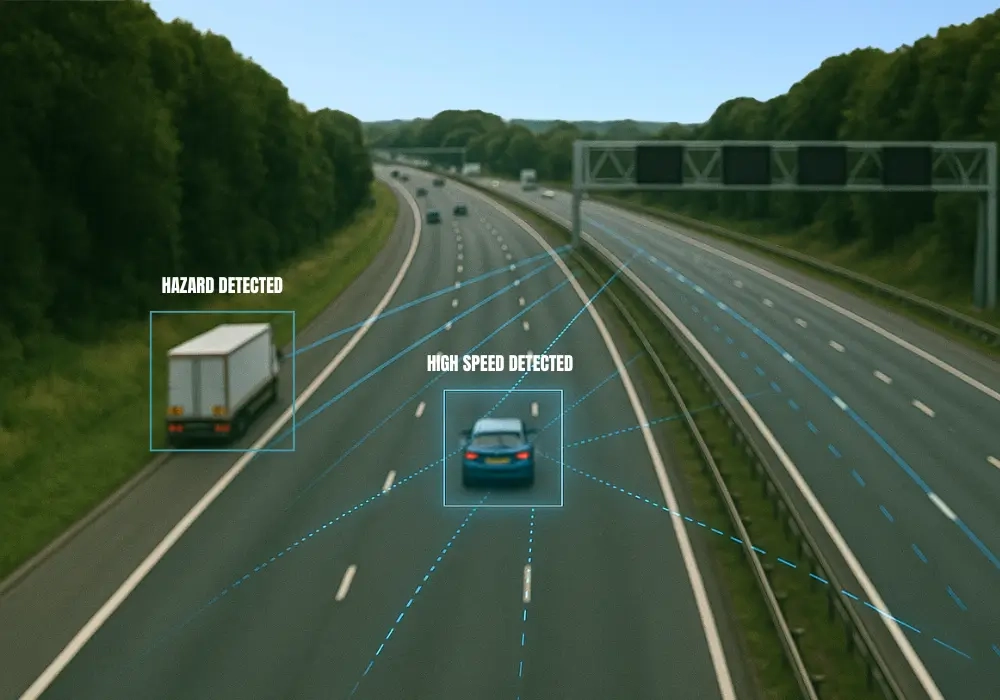
Understanding how the system works reveals why it performs as it does. Cameras and LiDAR collect different types of information, and the AI fuses them. Visual data shows texture and color changes, while LiDAR captures depth and shape.
A pothole, in Honda’s model, is defined as a sudden depression in the road surface exceeding certain thresholds, often around five centimeters. Shadows may look similar in a camera image, but they lack depth in LiDAR data. Cracks may show texture changes without significant depth.
By aligning these data streams through calibration, the system estimates pothole size and depth within an eight percent margin of error. That level of precision allows agencies to classify severity and urgency, not just presence.
Cloud Processing and Data Privacy
Once data leaves the vehicle, it enters a cloud-based analysis pipeline. Honda emphasizes that all information is anonymized. Vehicle identifiers are stripped, and only hazard type and location remain.
This matters because privacy concerns often derail connected vehicle projects. By framing the system as infrastructure monitoring rather than driver surveillance, Honda aims to build public trust. Data is aggregated across many vehicles, making individual driving patterns irrelevant.
Cybersecurity analyst Bruce Schneier has argued that anonymization and purpose limitation are essential for public acceptance of smart infrastructure. Honda’s design appears aligned with that principle, at least in its pilot phase.

Partners Behind the Project
Honda did not work alone. The system has been in development since 2021 with support from the University of Cincinnati and engineering firm Parsons.
Researchers at the University of Cincinnati contributed to AI model training and validation, while Parsons provided infrastructure and transportation engineering expertise. This blend of academic, industrial, and public sector input shaped a system focused on practicality rather than novelty.
Such collaborations are becoming more common as automakers explore mobility beyond vehicle sales. In this case, the car becomes a sensor node in a larger network.
Why No Consumer Honda Has It Yet
Despite the excitement, no Honda model currently offers pothole warnings from this system. That point deserves clarity. The pilot used prototype-equipped test vehicles, not production cars like the Civic or Accord.
Honda has stated that future versions could rely on sensors already present in many vehicles, but integration would require software updates, regulatory alignment, and further accuracy improvements. Automakers move cautiously when adding features that could influence driver behavior.
Safety engineer Mary Barra, speaking broadly about ADAS systems at a 2022 SAE conference, noted that premature deployment of partially mature systems can erode trust. Honda appears to be following that conservative philosophy.
Potential Timeline and Future Rollout
Speculation about timelines is inevitable. Honda has not committed to consumer availability, but internal statements suggest that expansion depends on scaling accuracy and partnerships. Opt-in data sharing from consumer vehicles is envisioned rather than mandatory participation.
If accuracy improves beyond the current 89 percent and partnerships expand beyond Ohio, a connected service could emerge later this decade. Industry analysts have suggested 2027 or later as a plausible window, though Honda has not confirmed this.
This cautious pace reflects the complexity of turning pilots into products, especially when public infrastructure is involved.
How It Compares to Traditional Road Inspections
Traditional road inspections rely on crews driving or walking routes, visually checking conditions. These methods are labor intensive and episodic.
| Aspect | Traditional Inspection | Honda AI System |
|---|---|---|
| Frequency | Periodic | Continuous |
| Cost | High labor expense | Lower marginal cost |
| Coverage | Limited routes | Broad, crowdsourced |
| Data detail | Qualitative | Quantitative and geotagged |
The AI approach does not eliminate human oversight but augments it with scale and consistency.
Economic Impact for Governments
Road maintenance budgets are under constant strain. In the United States, the American Society of Civil Engineers has repeatedly graded road infrastructure poorly. AI-assisted detection could help allocate limited funds more effectively.
Honda estimates that reducing manual inspections could save Ohio up to $4.5 million annually. Multiplied across states, the impact could be substantial. Early detection also prevents minor defects from becoming major repairs.
Transportation economist Susan Handy has noted that preventative maintenance yields the highest return on investment in road infrastructure. AI systems make prevention more feasible.
Turning Cars Into Infrastructure Sensors
One of the most intriguing aspects is philosophical. Cars have traditionally consumed infrastructure. This system allows them to contribute back.
By crowdsourcing data from vehicles already on the road, cities gain a constantly updating map of conditions. No new sensor networks need to be installed. The marginal cost of each additional vehicle is low.
This model aligns with smart city concepts, where existing assets are leveraged creatively. It also raises questions about governance and data ownership that will need careful answers.

Limitations and Open Questions
The system is not perfect. An 89 percent detection rate means some potholes will be missed, and some false positives will occur. Weather, lighting, and sensor calibration all affect performance.
There are also equity concerns. Roads traveled by fewer vehicles may receive less data, potentially biasing maintenance priorities. Addressing this would require thoughtful deployment strategies.
Honda acknowledges these challenges and frames the project as evolving. Continuous learning from flagged errors is built into the system.
The Broader Safety Context
Honda’s project fits into a larger shift toward proactive safety. Advanced driver assistance systems already warn about lane departures and imminent collisions. Road hazard awareness extends that logic beyond the vehicle.
By identifying potholes before impact, the system could reduce accidents caused by sudden swerving or tire blowouts. Even without direct driver alerts, smoother roads improve safety indirectly.
As mobility researcher Bryant Walker Smith has argued, safety emerges from systems, not single features. Road-aware AI contributes to that system.
Takeaways
- Honda has tested an AI system that detects potholes using cameras and LiDAR.
- The pilot covered over 3,000 miles of Ohio roads.
- Detection accuracy reached 89 percent for potholes.
- Data is anonymized and shared with transportation agencies.
- No consumer Honda models currently include the system.
- Future rollout depends on accuracy, partnerships, and policy.
Conclusion
I see Honda’s pothole-detecting AI as a glimpse into a quieter future of automotive innovation. It is not about flashy dashboards or bold marketing claims. It is about using intelligence already embedded in vehicles to solve a mundane but costly problem.
The system remains experimental, and significant hurdles remain before consumers ever see it. Yet its implications extend beyond Honda. If cars can help maintain the roads they drive on, the relationship between vehicles and cities changes.
This project suggests a future where mobility is collaborative, where private technology supports public good. Whether that future arrives in 2027 or later, the idea itself already reshapes expectations. Sometimes progress begins not with speed, but with noticing the cracks beneath our wheels.
FAQs
Did Honda build an AI that warns drivers about potholes?
Honda built an AI system that detects potholes, but it does not yet warn drivers directly.
Is this system available in Honda cars today?
No, it is still in pilot testing using prototype-equipped vehicles.
How accurate is Honda’s pothole detection AI?
It achieved about 89 percent accuracy during real world testing.
Who receives the data collected by the system?
Anonymized data is shared with transportation authorities like Ohio DOT.
When could consumers see this feature?
No timeline is confirmed, but analysts suggest possible rollout later this decade.