
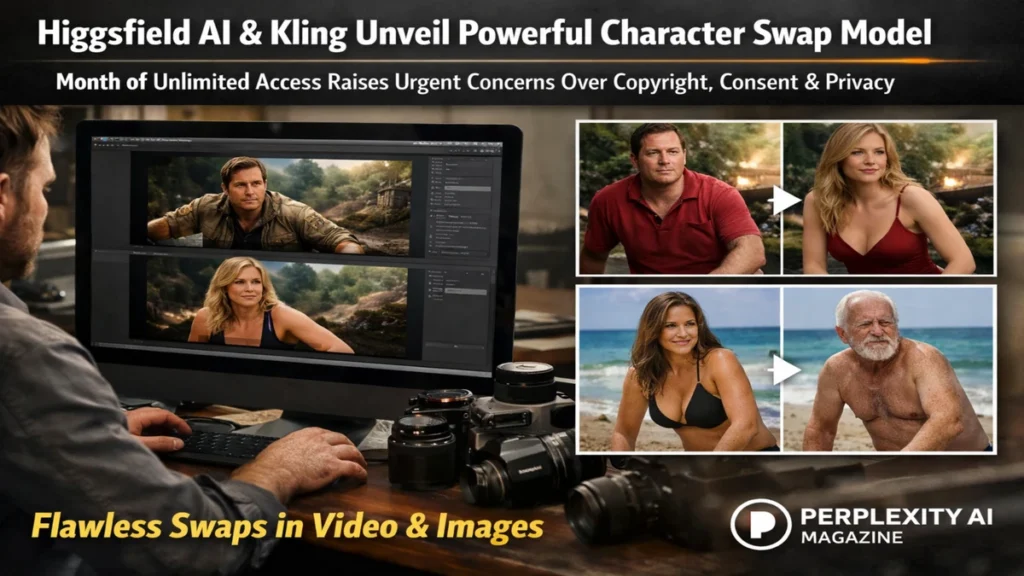
In January 2026, Higgsfield AI quietly crossed a threshold that many creators had been chasing for years. Through a partnership with Kling, the company released a new AI model capable of performing near-perfect character swaps in both video and images—without visible seams, lighting mismatches, or broken motion. Faces move naturally. Bodies retain their physics. Shadows, gestures, and eye lines stay intact. For the first time, the illusion holds. 0 higgsfield ai character swap.
To accelerate adoption, Higgsfield made a bold move: unlimited use of Kling-powered character swaps for an entire month through a promotional bundle. The result was immediate and explosive. Social platforms filled with short clips demonstrating cinematic-quality recasting, anime-to-live-action transformations, and professional-grade visual effects created entirely in a browser. What once required teams of VFX artists and weeks of post-production could now be achieved in minutes.
At the center of the excitement is Recast, Higgsfield AI’s browser-based character swap tool. Powered by Kling’s latest multimodal model—often compared to versions like Kling 2.6—it allows users to replace characters in existing footage while preserving motion, emotion, lighting, and scene context. The system supports animation-ready exports, voice cloning, multilingual dubbing, and rapid prototyping for filmmakers, marketers, and independent creators.
Yet as the technology dazzles, it also unsettles. Perfect character swaps blur lines between originality and imitation, between homage and infringement. Questions of copyright, consent, and data handling are no longer theoretical. They are operational. Higgsfield AI x Kling arrives not just as a technical milestone, but as a cultural and legal stress test for generative media.
The Technology Behind Perfect Character Swaps
At the core of the Higgsfield AI x Kling release is a multimodal model designed to understand faces, bodies, motion, lighting, and context as a single system rather than separate layers. Traditional face-swap tools often fail because they treat the face as an overlay. Kling’s approach integrates the character into the scene itself.
The model tracks skeletal movement, micro-expressions, hand gestures, and head rotation frame by frame. It adapts lighting and color grading dynamically, ensuring the swapped character inherits the environment’s shadows and highlights. This allows the output to remain coherent even during subtle movements like breathing or rapid changes like turns and gestures. – higgsfield ai character swap.
For creators, the most transformative element is accessibility. No manual masking, no keyframing, no compositing knowledge is required. Users upload a short video, select or upload a reference character, and generate a result that is immediately usable. Exports are clean enough for professional pipelines, including animation and post-production workflows.
According to visual effects researchers, this level of consistency represents a shift from “face replacement” to “character recasting,” a distinction that matters both artistically and legally.
Read: ChatGPT Go Launches With Ads and Eight Dollar Price
Why the Unlimited Month Changed Everything
The decision to offer unlimited generations for a full month was not a minor promotion. It fundamentally altered how creators engaged with the tool. Instead of rationing credits, users experimented freely—testing lighting extremes, emotional ranges, camera angles, and motion complexity.
This freedom revealed the system’s strengths. Users discovered that the model handled close-ups particularly well, maintaining skin texture and eye focus without uncanny artifacts. Longer clips, typically five to fifteen seconds, showed remarkable stability in lip movement and hand interaction.
The buzz was amplified by professional creators who used the unlimited window to stress-test the model. Filmmakers used it for previsualization. Game designers tested cutscene concepts. Marketers mocked up campaign visuals in hours instead of weeks. – higgsfield ai character swap.
The promotion also served as a live demonstration of scalability. Higgsfield’s infrastructure handled sustained, high-volume generation, signaling readiness for professional adoption rather than hobbyist novelty.
How Recast Works in Practice
Recast follows a streamlined, browser-based workflow designed to minimize friction while maximizing control.
| Step | Action | Purpose |
|---|---|---|
| 1 | Upload target video | Establish motion, scene, and timing |
| 2 | Upload reference image | Define new character identity |
| 3 | Optional customization | Backgrounds, voice, dubbing, tweaks |
| 4 | Generate output | AI performs full character recast |
The system works best with simple scenes: a single subject, clear framing, minimal occlusion. Under those conditions, the AI tracks motion with near-physical accuracy. Crowded scenes and fast cuts are supported, but results vary depending on complexity.
Recast Studio allows further refinement after generation, enabling creators to adjust outputs for animation, editing, or compositing. The result is a pipeline that feels closer to creative direction than technical execution.
Voice Cloning and Dubbing Integration
Beyond visuals, Higgsfield AI integrates voice cloning and multilingual dubbing directly into the character swap workflow. Users can upload a short audio sample—typically ten to thirty seconds—and the system analyzes timbre, accent, and emotional tone.
Once processed, creators can input new dialogue or generate scripts, adjusting speed and pitch as needed. Automatic lip-sync aligns the new audio with the swapped character’s mouth movements, maintaining realism across six supported languages. – higgsfield ai character swap.
This integration is significant because it collapses what was previously a fragmented process. Visual recasting, voice synthesis, and dubbing now occur within a single interface, reducing production friction and opening new possibilities for globalized content creation.
Audio engineers note that the quality depends heavily on input cleanliness. Noise-free samples yield dramatically better results, and short test clips help fine-tune emotional alignment before full generation.
Copyright Law Meets Generative Media
As character swaps become indistinguishable from traditional visual effects, copyright law becomes unavoidable. Swapping copyrighted characters from films, games, or books into new videos typically creates derivative works. In most jurisdictions, that requires permission from the rights holder.
Distinctive fictional characters enjoy protection when they are sufficiently unique, not merely generic archetypes. Using such characters without authorization—especially for commercial purposes—can trigger infringement claims regardless of intent.
Legal scholars emphasize that fair use offers only narrow protection. Parody, criticism, or commentary may qualify, but entertainment or promotional content rarely does. The more realistic and polished the output, the harder it becomes to argue transformation.
Higgsfield AI’s terms place responsibility squarely on users, reinforcing that technical capability does not confer legal permission.
Consent and the Right of Publicity
The legal risks are even sharper when real people are involved. Most jurisdictions recognize a right of publicity, which protects individuals from unauthorized commercial use of their likeness. Swapping a real person’s face into a video without consent—especially for monetized content—can lead to significant liability.
Platforms often prohibit celebrity swaps outright to reduce exposure. Violations can result in account suspension or bans. Even non-commercial uses can raise ethical concerns, particularly when realism blurs the line between fiction and representation.
According to digital ethics experts, consent is not just a legal formality but a moral boundary. As tools become more powerful, the burden on creators to obtain explicit permission increases, not decreases. – higgsfield ai character swap.
Privacy and Data Handling Realities
Higgsfield AI emphasizes that users retain ownership of uploaded content and generated outputs. Files are stored securely in cloud environments, accessible only to the user, and can be deleted permanently at any time. Basic privacy protections are in place, including anonymized IP tracking and device-level analytics.
However, the policies stop short of strict guarantees such as zero-retention or complete isolation from third-party processors. Uploaded content may be processed through external AI providers, including Kling’s infrastructure, for generation purposes.
Facial and biometric data is used solely to perform swaps under user consent, but the platform reserves operational rights to process data for service improvement. Privacy advocates note that these provisions are common but broad, leaving room for interpretation.
Compared with privacy-first alternatives, the trade-off favors capability and convenience over maximal data minimization.
When and How Data Is Shared
Higgsfield AI’s privacy policy allows data sharing under defined scenarios. Service providers and partners may process content for delivery, security, and performance optimization. Analytics firms may receive aggregated or de-identified data to understand usage patterns.
User-initiated sharing occurs when content is made public, linked to social platforms, or sent to collaborators. Advertising partners may receive limited information for interest-based ads, though users retain ownership of content itself.
| Data Type | Shared With | Purpose |
|---|---|---|
| Uploaded media | AI processors | Generation and rendering |
| Metadata | Analytics providers | Performance insights |
| Public content | Social platforms | User-directed sharing |
| Ad signals | Advertising partners | Interest-based ads |
The lack of explicit restrictions on third-party vendor access during generation is a point of concern for some professionals handling sensitive material.
Expert Views on the Creative Impact
“This is the first time character swapping feels like directing, not hacking,” said one visual effects supervisor familiar with the tool. “You’re making creative decisions instead of fixing technical problems.”
A media law professor offered a more cautious view. “The more realistic these outputs become, the less tolerance courts will have for casual infringement. The technology raises the stakes for compliance.”
A privacy researcher added, “Unlimited access accelerates innovation, but it also accelerates misuse. Governance needs to keep pace with capability.”
Together, these perspectives capture the tension at the heart of Higgsfield AI x Kling: extraordinary creative power paired with equally extraordinary responsibility.
Takeaways
- Higgsfield AI partnered with Kling to release an advanced character swap model in January 2026
- The system delivers photorealistic swaps with full motion, lighting, and emotional consistency
- A one-month unlimited promotion drove massive creator adoption and experimentation
- Recast integrates visual swapping, voice cloning, and dubbing in a single workflow
- Copyright and consent laws apply strictly to swapped characters and real people
- Users retain content ownership, but data may be processed by third parties
- The tool marks a shift from novelty effects to professional-grade recasting
Conclusion
The Higgsfield AI x Kling release represents a decisive moment in generative media. By solving the last visible flaws of character swapping, the partnership has effectively democratized a capability once reserved for elite studios. The unlimited access promotion did more than attract attention. It revealed how quickly creators will adopt tools that remove friction without sacrificing quality.
Yet the same realism that makes the technology compelling also magnifies its risks. Copyright, consent, and privacy are no longer abstract constraints but daily considerations. As generative tools approach indistinguishability from traditional media, the ethical and legal frameworks surrounding them must mature just as quickly.
Higgsfield AI x Kling is not simply a new product. It is a preview of a future where visual identity becomes fluid, creation becomes instantaneous, and responsibility becomes inseparable from creativity.
FAQs
What is Higgsfield AI x Kling?
It is a partnership releasing an advanced AI model for photorealistic character swaps in video and images.
Is the character swap tool unlimited?
A special promotion offered unlimited generations for one month through select bundles.
Can I swap copyrighted characters freely?
No. Copyright laws apply, and permission is required for most derivative uses.
Do I need consent to swap real people?
Yes. Using a real person’s likeness without consent can violate right of publicity laws.
Does Higgsfield AI share my data?
Content may be processed by third-party providers for generation, with sharing governed by the platform’s privacy policy.
