
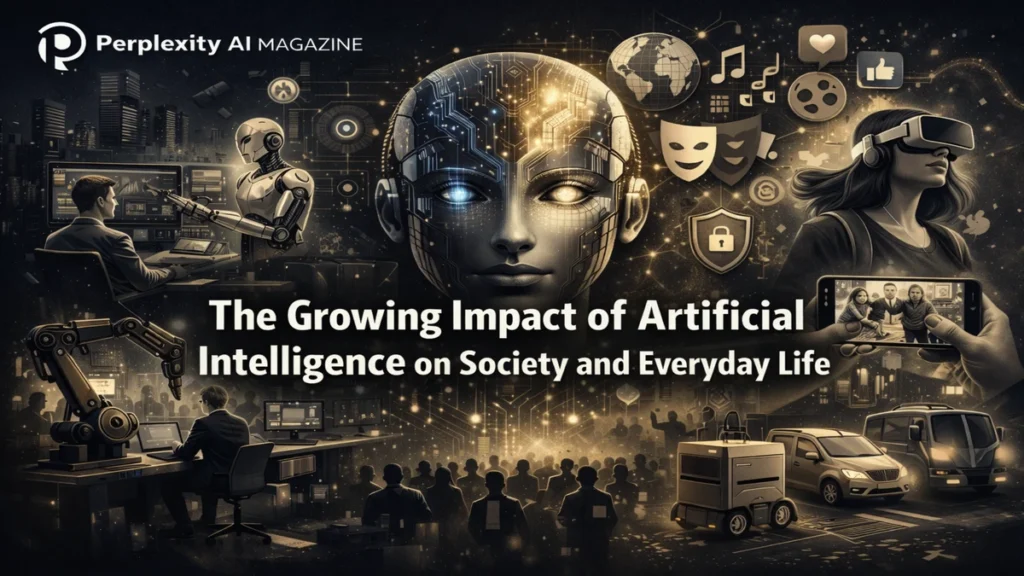
Artificial intelligence is no longer emerging — it is embedded. It shapes how companies operate, how people work, how information flows, and how daily life unfolds. From personalized streaming recommendations to medical imaging analysis, AI now quietly orchestrates much of modern society. With roughly 78 percent of global organizations using AI in at least one function and more than 80 percent of Americans engaging with AI-powered applications every day, artificial intelligence has become part of the invisible infrastructure of life.
This shift is not theoretical. Generative AI alone is estimated to contribute trillions of dollars annually to the global economy, while broader AI technologies are projected to add nearly $20 trillion by 2030. At the same time, inference costs for advanced models have fallen dramatically, making AI cheaper, faster, and more accessible than ever before. What was once experimental is now operational.
Yet AI’s expansion raises questions that reach beyond economics. It alters how people learn, how trust is built, how decisions are made, and how power is distributed. Productivity rises, but so do concerns about misinformation, surveillance, and displacement. This article explores how artificial intelligence is reshaping society — economically, culturally, and psychologically — tracing both its promise and its risks through data, lived experience, and expert insight.
Read: How Artificial Intelligence Is Reshaping Society, From Work to Culture
The Economic Transformation of AI
Artificial intelligence has become a major economic force, reshaping corporate strategy and national investment priorities. U.S. private investment in AI reached historic levels in 2024, outpacing other countries by wide margins. Organizations with mature AI strategies report productivity increases of roughly 30 percent, while high-performing companies attribute more than 5 percent of their EBIT growth to AI-enabled workflow redesigns.
The economic effect is not driven solely by automation. AI increasingly functions as a coordination layer across organizations — synthesizing information, optimizing decisions, and accelerating innovation. Generative AI, in particular, has reduced the cost of creativity and problem-solving by allowing machines to draft text, generate code, analyze documents, and simulate outcomes at scale.
Yet economic value remains uneven. While adoption is high, many firms struggle to move beyond experimentation into sustained returns. AI success depends less on tools than on organizational change — new workflows, new skills, and new governance structures. Technology alone does not create value; alignment does.
Table: AI’s Economic Footprint
| Indicator | Figure |
|---|---|
| Organizations using AI | ~78% |
| Productivity increase in AI-driven firms | ~30% |
| Generative AI annual economic value | $2.6–4.4 trillion |
| Total projected AI contribution by 2030 | ~$19.9 trillion |
| Inference cost reduction since 2022 | ~280x |
Everyday Life in an Algorithmic World
For most people, AI is not a tool — it is an environment. It powers the weather forecast in the morning, the navigation on the commute, the recommendations on streaming platforms, and the advertisements in social feeds. Over 80 percent of Americans use AI-powered systems daily, often without conscious awareness.
Chat-based AI tools are now used primarily for personal tasks: drafting emails, planning meals, organizing schedules, and exploring ideas. This signals a shift from AI as enterprise infrastructure to AI as cognitive companion. The boundary between human thinking and machine assistance is becoming porous.
This everyday integration changes habits subtly. People rely less on memory and more on retrieval, less on planning and more on recommendation, less on searching and more on asking. These changes reshape how knowledge is acquired, how decisions are made, and how agency is experienced.
Table: Where People Encounter AI Daily
| Domain | Typical Use |
|---|---|
| Weather apps | Forecasting and alerts |
| Streaming | Content recommendations |
| Shopping | Product ranking and pricing |
| Navigation | Route optimization |
| Social media | Feed personalization |
AI in Healthcare and Mobility
One of AI’s most tangible impacts is in healthcare. The number of AI-enabled medical devices has grown from just a handful in 2015 to more than 220 by 2023. These tools assist with imaging diagnostics, predictive monitoring, and treatment planning. Clinicians increasingly work alongside algorithms that flag anomalies, estimate risks, and propose interventions.
In transportation, autonomous systems have moved from experimental pilots into real-world deployment. Self-driving ride services now operate at scale in limited regions, offering a glimpse of a future where mobility is automated, optimized, and data-driven.
These changes promise efficiency and access, but they also shift responsibility. When machines influence diagnoses or driving decisions, accountability becomes complex. Errors no longer originate from a single human actor but from intertwined systems of data, code, and oversight.
Education, Work, and Cognitive Labor
Artificial intelligence has begun reshaping what it means to work and learn. Employees use AI to write reports, generate code, analyze data, and prepare presentations. Students use it to draft assignments, explore concepts, and practice skills.
This transformation challenges traditional ideas of effort, originality, and merit. If AI assists with writing and reasoning, what does mastery mean? If machines can draft, analyze, and predict, what remains uniquely human?
Rather than replacing human cognition, AI is increasingly augmenting it — acting as a collaborator rather than a competitor. But collaboration requires literacy. Those who understand how to use AI gain leverage; those who do not risk marginalization.
Public Perception and Ethical Tension
Public attitudes toward AI are deeply ambivalent. Many people recognize its benefits in convenience, productivity, and healthcare. At the same time, large majorities worry about misinformation, surveillance, job displacement, and loss of control.
Trust is the central issue. People are willing to accept AI in narrow, instrumental roles, but they resist systems that feel opaque, manipulative, or autonomous. The more AI influences social narratives, political discourse, and personal identity, the more it demands accountability and transparency.
The challenge is not technological but social: how to govern systems that evolve faster than law, move across borders, and shape behavior invisibly.
Expert Perspectives
“AI is not a single invention — it is a general-purpose infrastructure that reshapes everything it touches,” notes one technology analyst. “Its social impact depends entirely on how intentionally we design and regulate it.”
Another researcher emphasizes that “the productivity gains of AI come not from automation alone, but from redesigning human work around machine capabilities.”
An ethicist warns, “If we treat AI purely as a commercial product and not as a social force, we risk amplifying inequality, bias, and misinformation at unprecedented scale.”
Takeaways
- AI is now embedded in both enterprise operations and everyday consumer life.
- Economic value is significant but unevenly distributed.
- Healthcare and mobility are among the most visibly transformed sectors.
- AI changes how people think, learn, and make decisions.
- Public trust remains fragile and conditional.
- Governance and transparency are essential to long-term stability.
Conclusion
Artificial intelligence is not arriving — it is already here, woven into the fabric of daily life. It shapes what people see, what they buy, how they work, how they learn, and how they understand the world. Its benefits are real: efficiency, insight, accessibility, and innovation at unprecedented scale. But its risks are equally real: concentration of power, erosion of privacy, amplification of misinformation, and deepening inequality.
The future of AI will not be determined by engineers alone. It will be shaped by educators, policymakers, businesses, and citizens deciding what kinds of systems they accept, what values they encode, and what limits they enforce. Artificial intelligence is not destiny — it is a tool whose impact reflects human choices. Whether it becomes a force for collective flourishing or social fragmentation depends on how wisely and responsibly it is guided.
FAQs
What percentage of organizations use AI?
Around 78 percent of global organizations report using AI in at least one function.
How many people use AI worldwide?
Roughly 1.7 to 1.8 billion people have interacted with AI, with hundreds of millions using it daily.
Is AI replacing jobs?
AI is reshaping jobs more than replacing them, shifting skill demands and task structures.
Is AI safe in healthcare?
AI improves diagnostics and efficiency but requires oversight, validation, and accountability.
Why are people concerned about AI?
Concerns center on misinformation, privacy, fairness, and loss of human control.
