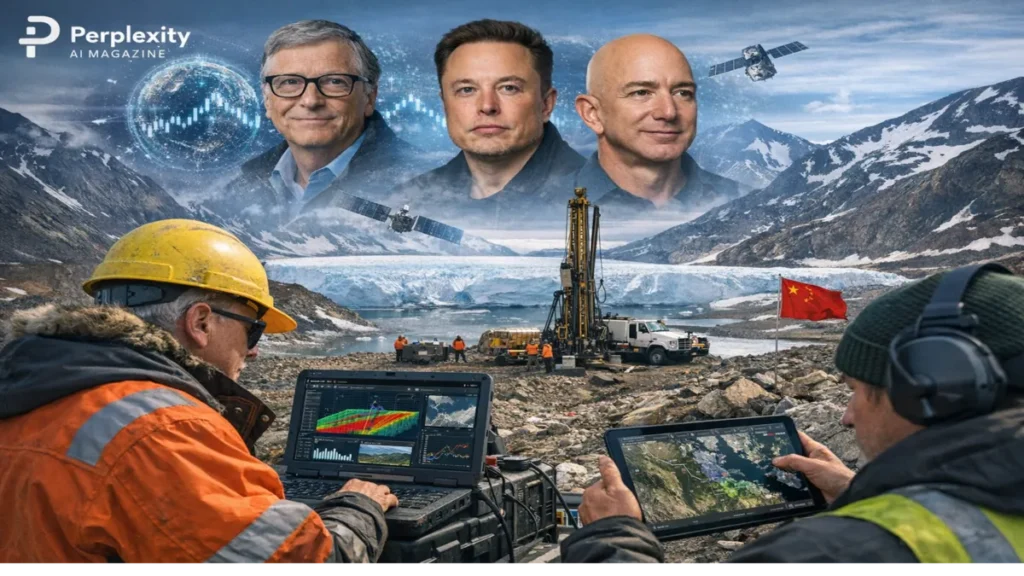
I first noticed Greenland entering the technology conversation not through climate science or Arctic politics, but through venture capital. Reports began circulating that Bill Gates, Jeff Bezos, and Sam Altman were backing a company using artificial intelligence to search for rare earth minerals beneath Greenland’s ice and rock. Around the same time, Peter Thiel’s name surfaced in stories about experimental Arctic ventures, not directly about mining, but about building new kinds of technological communities on the island. What looked at first like a curious coincidence revealed itself as something more coherent: Greenland had become a frontier not only of geology, but of computation, capital, and geopolitical imagination. – greenland rare earth ai.
The search for rare earth elements is not abstract. These minerals sit inside electric vehicles, wind turbines, smartphones, satellites, and military systems. Control over their supply shapes industrial power. China currently dominates rare earth production and processing, which has pushed Western governments and corporations to seek alternatives. Greenland, with its estimated deposits and changing accessibility due to melting ice, suddenly appears as both opportunity and dilemma.
AI changes the equation. Instead of slow, speculative drilling, companies can now model geological probability, narrowing the search before a single machine touches the ground. That promise has attracted some of the world’s most influential technology investors. Yet the story is not simply one of extraction. It is also about sovereignty, environment, and the tension between innovation and restraint.
This article traces how these investments came together, how they differ, and what they mean for Greenland and the world.
The strategic importance of rare earths
Rare earth elements are a group of metals essential to modern technology. They are used in permanent magnets, lasers, batteries, semiconductors, and precision weapons. Without them, much of the digital and clean energy economy would stall.
Global supply chains for rare earths are fragile. Production is concentrated in a small number of countries, with China playing a dominant role. That concentration has turned rare earths into geopolitical instruments as much as industrial inputs. – greenland rare earth ai.
Greenland’s appeal lies in its untapped reserves. Surveys suggest that the island holds meaningful quantities of rare earth elements, but harsh climate, limited infrastructure, and environmental protections have historically limited development. As ice retreats and technology advances, that balance shifts.
Investors now see Greenland not as an impossible terrain, but as a strategic hedge against supply chain vulnerability.
Read: OpenAI ChatGPT Health Secure Personal Health AI
KoBold Metals and AI exploration
KoBold Metals is at the center of this shift. The company uses artificial intelligence to analyze geological data, satellite imagery, and historical records to predict where mineral deposits are most likely to exist.
Instead of sending teams into the field with broad uncertainty, KoBold narrows targets computationally. The model looks for patterns in rock composition, geophysical signals, and known mineral formations, learning from both successes and failures. – greenland rare earth ai.
Bill Gates’s Breakthrough Energy fund invested in KoBold because rare earths are essential to clean energy technologies. Jeff Bezos invested because of the strategic and technological potential. Sam Altman invested because it represents the application of AI to a physical, high-stakes domain.
Their involvement signals confidence that AI can reduce the risk and cost of exploration while increasing the chance of meaningful discovery.
Table: Investors and roles
| Investor | Involvement | Focus |
|---|---|---|
| Bill Gates | KoBold Metals investor | Clean energy and strategic minerals |
| Jeff Bezos | KoBold Metals investor | Long-term resource strategy |
| Sam Altman | KoBold Metals investor | AI-driven exploration |
| Peter Thiel | Arctic tech ventures | Frontier infrastructure |
Peter Thiel and alternative Arctic visions
Peter Thiel’s name appears in Greenland conversations for a different reason. Rather than investing directly in rare earth exploration, Thiel is associated with startups exploring the idea of experimental cities or high-tech zones in frontier regions.
One such concept, often referred to through the startup Praxis, imagines building new kinds of communities that combine technology, alternative governance, and economic experimentation. Greenland’s low population density and geopolitical uniqueness make it appealing for such projects.
Thiel’s interest reflects a broader ideological project: testing new social and political models in spaces outside established systems. It is not about minerals so much as about institutions. – greenland rare earth ai.
This difference matters. While Gates, Bezos, and Altman are tied to resource strategy, Thiel is tied to structural experimentation. Both converge in Greenland because it is a place where conventional rules feel less fixed.
The environmental dimension
Greenland’s environment is fragile. Mining operations pose risks of contamination, habitat destruction, and long-term ecological damage. Any extraction effort must contend with these realities.
Local governance in Greenland emphasizes environmental protection and community consent. Greenlandic leaders have stressed that resource development must benefit local populations and preserve ecological integrity.
This creates a tension. On one side is global demand for minerals that enable clean energy and digital infrastructure. On the other is the local cost of extraction in sensitive ecosystems.
AI does not remove this tension. It only shifts where decisions are made.
Table: Benefits and risks
| Dimension | Opportunity | Risk |
|---|---|---|
| Technology | Efficient discovery | Overconfidence in models |
| Economics | New revenue streams | Boom-bust cycles |
| Geopolitics | Supply diversification | Strategic conflict |
| Environment | Managed extraction | Irreversible damage |
Geopolitics and sovereignty
Greenland is not an empty frontier. It has its own government, people, and political aspirations. It exists within the Kingdom of Denmark but seeks greater autonomy.
Foreign investment brings capital and attention, but also pressure. When global powers and billionaires show interest, it raises questions about control, consent, and long-term benefit.
Greenlandic leaders have repeatedly emphasized that the island is not for sale, and that development must be negotiated on their terms.
This turns rare earth mining into a political process as much as an economic one. – greenland rare earth ai.
Expert perspectives
A mining analyst observes that AI “does not replace geology, it augments it,” cautioning that physical validation remains essential.
An Arctic policy expert notes that “Greenland is becoming symbolic of how climate change, technology, and geopolitics intersect.”
A sustainability researcher warns that “we cannot repeat the mistakes of past resource rushes in fragile environments.”
Takeaways
- Rare earths are strategically vital to modern technology and energy
- Greenland holds untapped reserves that are now becoming accessible
- AI reduces exploration uncertainty and attracts technology investors
- Gates, Bezos, and Altman back AI-driven mineral discovery
- Thiel’s involvement centers on alternative Arctic development concepts
- Environmental and sovereignty concerns shape what is possible
- The Arctic is becoming a new frontier of technological geopolitics
Conclusion
The story unfolding in Greenland is not simply about drilling for minerals. It is about how the tools of the digital age reach into the physical world, reshaping landscapes, politics, and expectations.
Artificial intelligence promises efficiency, but it also accelerates decision-making. Billionaire capital promises innovation, but it also concentrates power. The Arctic promises opportunity, but it also demands restraint. – greenland rare earth ai.
Greenland sits at this crossroads. What happens there will shape not only the future of rare earth supply, but the future of how humanity balances technological ambition with ecological and social responsibility.
FAQs
Why are rare earths important
They are essential for electronics, renewable energy, and defense systems.
Why Greenland
It has significant untapped deposits and is geopolitically stable.
Is Peter Thiel investing in mining
No, his involvement relates to experimental tech and infrastructure projects.
Does AI replace traditional geology
No, it complements and accelerates it.
Are there environmental safeguards
Yes, Greenland’s regulations emphasize protection and consent.