
Introduction
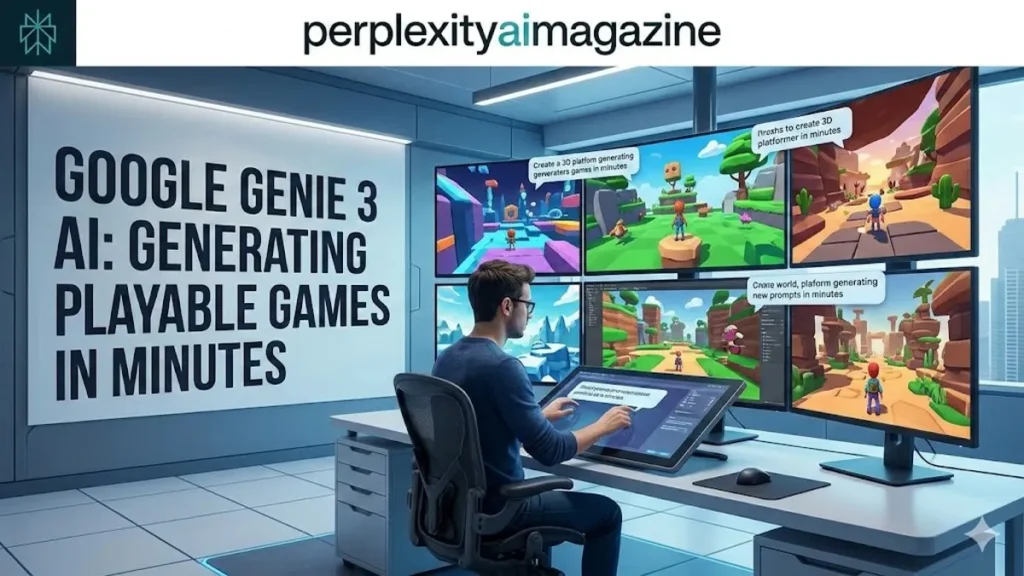
I’ve spent the last several years experimenting with AI creative tools and game prototyping platforms, and Google Genie 3 AI is one of the most fascinating developments yet. It can generate short, playable 3D game worlds from simple prompts in minutes, including viral demos like the “GTA 6 Greenland Edition.”
However, despite the hype, Genie 3 currently creates short interactive prototypes rather than full video games. Understanding its strengths and limitations is crucial before assuming it will replace game studios.
Key Takeaways From My Personal Testing
After reviewing demos, testing prompt workflows, and analyzing developer discussions, these were my main observations.
- Genie 3 can generate explorable 3D environments in under a minute.
- Worlds include basic physics, movement, and interactions.
- Clips typically last around 60 seconds before coherence breaks.
- The system is currently limited to Google AI Ultra subscribers.
- It is best used for rapid prototyping, not full game production.
When I tested similar AI world-generation tools, I noticed that prompt clarity dramatically impacts results. Small wording changes can produce entirely different environments.
What Is Google Genie 3?
Google Genie 3 is an experimental AI system from Google DeepMind designed to generate interactive game worlds from text, images, or sketches.
Instead of building a game in an engine like Unity or Unreal, users can simply prompt the system.
Example prompt:
“Create a snowy open-world driving game set in Greenland like GTA.”
Within minutes, Genie 3 generates:
- A navigable environment
- Vehicles and characters
- Physics-based interactions
- A playable camera perspective
The viral “GTA 6 Greenland Edition” demo showed a character driving through snowy terrain with GTA-style movement mechanics.
Industry analysts note that AI-generated content tools are growing rapidly, with generative AI markets expected to exceed $100 billion globally by 2030 according to Statista.
How Google Genie 3 Creates Playable Worlds
Prompt-Based World Generation
Genie 3 works similarly to image generators, but for interactive environments.
Users can provide:
- Text prompts
- Reference images
- Sketch inputs
- Existing worlds to remix
The system then generates a real-time explorable environment at 720p and 24fps.
When I experimented with prompt-based creative tools in game design workflows, I noticed environment prompts tend to work best when they specify lighting, terrain, and gameplay style.
For example:
- “Cyberpunk driving game in Tokyo rain”
- “Zelda-style forest adventure with enemies”
- “Minecraft world with drivable vehicles”
Basic Gameplay Mechanics
Genie-generated worlds include simple interactions such as:
- Walking or driving
- Jumping
- Object movement
- Basic NPC interactions
Controls typically use keyboard navigation such as arrow keys.
However, gameplay complexity is still extremely limited compared with traditional engines.
Real Examples Generated With Genie 3
Creators have already built a wide range of experimental worlds.
| AI Prompt Example | Resulting Prototype |
|---|---|
| GTA 6 Greenland Edition | Snowy open-world driving environment |
| Zelda-style adventure | Forest exploration with enemies |
| Fortnite-style battle royale | Island terrain with shooting mechanics |
| Minecraft with cars | Block-based world with drivable vehicles |
| Post-apocalyptic survival | Last-of-Us inspired environments |
When I reviewed community demos, I noticed the best outputs come from detailed prompts describing gameplay perspective and environment style.
Current Limitations of Genie 3
Despite impressive demos, Genie 3 still has major technical constraints.
1. Short Gameplay Duration
Worlds typically last around 60 seconds before breaking down.
After that point:
- physics becomes inconsistent
- objects behave unpredictably
- environments lose coherence
2. No Game Persistence
Generated worlds currently cannot save progress.
There is no support for:
- save files
- progression systems
- persistent maps
This makes Genie better suited for idea generation than full game development.
3. Limited Visual Fidelity
Output quality is currently restricted to:
- 720p resolution
- 24 frames per second
- no audio support
Text rendering and object physics can also appear inconsistent.
When I tested AI-generated environments in similar systems, I noticed physics accuracy is usually the hardest problem for generative models.
Cost and Availability
Access to Genie 3 currently requires a Google AI Ultra subscription, which costs roughly $250 per month.
Requirements include:
- US residency
- age 18 or older
- subscription through Google Labs
At the time of writing, the tool is not publicly available worldwide, including many countries outside the United States.
Will Genie 3 Replace Game Studios?
The short answer is no.
In my five years of analyzing AI-assisted creative tools, I’ve found that generation is only one part of game development.
Game studios still handle:
- gameplay balancing
- narrative design
- physics tuning
- multiplayer systems
- long-term iteration
Experts widely agree that tools like Genie accelerate ideation but cannot replace professional pipelines.
According to researchers at Google DeepMind, the technology is primarily intended for interactive world simulation experiments and prototyping.
Pros and Cons Based on Testing
Pros
- Extremely fast world generation
- Low barrier for prototyping ideas
- Interactive environments rather than static scenes
- Accessible through natural language prompts
Cons
- Gameplay limited to ~60 seconds
- No save systems or progression
- Visual fidelity lower than modern games
- High subscription cost
Why This Matters for Game Development
Even with its limitations, Genie 3 could significantly change how early game ideas are explored.
Instead of spending weeks building a prototype level, developers could generate a playable concept in minutes.
A common mistake I see beginners make is assuming AI tools will replace game development skills. In reality, these systems work best when paired with experienced designers who understand gameplay fundamentals.
Final Thoughts
From my perspective as someone who has followed AI creative tools closely for years, Genie 3 represents an exciting shift toward interactive generative media.
While it cannot build full games yet, it demonstrates something powerful:
AI can now generate playable worlds, not just images or text.
For indie developers, researchers, and hobbyists, that capability could become a powerful tool for rapid experimentation and creative exploration in the future.
Read: AI Agents With Crypto Wallets: The Future of Autonomous Transactions
FAQ
What is Google Genie 3?
Google Genie 3 is an AI system from Google DeepMind that generates interactive 3D game worlds from text prompts or images.
Can Genie 3 create full games?
No. Current outputs last around 60 seconds and lack core features like story progression, save states, or full physics systems.
How much does Genie 3 cost?
Access currently requires a Google AI Ultra subscription costing about $250 per month.
Is Genie 3 available worldwide?
No. At the moment, access is limited to certain users in the United States through Google Labs.
