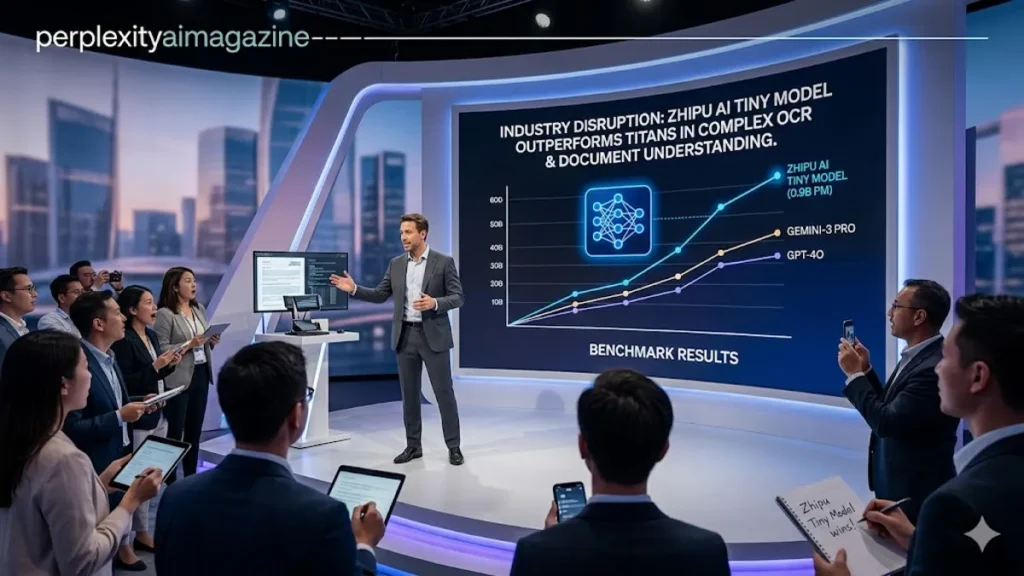
In the high-stakes arms race of artificial intelligence, the prevailing wisdom has long been that “bigger is better.” Tech conglomerates have spent billions of dollars and megawatts of power training large language models (LLMs) with hundreds of billions—sometimes trillions—of parameters. However, a lean newcomer from the labs of Zhipu AI and Tsinghua University has shattered this paradigm. GLM-OCR, a vision-language model with a mere 0.9 billion parameters, has claimed the top spot on the OmniDocBench v1.5 benchmark. By achieving an unprecedented score of 94.62, this “peanut-sized” model has effectively outperformed Google’s Gemini-3 Pro and Alibaba’s Qwen3-VL-235B, despite being up to 260 times smaller than its closest competitors.
The significance of this achievement lies in the model’s specialized mastery of document understanding. While general-purpose models like GPT-4o or Gemini struggle with the intricate formatting of academic papers, financial reports, and complex mathematical formulas, GLM-OCR treats document parsing as a distinct architectural challenge. It utilizes a sophisticated two-stage process that first maps the physical layout of a page before engaging in high-speed parallel processing. This surgical approach allows it to navigate dense tables and handwritten annotations with a level of precision that remains elusive for the “brute-force” scaling methods used by larger, more generalized systems.
The Architecture of Efficiency
At the heart of GLM-OCR’s dominance is a rejection of the standard autoregressive decoding process, which typically predicts one token at a time. Instead, the researchers at Zhipu AI implemented Multi-Token Prediction (MTP). This allows the model to output multiple tokens in a single step, which is particularly effective for deterministic tasks like reading text from an image. In a document parsing context, where the “answer” is visually present rather than abstractly generated, MTP boosts efficiency and speed without sacrificing the granular detail required to distinguish a decimal point from a stray mark on a page.
Supporting this token-prediction engine is the PP-DocLayout-V3 layout engine. Rather than overwhelming the vision encoder with a single high-resolution image of a cluttered page, the engine first segments the document into distinct regions—titles, tables, figures, and text blocks. These regions are then processed in parallel, ensuring that the model maintains a high global context of the document structure while focusing local attention on the nuances of specific data cells. This “divide and conquer” strategy is what allows a sub-1B parameter model to maintain higher structural integrity in its output than a 235B parameter generalist.
Benchmarking the Disruption
The OmniDocBench v1.5 serves as the ultimate proving ground for this technology, moving beyond simple text recognition to evaluate “document intelligence.” The benchmark tests how well a model understands the relationship between different elements on a page, such as how a caption relates to a figure or how a footnote anchors to a specific paragraph. GLM-OCR’s performance on this metric is not just a marginal win; it is a definitive statement on the future of specialized AI. It consistently maintains a higher TEDS (Tree Edit Distance for Structure) score than its peers, indicating a superior ability to reconstruct complex tables.
Table 1: OmniDocBench v1.5 Performance Comparison
| Model | Parameter Count | Overall Score | Key Strength |
| GLM-OCR | 0.9B | 94.62 | Complex Tables & Formulas |
| PaddleOCR-VL | ~1B | 94.50 | High-speed Text Detection |
| Gemini-3 Pro | ~100B+ | 90.33 | General Reasoning |
| Qwen3-VL-235B | 235B | 89.15 | Large-scale Multimodal |
| GPT-4o | Unknown | 75.02 | Versatile Visual Interaction |
The disparity between GLM-OCR and GPT-4o is perhaps the most shocking revelation from the recent benchmark data. While GPT-4o is a master of conversation and creative reasoning, its performance in rigid document parsing (scoring 75.02) suggests that general-purpose vision-language models often “hallucinate” the structure of tables or lose the reading order in multi-column layouts. As Dr. Zhang Lin, a senior researcher in computer vision, noted: “GLM-OCR proves that for specific industrial applications like finance or law, a scalpel is often more effective than a sledgehammer.”
Localized Intelligence and Privacy
One of the most practical advantages of GLM-OCR is its footprint. Most state-of-the-art document processors require a connection to a massive cloud API, raising significant privacy concerns for sensitive legal or medical data. Because GLM-OCR is open-source and weighs in at roughly 2.2GB, it can run locally on standard consumer hardware—even laptops without high-end GPUs. This democratization of high-tier OCR means that small firms can now process thousands of documents per hour without incurring the costs or security risks associated with sending data to external servers.
The model’s compatibility with tools like Ollama and vLLM further simplifies the deployment process. By running a simple command, developers can integrate a world-class document understanding engine into their local workflows. This “edge AI” capability is essential for industries where latency and data sovereignty are non-negotiable. Whether it is a bank digitizing centuries of handwritten ledgers or a university library indexing rare manuscripts, the ability to perform high-fidelity parsing on-premise represents a significant shift in how enterprise AI is deployed.
Table 2: Hardware and Deployment Specifications
| Deployment Mode | RAM/VRAM Requirement | Storage Space | Latency (Approx.) |
| Ollama (Full) | 8GB | 2.2GB | 1.8 Pages/Sec |
| Quantized (q8_0) | 4GB | 1.6GB | 2.5 Pages/Sec |
| vLLM (Server) | 16GB (Recommended) | 2.2GB | High Throughput |
| Python/Pip | 8GB | 2.2GB | Programmable |
The Battle of the Metrics
When we dive deeper into the specific metrics used by OmniDocBench, the technical superiority of GLM-OCR becomes even clearer. In the realm of mathematical formulas, the model utilizes a specialized Formula CDM (Character-level Detection Metric) to ensure that every superscript and subscript is captured accurately. While larger models often “smooth over” these details, leading to critical errors in scientific or financial calculations, GLM-OCR’s focus on high-fidelity reconstruction ensures that the semantic meaning of the data remains intact from the image to the final Markdown output.
Reading order is another area where traditional VLMs often fail. In a multi-column academic paper, a model must correctly identify that the bottom of the left column leads to the top of the right column, rather than reading horizontally across both. GLM-OCR’s layout engine excels here, achieving a Reading Order Edit Distance of 0.044, compared to GPT-4o’s 0.148. This distinction ensures that the extracted text is not just accurate in content, but logical in flow, making it immediately usable for downstream tasks like RAG (Retrieval-Augmented Generation) or automated summarization.
“The efficiency of GLM-OCR is a wake-up call for the industry. It demonstrates that architectural innovation, specifically in layout detection and token prediction, can compensate for billions of parameters.” — Sarah Chen, AI Infrastructure Architect.
“We are entering an era of ‘Small Language Models’ that do one thing perfectly. For document intelligence, GLM-OCR is currently the gold standard for that philosophy.” — Markus Thorne, Lead Developer at OpenDocs.
“The ability to run a model of this caliber on a $500 laptop changes the economics of digital transformation for small businesses worldwide.” — Elena Rossi, Fintech Consultant.
The Future of “Peanut” Models
The success of GLM-OCR is likely to inspire a new wave of specialized, small-scale models designed for specific vertical markets. As the cost of training “frontier” models continues to skyrocket, the AI community is increasingly looking toward distillation and specialized architectures to provide high-value services. Zhipu AI’s decision to keep the model open-source serves as a catalyst for this movement, allowing researchers to fine-tune the 0.9B parameter base for even more niche tasks, such as ancient calligraphy or specialized blueprint reading.
As we look toward 2026, the narrative of AI development is shifting from the “Great Scaling” to the “Great Optimization.” GLM-OCR stands as a testament to the idea that intelligence is not merely a function of size, but of how effectively a model interacts with the structure of the human world. In the battle for document understanding, the peanut has indeed proven to be more powerful than the giant.
Key Takeaways
- Size vs. Performance: GLM-OCR (0.9B parameters) outperforms models 260 times its size, including Gemini-3 Pro, on document benchmarks.
- Architectural Edge: The use of PP-DocLayout-V3 and Multi-Token Prediction (MTP) allows for superior structural accuracy and speed.
- Privacy-First: The small footprint enables local, on-premise execution, making it ideal for sensitive legal and financial data.
- Open-Source Accessibility: Available via GitHub, Ollama, and Hugging Face, lowering the barrier to entry for high-tier document parsing.
- Superior Structure: It achieves a 94.62 score on OmniDocBench v1.5, significantly beating GPT-4o’s 75.02, particularly in tables and math.
- Resource Efficiency: Can run on consumer-grade hardware with as little as 4GB of RAM using quantized versions.
Conclusion
The emergence of GLM-OCR marks a pivotal moment in the evolution of artificial intelligence. It challenges the established hegemony of “Big AI” by proving that specialized, compact models can deliver superior results in mission-critical tasks. By focusing on the structural nuances of documents rather than just the breadth of linguistic data, Zhipu AI and Tsinghua University have created a tool that is both more accurate and more accessible than the offerings of Silicon Valley’s largest players.
As the industry moves toward more sustainable and privacy-conscious AI solutions, the lessons learned from GLM-OCR’s architecture will likely influence the next generation of vision-language models. The “peanut-sized” model has demonstrated that when it comes to understanding the complex world of human documents, precision and purpose outweigh sheer scale. For organizations looking to digitize their workflows, the choice is no longer between expensive cloud APIs and subpar local OCR; the era of high-performance, edge-based document intelligence has arrived.
READ: MIT Tech Lets Humanoid Robots See Through Walls
FAQs
How can I run GLM-OCR on my local machine?
The easiest way is via Ollama. Once Ollama is installed, run ollama run glm-ocr. This will download the approximately 2.2GB model and allow you to process images directly from your terminal. For Python developers, pip install glmocr provides a programmatic interface for integration into custom applications.
Why does a 0.9B model beat a 200B+ model in OCR?
General LLMs are trained to predict the next word in a conversation, whereas GLM-OCR is specifically architected for vision-to-structure tasks. Its layout engine and Multi-Token Prediction are optimized for the “reading” process, which is fundamentally different from the “reasoning” process of larger models.
Is GLM-OCR better than GPT-4o for all tasks?
No. GPT-4o remains superior for general reasoning, creative writing, and complex multimodal conversation. GLM-OCR is a specialized tool; it is significantly better at parsing documents, tables, and formulas into structured data like Markdown or JSON.
What kind of documents can it handle?
It is tested on OmniDocBench v1.5, which includes academic papers, textbooks, exams, reports, and financial statements. It handles multi-column layouts, mixed image-text pages, and complex tables with merged cells exceptionally well.
Does it require a high-end GPU?
While a GPU will speed up processing (up to 1.8 pages per second), GLM-OCR can run effectively on a standard CPU. Quantized versions (like q8_0) require as little as 4GB of RAM, making it compatible with most modern laptops.
References
- Cao, Y., et al. (2025). OmniDocBench: A Comprehensive Benchmark for Document Parsing and Understanding. Tsinghua University Research Press.
- Zhipu AI. (2025). GLM-OCR: Technical Report on Multi-Token Prediction and Layout-Aware Vision Models. GitHub Repository.
- Alibaba Group. (2025). Qwen3-VL: Scaling Vision-Language Models for General Intelligence. Alibaba AI Labs.
- Google DeepMind. (2026). Gemini 3: Next Generation Multimodal Reasoning. Google AI Blog.
- Zhang, L. (2025). The shift toward specialized small language models in industrial OCR. Journal of Vision and Learning.