

As of 2026, the global race to adopt artificial intelligence is no longer theoretical. It is measurable, uneven, and increasingly consequential. Governments, corporations, and workers are not asking whether to use AI, but how fast they can deploy it without falling behind. The countries leading this shift are already visible. The United States, China, and Singapore now sit at the front of global AI adoption, not merely experimenting with the technology but embedding it deeply into their economies.
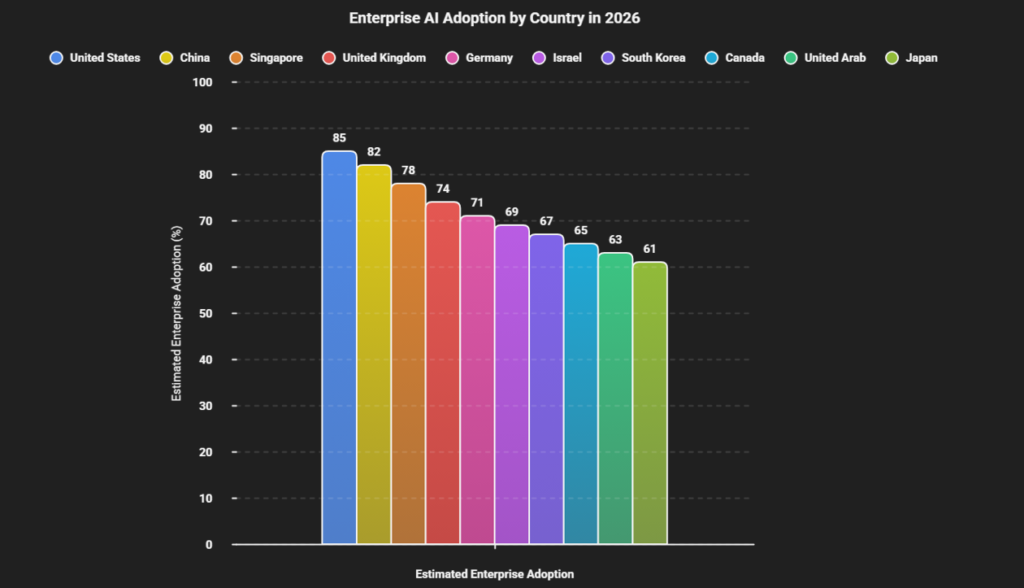
Enterprise adoption rates tell the story most clearly. In the United States, roughly 85 percent of large enterprises now use AI in core operations. China follows closely at about 82 percent, driven by state-backed infrastructure and industrial integration. Singapore, long known for strategic governance, reaches approximately 78 percent, leveraging AI across finance, logistics, and public services. These figures matter because enterprise adoption is where AI translates into productivity, profit, and geopolitical leverage.
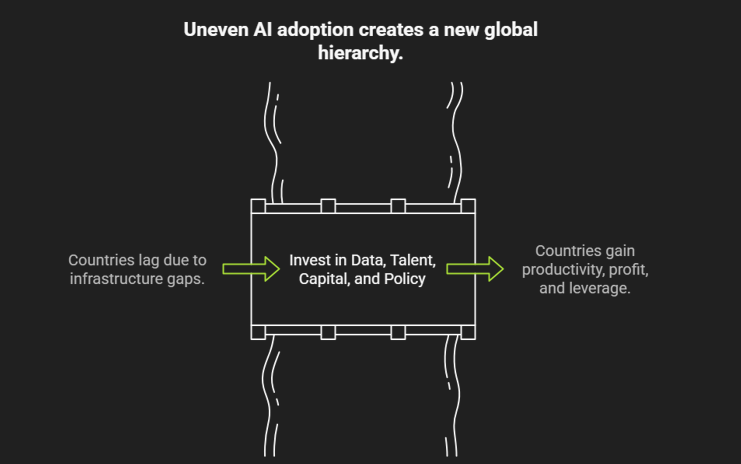
In the first hundred words of this conversation lies the central insight: AI adoption is not spreading evenly. It clusters where data, talent, capital, and policy align. Countries that moved early are now compounding their advantage. Others are racing to catch up, sometimes growing faster in percentage terms but from far smaller bases.
The result is a new global hierarchy. Traditional economic powerhouses remain strong, but smaller nations with focused strategies are punching above their weight. Meanwhile, large parts of the Global South lag behind, constrained by infrastructure and investment gaps. Understanding who is adopting AI fastest—and why—offers a preview of how the world economy may be reshaped over the next decade.
The United States: Scale, Capital, and Momentum
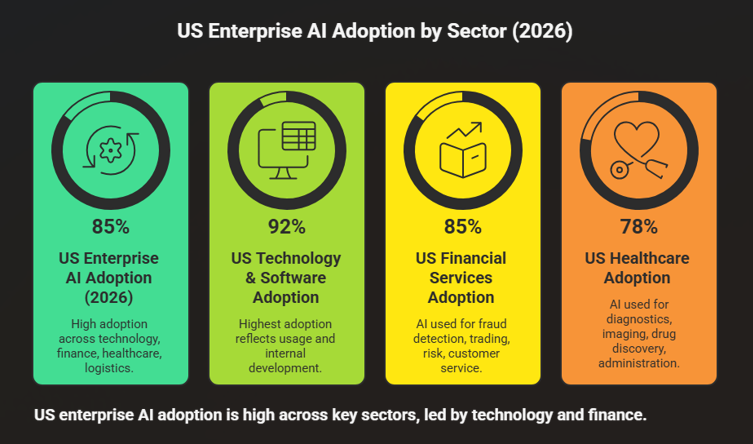
The United States leads global AI adoption largely because it already possessed the prerequisites. Massive venture capital markets, dominant technology firms, and deep research universities created an environment where AI could move quickly from lab to deployment. By 2026, enterprise AI adoption in the US has reached approximately 85 percent, with technology, finance, healthcare, and logistics at the forefront.
American technology and software companies show the highest adoption rates, approaching 92 percent. This reflects not only usage but internal development. Large firms build proprietary models, integrate AI into workflows, and deploy tools across customer-facing and internal systems. Financial services follow closely at about 85 percent, using AI for fraud detection, algorithmic trading, risk modeling, and customer service automation.
Healthcare adoption, around 78 percent, reflects growing reliance on AI for diagnostics, medical imaging, drug discovery, and administrative optimization. While regulatory complexity slows some deployments, the scale of data and funding continues to push adoption forward.
Read: Higgsfield AI Character Swap Redefines Photorealistic Video Recasting
What distinguishes the United States is not growth speed but depth. Adoption increases are smaller year over year because the baseline was already high before 2020. AI in the US is less a revolution than an acceleration of existing technological dominance.
China: State Power Meets Industrial AI
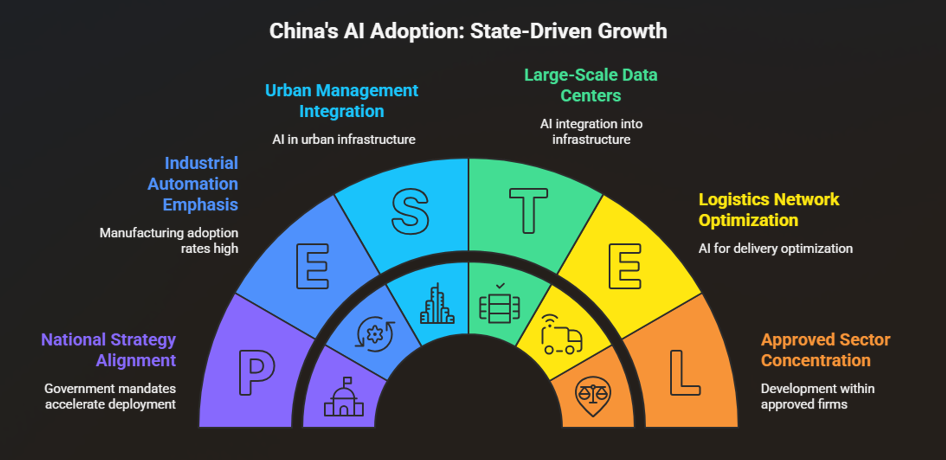
China’s AI adoption story is different in structure but similar in ambition. National enterprise adoption now exceeds 80 percent, representing one of the largest absolute expansions of AI usage in the world. Since 2020, China has seen an increase of roughly 36 percentage points, one of the fastest national growth rates globally.
The driving force is state coordination. Government mandates, large-scale data centers, and integration of AI into manufacturing, logistics, and surveillance have accelerated deployment. Manufacturing alone shows adoption rates above 72 percent, reflecting China’s emphasis on industrial automation and smart factories. E-commerce platforms and logistics networks rely heavily on AI for demand forecasting, pricing, and delivery optimization.
Unlike the United States, where private firms lead, China’s adoption is tightly aligned with national strategy. AI is framed as a pillar of economic security and technological sovereignty. This alignment allows rapid scaling but also concentrates development within approved sectors and firms.
The result is a system optimized for deployment rather than experimentation. China’s AI ecosystem prioritizes integration into real-world infrastructure, giving it a structural advantage in manufacturing and urban management.
Singapore: Precision Over Size
Singapore’s place among the top AI adopters is striking given its small population. With approximately 78 percent enterprise adoption, the city-state rivals much larger economies. Its success stems from deliberate policy rather than market scale.
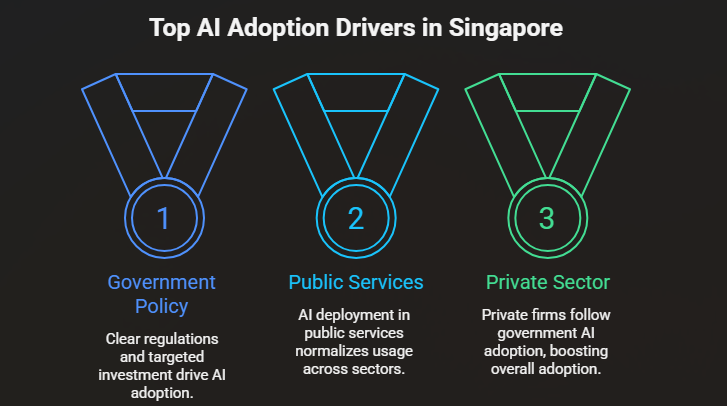
Singapore’s government has treated AI as national infrastructure. Clear regulatory frameworks, public-private partnerships, and targeted investment have made adoption predictable and attractive. Finance and logistics dominate, reflecting Singapore’s role as a global hub. AI is used for fraud detection, risk assessment, supply chain optimization, and port management.
Public services also play a significant role. Government agencies deploy AI for traffic management, urban planning, and service delivery, normalizing usage across sectors. This creates a feedback loop: as the state adopts AI, private firms follow.
Singapore’s growth since 2020, roughly 30 to 35 percentage points, demonstrates how coordinated governance can compensate for limited scale. It offers a model for other small, high-capacity economies seeking to remain competitive in an AI-driven world.
The Rest of the Top Ten
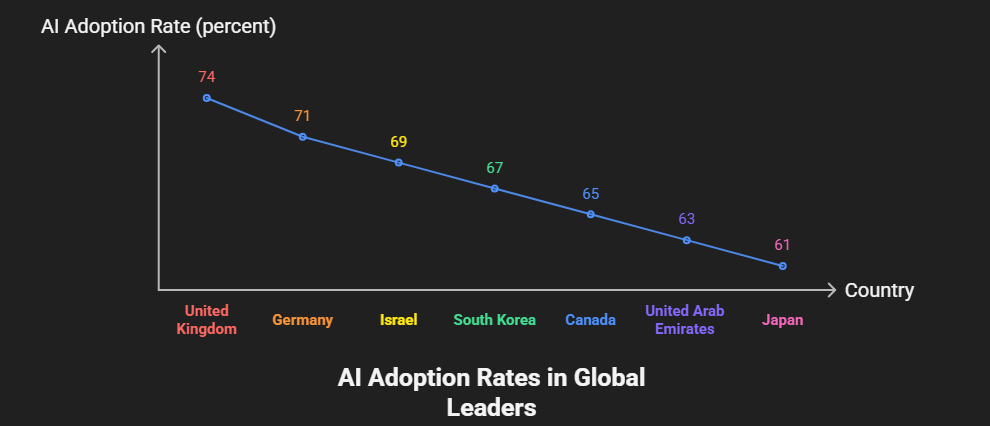
Beyond the top three, a second tier of AI adopters rounds out the global leaders. The United Kingdom sits at approximately 74 percent enterprise adoption, driven by finance, professional services, and research institutions. Germany follows at around 71 percent, with strength in manufacturing, automotive AI, and industrial automation.
Israel, at about 69 percent, benefits from a dense startup ecosystem and military-linked innovation. South Korea reaches roughly 67 percent, excelling in telecom, electronics, and robotics. Canada, at 65 percent, shows strong adoption in healthcare and research, supported by early AI investment.
The United Arab Emirates, around 63 percent, leverages oil-funded diversification and smart city initiatives. Japan, at approximately 61 percent, adopts AI more cautiously, balancing automation with cultural and labor considerations.
Together, these countries account for a disproportionate share of global AI progress, reflecting advantages in talent, infrastructure, and policy alignment.
Enterprise AI Adoption by Country in 2026
| Country | Estimated Enterprise Adoption |
|---|---|
| United States | 85% |
| China | 82% |
| Singapore | 78% |
| United Kingdom | 74% |
| Germany | 71% |
| Israel | 69% |
| South Korea | 67% |
| Canada | 65% |
| United Arab Emirates | 63% |
| Japan | 61% |
Industry Matters as Much as Geography
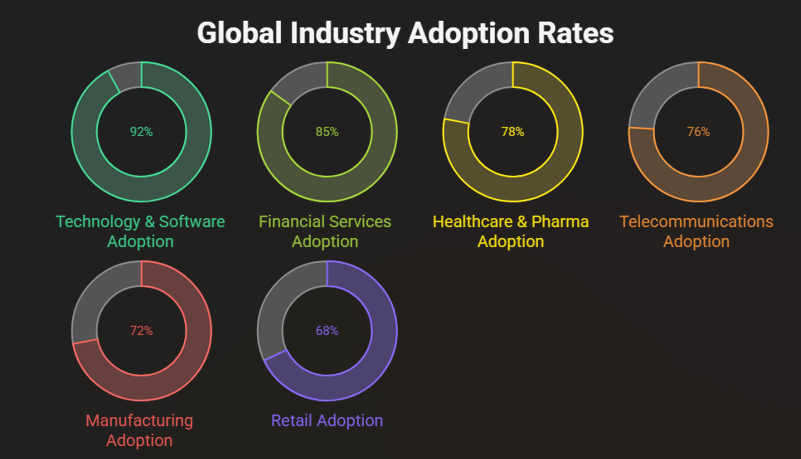
Adoption rates vary sharply by industry, even within leading countries. Globally, technology and software sectors lead with adoption rates around 92 percent. Financial services follow at roughly 85 percent, reflecting AI’s effectiveness in data-rich environments.
Healthcare and pharmaceuticals reach approximately 78 percent adoption, particularly strong in the United States, Canada, and the United Kingdom. Manufacturing averages about 72 percent, with Germany, China, and South Korea leading. Telecommunications, at around 76 percent, benefits from network optimization and predictive maintenance.
Retail lags slightly at about 68 percent, constrained by fragmented data and thinner margins. These variations matter because they shape national productivity gains. Countries strong in high-adoption industries see faster returns on AI investment.
Industry Adoption Across Leading Economies
| Industry | Global Adoption Rate |
|---|---|
| Technology & Software | 92% |
| Financial Services | 85% |
| Healthcare & Pharma | 78% |
| Telecommunications | 76% |
| Manufacturing | 72% |
| Retail | 68% |
Growth Leaders Since 2020
While absolute adoption levels matter, growth rates reveal momentum. China and India stand out as the fastest growers. China’s adoption rose from roughly 22 percent before 2020 to well over 80 percent by 2026. India, though still behind leaders, jumped from around 32 percent to approximately 59 percent.
India’s growth is driven by a booming startup ecosystem, abundant technical talent, and rapid digitalization. However, infrastructure gaps and uneven enterprise readiness limit absolute adoption.
Singapore and the UAE also show strong gains, around 30 to 35 percentage points, reflecting strategic national initiatives. By contrast, the United States shows slower relative growth, around 3 to 10 percentage points, because it started from a higher base.
Emerging markets such as Vietnam and Indonesia exhibit rapid percentage growth from very low baselines, signaling potential but not yet global impact.
Why Some Countries Lag Behind
Despite global enthusiasm, comprehensive rankings reveal stark disparities. Many countries in the Global South remain below 10 percent enterprise adoption. Barriers include limited data infrastructure, high compute costs, skills shortages, and regulatory uncertainty.
Even where talent exists, capital constraints slow deployment. AI adoption is not just about algorithms. It requires cloud access, reliable electricity, data governance, and organizational change. Without these foundations, adoption stalls.
This gap raises concerns about a widening digital divide. As AI amplifies productivity in leading economies, lagging countries risk falling further behind, reinforcing existing inequalities in income and influence.
Expert Perspectives on the AI Adoption Gap
“AI adoption follows power,” said a technology policy researcher. “Countries with capital, data, and coordination move first, and the benefits compound quickly.”
An economist specializing in innovation added, “Growth rates can be misleading. What matters is sustained integration into core industries, not pilot projects.”
A global development expert warned, “Without targeted investment, many emerging economies will become AI consumers rather than producers, deepening dependency.”
These views converge on a central theme: adoption speed reflects structural advantage more than enthusiasm.
Takeaways
- The United States, China, and Singapore lead global AI adoption as of 2026
- Enterprise adoption is highest where data, capital, and policy align
- Technology and finance dominate AI usage across countries
- China and India show the fastest growth since 2020
- Smaller nations can compete through focused national strategies
- Many emerging economies remain far behind due to infrastructure gaps
- AI adoption is reshaping global economic hierarchy
Conclusion
The global AI landscape in 2026 reveals a world dividing along new technological lines. A small group of countries is embedding artificial intelligence deeply into their economies, gaining productivity, resilience, and influence. Others are advancing more slowly, constrained by resources and readiness.
This divergence is not inevitable. Singapore’s rise shows that size is less important than strategy. India’s growth demonstrates the power of talent and entrepreneurship. Yet the window for catching up narrows as leaders compound their advantage.
AI adoption is no longer a future indicator. It is a present force reshaping competitiveness. The countries moving fastest today are not just adopting technology. They are redefining the terms of global economic power for decades to come.
FAQs
Which country adopts AI the fastest in 2026?
The United States leads in absolute enterprise adoption, while China shows the fastest large-scale growth.
Why is Singapore so high in AI adoption?
Strong government strategy, regulatory clarity, and focus on finance and logistics drive adoption.
Which industries adopt AI the most?
Technology, finance, and healthcare lead due to data availability and clear return on investment.
Is India a global AI leader?
India shows rapid growth but remains behind top adopters in absolute terms.
Why do many countries lag in AI adoption?
Limited infrastructure, capital, and skills constrain large-scale deployment.
