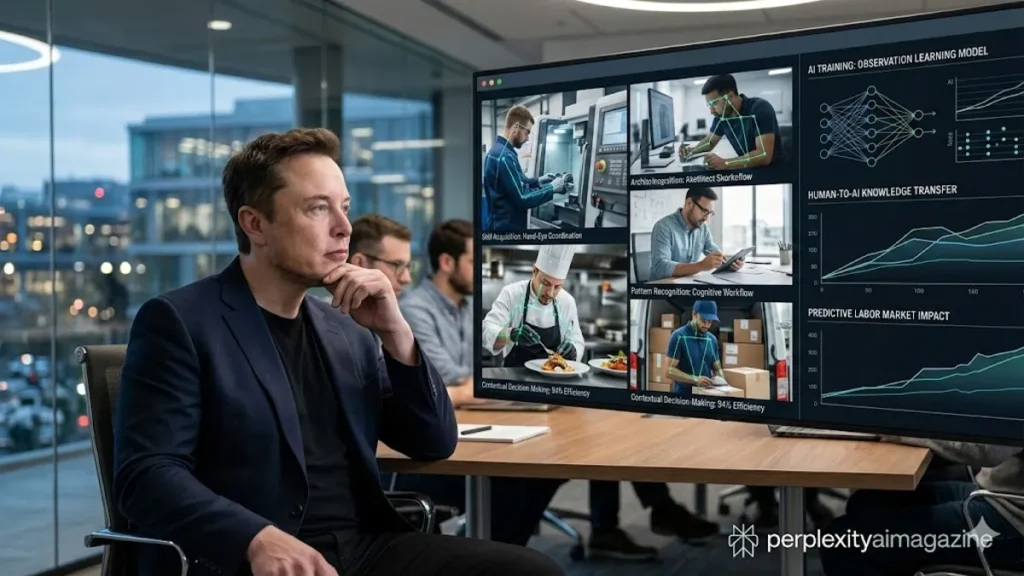
Artificial intelligence learning human jobs by simply watching people work is no longer a distant concept in research labs. The idea gained renewed attention after Elon Musk responded “Pretty much” to a March 5, 2026 social media claim suggesting that AI labs could train models to perform someone’s job by feeding them recordings of their daily work. His response, brief but striking, reinforced a growing belief among technologists that AI systems may soon replicate many forms of human labor through observation. – Elon Musk AI learn jobs by watching humans.
The concept behind the claim is rooted in imitation learning, a field in machine learning where algorithms learn tasks by observing demonstrations. Instead of programming explicit instructions, engineers feed models large amounts of video data showing how humans perform real-world activities. The AI then analyzes patterns, actions, and outcomes to reproduce similar behaviors.
For Musk, the idea fits squarely within a broader vision he has articulated for years. He has repeatedly predicted that artificial intelligence and robots will eventually replace nearly all human jobs. Speaking at the VivaTech conference in Paris in May 2024, Musk declared that AI would likely eliminate most traditional employment, turning work into something optional, “more like a hobby.”
The technology behind such a future is already emerging. AI agents capable of controlling keyboards, navigating software, and performing digital tasks are being tested inside companies including Musk’s own artificial intelligence venture, xAI. Meanwhile, Tesla’s Optimus humanoid robot is trained using human motion capture and video demonstrations to perform tasks in factories and physical environments.
What once sounded like science fiction is increasingly becoming a research strategy. The real question is not whether AI can observe human work. It is whether watching us may soon be enough to replace us.
The Social Media Moment That Sparked Debate
The discussion began with an Instagram post circulating online on March 5, 2026. The post claimed that artificial intelligence laboratories were developing systems capable of learning entire jobs by analyzing recordings of workers performing daily tasks.
The concept resonated widely in the technology community. Engineers have long known that large datasets of human behavior can be used to train machine learning systems. What made the post unusual was its framing of job replication as something already happening. – Elon Musk AI learn jobs by watching humans.
Elon Musk responded with two words: “Pretty much.”
Although brief, the response quickly spread across technology forums and news discussions. Musk has nearly 200 million followers across platforms, and his comments often influence public perceptions of emerging technologies.
His response suggested that the concept described in the post aligns with how many AI systems are currently trained. Rather than writing detailed instructions, engineers increasingly rely on massive datasets that capture human actions.
This includes everything from driving data used to train autonomous vehicles to keyboard and screen interactions used to train AI agents capable of navigating digital environments.
Musk’s reaction did not introduce a new technology. Instead, it highlighted a transformation already underway in machine learning research.
Why AI Can Learn From Human Behavior
The idea of machines learning from human demonstrations is known as imitation learning or behavioral cloning. In this approach, algorithms analyze examples of human activity and learn to replicate the patterns.
Researchers at Stanford and other institutions have demonstrated that machine learning systems can learn complex behaviors through observation alone. According to the Stanford AI Index Report, imitation learning has become a core technique in robotics and autonomous systems (Stanford Institute for Human-Centered Artificial Intelligence, 2024).
Video data, screen recordings, and sensor inputs provide detailed information about human actions. When processed at scale, these datasets allow AI models to infer strategies and workflows that were previously difficult to program explicitly. – Elon Musk AI learn jobs by watching humans.
For instance, robots trained through human demonstrations can learn how to pick up objects, assemble components, or navigate physical spaces. Similarly, software agents can learn how to fill out forms, analyze spreadsheets, or write code by studying examples.
Andrew Ng, a leading AI researcher, has noted that demonstration-based learning dramatically reduces the need for manual programming. “Instead of writing rules for machines, we show them examples of what humans do,” he said during a Stanford lecture on machine learning systems (Ng, 2023).
This shift from rule-based programming to observational learning is reshaping how artificial intelligence is developed.
Table: Major AI Training Methods Used Today
| Training Method | Description | Example Applications |
|---|---|---|
| Supervised Learning | Models trained on labeled datasets | Image recognition, spam filtering |
| Reinforcement Learning | AI learns through rewards and penalties | Game playing, robotics |
| Imitation Learning | Systems learn from human demonstrations | Robotics, autonomous vehicles |
| Self-Supervised Learning | Models generate labels from raw data | Large language models |
| Multimodal Learning | AI processes text, images, and video together | Generative AI assistants |
Elon Musk’s Longstanding Predictions About AI and Jobs
Musk’s agreement with the social media claim fits within a long pattern of predictions about automation and employment.
He has repeatedly warned that artificial intelligence could replace most forms of human labor. During the VivaTech conference in Paris in May 2024, Musk said that AI would likely eliminate the need for human workers entirely.
“Probably none of us will have a job,” he told the audience, suggesting that AI-driven production could make goods and services abundant (VivaTech Conference, 2024).
In such a future, Musk said, employment would become optional. People might still pursue careers, but more as hobbies than economic necessities.
Instead of traditional wages, Musk has suggested the idea of “universal high income,” a concept similar to universal basic income but funded by the productivity of automated systems.
He has also cited the science fiction works of author Iain M. Banks as inspiration. Banks’ Culture series describes a future society where advanced artificial intelligence manages most economic activity, allowing humans to pursue creative or recreational lives. – Elon Musk AI learn jobs by watching humans.
While critics argue that such predictions underestimate the complexity of labor markets, Musk’s views continue to influence discussions about the future of work.
Inside xAI’s Human Emulator Systems
One of the most intriguing developments in Musk’s AI ecosystem is the emergence of human emulator systems inside xAI.
These systems are designed to mimic human workers performing digital tasks. Instead of integrating directly with software APIs, the AI interacts with computers the same way humans do.
Using virtual keyboards and mice, the agents read screens, click buttons, type commands, and navigate interfaces. The approach allows them to work with existing software without requiring specialized integrations.
The concept resembles human workers performing tasks at a computer, except the AI agents can operate continuously without rest.
Reports indicate that these agents can perform tasks such as data entry, code testing, interface design, and document processing.
In internal experiments, multiple AI agents reportedly work together to simulate entire office teams, completing workflows end to end. – Elon Musk AI learn jobs by watching humans.
The technology represents a significant shift in automation. Instead of replacing individual tasks, these systems aim to replicate entire professional roles.
Table: Examples of Jobs Potentially Affected by Observational AI Training
| Job Category | Tasks AI Could Learn by Observation |
|---|---|
| Customer Support | Responding to messages, troubleshooting issues |
| Data Entry | Form filling, spreadsheet updates |
| Software Testing | Running tests, identifying interface bugs |
| Content Moderation | Reviewing and categorizing posts |
| Administrative Work | Scheduling, document processing |
Robotics and the Role of Video Data
The concept of AI learning from human activity is especially important in robotics.
Tesla’s Optimus robot project relies heavily on motion capture data and video recordings of humans performing tasks. These recordings help robots learn how to manipulate objects, navigate environments, and interact with tools.
Robotics researchers have increasingly embraced this training approach because writing detailed instructions for physical actions is extremely difficult.
Instead, robots observe how humans move and attempt to replicate those patterns.
According to a 2023 report by MIT Technology Review, demonstration-based learning has become one of the fastest ways to train robots for real-world environments (Knight, 2023).
Video datasets containing thousands of hours of human activity provide valuable training material.
The result is a new generation of robots capable of learning tasks far faster than previous systems.
Expert Perspectives on AI Learning From Observation
Many researchers believe that observational learning will play a crucial role in the future of artificial intelligence.
Fei-Fei Li, a leading AI scientist and co-director of Stanford’s Human-Centered AI Institute, has emphasized the importance of visual data in training intelligent systems.
“Vision is fundamental to intelligence,” Li wrote in research discussing large-scale image datasets and machine perception (Li, 2015).
Similarly, MIT robotics professor Daniela Rus has highlighted how robots can learn complex behaviors from human demonstrations. – Elon Musk AI learn jobs by watching humans.
“When machines watch humans perform tasks, they can infer strategies that would be difficult to encode manually,” Rus explained in a lecture on autonomous systems (Rus, 2022).
However, experts also caution that observation alone may not be enough to replicate many professions. Human work often involves judgment, creativity, and social context that can be difficult for machines to interpret.
Still, the rapid progress of multimodal AI systems capable of understanding images, video, and text simultaneously suggests that the gap may be narrowing.
The Economic Implications of Observational AI
If artificial intelligence systems truly learn jobs simply by observing human work, the implications for the labor market could be enormous.
Historically, automation has replaced specific tasks rather than entire professions. Industrial robots, for example, automated repetitive manufacturing activities but did not eliminate factory management or engineering roles.
Observational AI could potentially go further. By learning from real-world workflows, systems might replicate complete job processes. – Elon Musk AI learn jobs by watching humans.
Economists remain divided about the scale of disruption.
A 2023 report by Goldman Sachs estimated that generative AI could affect up to 300 million full-time jobs globally, though many roles would likely evolve rather than disappear (Goldman Sachs Global Investment Research, 2023).
The same technologies that automate tasks may also create new industries and opportunities.
However, the transition could be turbulent, particularly for workers in routine digital professions.
Takeaways
- Elon Musk’s response to a social media claim reignited debate about AI learning jobs through observation.
- Observational learning techniques allow AI systems to analyze recordings of human activities and replicate tasks.
- Robotics projects like Tesla Optimus rely heavily on video demonstrations for training.
- xAI is developing human emulator agents capable of performing digital tasks using virtual keyboards and mice.
- Experts believe imitation learning could transform how AI systems acquire complex skills.
- Economists warn that large-scale job automation could reshape global labor markets.
Conclusion
The idea that artificial intelligence could learn entire professions simply by watching humans perform their daily work once belonged to science fiction. Today, it is becoming a serious research strategy.
Elon Musk’s brief response to the viral social media claim did not reveal new technology, but it captured the direction in which artificial intelligence development is heading. Machines are increasingly trained not through carefully written instructions but through observation of human behavior.
Video datasets, motion capture systems, and screen recordings now serve as training material for algorithms capable of replicating tasks across both physical and digital environments.
Yet the future of work remains uncertain. While observational AI may automate many routine activities, human creativity, emotional intelligence, and ethical judgment remain difficult to replicate.
The coming decades will likely bring profound changes to how work is organized and performed. Whether those changes lead to widespread displacement or a new era of human opportunity will depend on how societies adapt to technologies that can learn simply by watching us.
FAQs
Can AI really learn jobs by watching humans?
Yes, through imitation learning and behavioral cloning, AI systems can learn tasks by analyzing recordings of human actions and replicating them.
What did Elon Musk say about AI learning jobs?
On March 5, 2026, Musk replied “Pretty much” to a social media claim that AI labs can train models to perform jobs using recordings of daily human work.
What is imitation learning in AI?
Imitation learning is a machine learning technique where algorithms learn behaviors by observing demonstrations rather than following explicit programmed instructions.
How are robots trained using human demonstrations?
Robots use motion capture, video recordings, and sensor data to analyze how humans perform tasks and replicate those movements.
Will AI eliminate all jobs?
Experts disagree. While AI may automate many tasks, new industries and professions are likely to emerge alongside technological change.