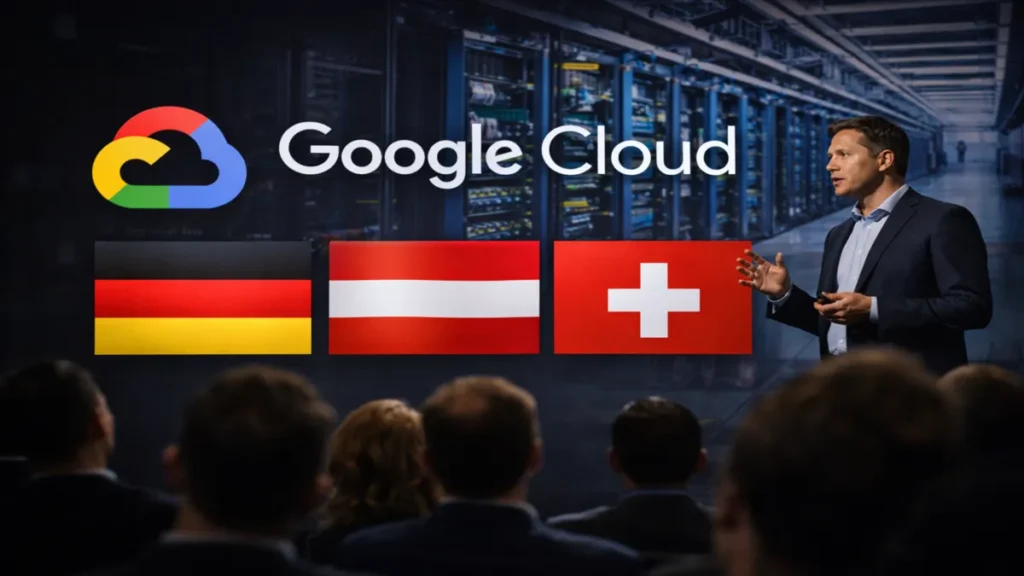
i am watching a quiet but consequential shift unfold across Europe’s industrial heartland, where cloud infrastructure has become as strategic as railways or energy grids once were. In Germany, Austria, and Switzerland, large enterprises are moving critical systems onto Google Cloud Platform not because it is fashionable, but because it has become structurally necessary. Data volumes are exploding, AI is moving from experimentation into production, and regulatory pressure is intensifying. The cloud is no longer a convenience layer. It is the new operating system of the modern enterprise. – dach region companies google cloud platform.
In the DACH region, Google Cloud’s presence remains smaller than Amazon Web Services or Microsoft Azure by market share, but its momentum is accelerating in a way that reveals deeper economic and political forces. Enterprises are not only buying compute and storage. They are buying regulatory alignment, latency guarantees, sovereign control, and future-proof AI infrastructure. The emergence of Frankfurt’s europe-west3 and Zurich’s europe-west6 regions reflects this shift, enabling GDPR-compliant workloads that remain physically and legally within European jurisdiction.
At the same time, Google’s €5.5 billion investment into German data center expansion marks a pivotal moment. It is not merely a corporate expansion. It is an infrastructural commitment that signals Europe’s demand for cloud systems that respect sovereignty while delivering hyperscale performance. Retailers, banks, broadcasters, research institutions, and manufacturers are aligning their digital futures around this balance.
This article examines how major DACH enterprises are using Google Cloud, why sovereignty and compliance have become as important as cost and performance, and how this transformation is reshaping competition, governance, and technological power across Europe.
Enterprise Adoption in the DACH Region
Large enterprises in the DACH region are using Google Cloud primarily to modernize legacy systems, scale data processing, and deploy artificial intelligence within regulated environments. In Germany, METRO AG uses Google Cloud for supply chain analytics and Kubernetes orchestration, allowing the company to unify logistics data across markets while dynamically scaling workloads during seasonal demand.
Deutsche Börse has integrated Google Cloud into its cloud-first migration strategy, deploying machine learning models for trading analysis, risk detection, and operational forecasting. This shift enables faster deployment cycles and real-time analytical insight that would be impractical on traditional on-premise infrastructure.
MediaMarktSaturn relies on Google Kubernetes Engine and BigQuery to support peak e-commerce traffic, especially during major retail events like Black Friday. By offloading elasticity and data warehousing to the cloud, the company gains both resilience and speed while maintaining regulatory controls. – dach region companies google cloud platform.
In aerospace and robotics, Germany’s research institutions are using Google Cloud to accelerate AI model training. What once required weeks of computation on local clusters can now be executed in days or hours, allowing faster iteration in robotics, simulation, and automation.
In Switzerland and Austria, adoption is driven primarily by regulatory constraints. Financial institutions regulated by FINMA are adopting sovereign cloud configurations to maintain compliance while benefiting from hyperscale analytics and AI tooling. Broadcasters like ARD and ZDF use Apigee API management to support high-frequency digital publishing pipelines while ensuring operational stability.
Read: Jensen Huang China AI Concerns Explained
Strategic Drivers of Adoption
Three forces are driving Google Cloud adoption across the DACH region.
First is regulatory pressure. GDPR, national data protection laws, and sector-specific regulations require strict controls over data location, processing, and access. Enterprises cannot simply adopt global cloud platforms without legal and governance considerations.
Second is AI readiness. Vertex AI and Gemini models offer enterprises a path to deploy machine learning at scale without building specialized infrastructure in-house. For many organizations, this is the only viable way to compete in data-driven markets. – dach region companies google cloud platform..
Third is infrastructure sovereignty. The location of data centers, ownership of encryption keys, and governance of operational access now influence vendor selection as much as pricing.
Together, these forces mean that cloud adoption is no longer purely technical. It is legal, political, economic, and strategic.
Google’s Infrastructure Expansion in Germany
Google’s €5.5 billion investment in Germany between 2026 and 2029 fundamentally changes the scale and credibility of its regional presence. The expansion of the Dietzenbach data center and the Hanau campus strengthens the Frankfurt cloud region, enabling lower latency, higher capacity, and greater resilience for enterprise workloads.
This expansion is designed specifically to support AI-intensive workloads and regulated industries. It triples local capacity, supports the deployment of Gemini and Vertex AI services within Germany, and allows sensitive enterprise data to remain under German jurisdiction.
The economic effects are also significant. The expansion is expected to contribute more than €1 billion annually to GDP and support roughly 9,000 jobs across construction, operations, and associated industries. Waste heat recovery systems integrate data center output into district heating networks, addressing energy efficiency and sustainability concerns.
Market Effects and Competitive Pressure
The expansion forces competitors to respond. AWS and Azure, which hold larger market shares, must now accelerate their own German and European infrastructure investments to remain competitive in regulated sectors. This intensifies competition not on pricing alone, but on compliance frameworks, transparency, and sovereignty assurances.
Local European providers benefit as well. The sovereignty debate strengthens demand for regional cloud alternatives aligned with Gaia-X principles, even as enterprises continue to rely on hyperscalers for advanced AI services.
Sovereignty and Its Limits
Despite the progress, sovereignty remains imperfect. Google remains a U.S. company subject to U.S. law. Even with German trustees controlling encryption keys and local data residency, some stakeholders argue that true sovereignty requires European ownership of the entire technology stack.
This tension creates a dual market. Commercial enterprises favor hybrid sovereignty models that combine hyperscale innovation with localized governance. Public sector and high-security organizations remain more cautious, often preferring European-only solutions for their most sensitive workloads.
Expert Reflections
“Cloud sovereignty is no longer about isolation,” one European policy advisor explains. “It is about controlled integration.”
A cloud economist notes, “The hyperscalers are becoming infrastructure providers, not just service vendors. That changes their political and economic role.”
A technology strategist adds, “The real competition is not AWS versus Google versus Azure. It is centralized digital power versus distributed digital governance.”
These perspectives capture the complexity of the transformation underway.
Key Takeaways
- DACH enterprises adopt Google Cloud primarily for AI scalability and regulatory alignment.
- Sovereign cloud frameworks are now decisive in procurement decisions.
- Google’s €5.5 billion investment transforms its competitive position in Europe.
- Compliance is as strategic as performance.
- Sustainability is becoming part of infrastructure legitimacy.
- Sovereignty remains politically and philosophically contested.
Conclusion
The rise of Google Cloud in the DACH region is not a story of technology alone. It is a story about how infrastructure shapes power, how regulation shapes markets, and how enterprises navigate between innovation and control.
Germany’s investment wave reflects Europe’s determination to remain technologically competitive without surrendering regulatory authority. Enterprises are building digital systems that must endure for decades, not just quarters. That means choosing platforms that align not only with technical needs but with political and legal realities.
The cloud is becoming Europe’s new industrial substrate. How it is built, who controls it, and where it resides will shape the continent’s economic sovereignty as profoundly as steel, rail, and electricity once did.
FAQs
What is driving Google Cloud adoption in DACH?
Primarily AI scalability, compliance requirements, and data sovereignty.
Why is sovereignty important?
It ensures legal control, regulatory compliance, and trust in critical systems.
How does this affect competition?
It shifts competition from pricing to governance, compliance, and infrastructure location.
Is Google Cloud dominant in Europe?
No, but it is growing fastest in regulated and AI-driven sectors.
Will sovereignty concerns disappear?
No. They will continue shaping policy, procurement, and infrastructure investment.