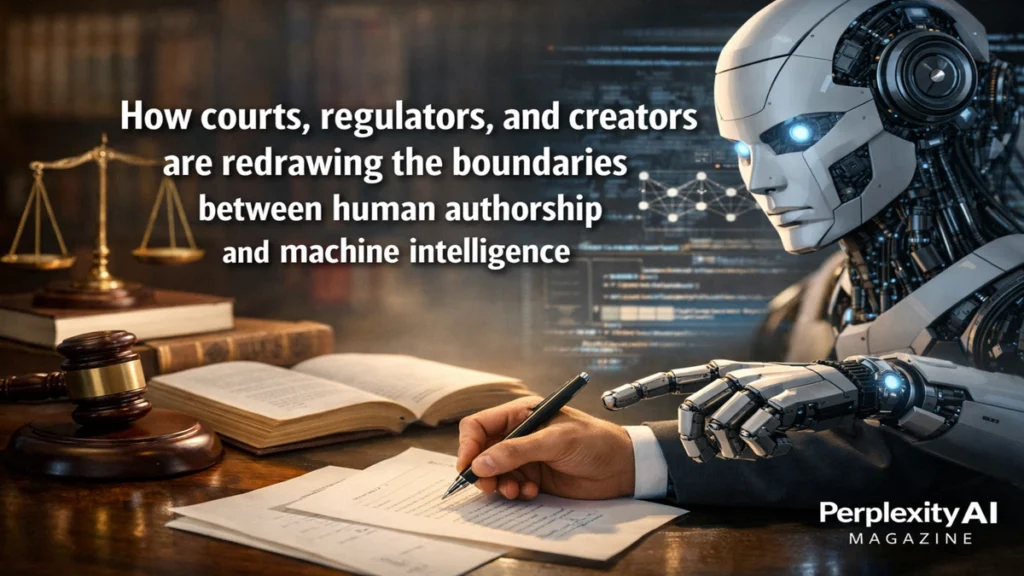
i have been covering technology long enough to recognize when a legal debate stops being theoretical and starts to change behavior on the ground. Copyright and artificial intelligence crossed that line over the last two years. What began as abstract arguments about training data and fair use has turned into court orders, billion-dollar settlements, and compliance roadmaps that now sit on the desks of executives, investors, and product teams. – copyright ai news.
In the first hundred words, the search intent is clear. Readers want to know what is actually happening right now with copyright and AI, who is winning in court, what governments are deciding, and how those decisions affect businesses and creators. The answer is not simple, but it is finally becoming legible.
Generative AI systems depend on vast amounts of text, images, music, and video. Much of that material is protected by copyright. For years, AI developers assumed that training models on publicly accessible content would be treated like search indexing or academic text mining. Courts and regulators are now testing that assumption, often with skepticism.
At the same time, publishers, authors, musicians, and artists have realized that AI is not just a threat but also a bargaining chip. Licensing deals, revenue-sharing agreements, and data access contracts are proliferating. Copyright is no longer only a defensive legal tool. It has become an asset class.
This article explains the current state of copyright AI news in early 2026, tracing the lawsuits shaping precedent, the policies redefining ownership, and the strategic shifts rippling through the AI industry. I approach the subject not as a cheerleader for technology or a defender of legacy media, but as an observer of how law adapts when creative work becomes both input and output of machines.
Read: AI Music Fraud and the Fake Bands Streaming Scandal
The lawsuits that forced the issue into the open
The modern copyright-AI era did not begin with legislation. It began with complaints filed in courtrooms. When authors, news organizations, and music companies sued AI developers, they transformed an academic debate into a legal confrontation with real stakes.
The most closely watched case remains **The New York Times vs. OpenAI and Microsoft. Filed in late 2023, the lawsuit alleges that Times articles were copied and used to train large language models, and that some outputs reproduce substantial portions of protected journalism. The defendants argue that training is transformative fair use and that any verbatim reproduction results from adversarial prompting rather than normal use.
Parallel cases broadened the pressure. Groups of authors sued Anthropic and other AI firms over the alleged use of pirated book datasets. Music labels targeted AI audio platforms capable of generating songs in recognizable styles. Each case pushed judges to confront questions copyright law never anticipated at this scale.
What changed in 2025 and 2026 was not just the volume of litigation but its consequences. Discovery battles exposed internal training practices. Preservation orders raised user-privacy concerns. Settlements reached into the billions. Copyright AI news stopped being speculative and started to look like industrial regulation by lawsuit.
A landmark settlement and what it signaled
One settlement in particular reshaped industry expectations. In mid-2025, authors reached a reported multibillion-dollar agreement with Anthropic over the use of pirated books in training data. While details remain partly confidential, the size of the payout sent an unmistakable signal.
Courts appeared willing to distinguish between lawfully acquired data and datasets assembled through piracy. That distinction matters. It suggests that fair use arguments may survive in some contexts but collapse when training relies on illicit sources. As one copyright scholar put it, “The method of acquisition is becoming as important as the method of transformation.”
This shift forced AI companies to audit their data pipelines. Investors began asking whether models carried latent legal risk tied to their training sets. The idea that data provenance could determine enterprise valuation moved from theory to practice.
The settlement also reframed negotiations. Publishers and authors realized that litigation could produce leverage even without final judgments. AI firms realized that uncertainty itself was expensive. Licensing, once dismissed as impractical at scale, suddenly looked cheaper than years of courtroom battles.
When policy stepped in after the courts
Governments were slow to act at first, watching courts struggle with doctrines built for photocopiers and file sharing. By 2025, that caution gave way to rulemaking.
In the United States, the U.S. Copyright Office released a multipart report on artificial intelligence and copyright. The core conclusion was stark. Works generated entirely by AI are not copyrightable. Protection attaches only where there is meaningful human creative input.
This guidance clarified ownership but raised new questions. How much human input is enough. Does prompt engineering qualify. What about iterative editing with AI assistance. Courts have not yet answered these questions consistently, but the policy direction is clear. Copyright law remains human-centered.
Across the Atlantic, the European Union took a different approach. The European Union’s AI Act, particularly Article 50, requires transparency about copyrighted material used in training. Companies must disclose summaries of data sources, creating compliance obligations that extend beyond traditional copyright enforcement.
The United Kingdom charted a middle path. A government progress report acknowledged creator concerns while emphasizing the economic value of AI development. A final impact assessment, expected in 2026, aims to balance opt-out mechanisms with innovation incentives.
How copyright rules now differ by region
| Region | Key Rule | Practical Impact |
|---|---|---|
| United States | AI-only outputs not copyrightable | Human authorship becomes essential for ownership |
| European Union | Training transparency required | Compliance costs and disclosure obligations rise |
| United Kingdom | Policy under review | Potential opt-out and licensing frameworks |
| India | Labeling and disclosure norms | Consumer awareness and attribution focus |
This fragmentation has created what many executives now call a regulatory minefield. A model compliant in one jurisdiction may violate rules in another. Global deployment strategies increasingly resemble tax planning, with careful jurisdictional analysis.
From lawsuits to licensing as a business model
One of the quieter but more consequential developments in copyright AI news has been the normalization of licensing deals. Publishers that once saw AI as an existential threat now see it as a customer.
Financial newspapers, magazine groups, and stock photo libraries have signed agreements allowing AI companies to use their archives for training in exchange for fees, attribution, or revenue sharing. For media companies facing declining advertising revenue, licensing offers a new income stream.
For AI developers, licensing provides certainty. A licensed dataset reduces litigation risk and reassures enterprise clients wary of downstream liability. The trade-off is cost and complexity. Negotiating with hundreds of rights holders is slow, and exclusivity terms can distort competition.
Still, the direction is clear. Copyright is no longer just a shield. It is a bargaining chip. The question is whether smaller creators can participate meaningfully or whether licensing will favor large institutional rights holders.
Expert voices on the shifting terrain
Three perspectives dominate conversations with legal and industry experts.
A former federal judge specializing in intellectual property law observed in 2025 that “fair use was never designed to excuse industrial-scale copying without accountability.” His view reflects judicial discomfort with equating AI training to casual human reading.
A technology policy researcher at a leading university argued that “transparency requirements are a proxy for trust.” According to her, forcing companies to explain what they trained on does not stop infringement by itself, but it changes incentives and public scrutiny.
Meanwhile, a chief legal officer at a major AI startup offered a pragmatic take. “We do not want to fight every publisher in court. We want rules we can build against.” That sentiment explains why voluntary licensing and compliance frameworks are accelerating even before final judgments arrive.
The rise of RAG and a new wave of disputes
Training data is only one front. Another is output. Retrieval-augmented generation, or RAG, allows AI systems to pull from live or archived documents when answering queries. Publishers argue that this crosses a line when it returns verbatim or near-verbatim text.
Several lawsuits filed in late 2025 target AI products that summarize or reproduce news articles on demand. The legal theory is straightforward. Even if training was lawful, serving copyrighted text to users without permission is not transformative. It is distribution.
AI companies counter that RAG systems can be configured to avoid verbatim reproduction and that summaries benefit publishers by driving traffic. Courts are now examining logs, prompts, and system design to determine intent and effect.
This focus on outputs rather than inputs may prove decisive. It shifts the debate from abstract training practices to concrete user experiences. If courts find that AI substitutes for subscriptions, fair use arguments weaken considerably.
A timeline of how copyright AI news unfolded
| Year | Development |
|---|---|
| 2023 | Major lawsuits filed by authors and publishers |
| 2024 | Early motions test fair use theories |
| 2025 | Large settlements and policy reports released |
| 2026 | Compliance, licensing, and output-focused suits dominate |
The pattern suggests maturation. Initial shock gives way to negotiation. Litigation narrows from existential claims to specific practices. Industries adapt.
Investment and strategy implications
From an investment perspective, copyright AI news has become a material risk factor. Due diligence now includes questions about data provenance, licensing coverage, and jurisdictional exposure. Models trained on opaque datasets are discounted relative to those built on licensed or synthetic data.
Strategically, companies face a choice. They can treat copyright as a cost of doing business, paying settlements and adjusting later, or they can integrate compliance into product design from the start. Increasingly, the latter approach wins favor with enterprise customers and regulators.
There is also an opportunity side. Firms that help manage rights, track attribution, or facilitate licensing stand to benefit. Copyright infrastructure, long considered boring, is becoming a growth sector.
Takeaways
- Copyright and AI conflicts have moved from theory to enforceable outcomes.
- Courts distinguish sharply between lawful and pirated training data.
- AI-only outputs generally lack copyright protection in the United States.
- Licensing deals are replacing some litigation with negotiated certainty.
- Output behavior, especially via RAG, is emerging as the next legal battleground.
- Regulatory fragmentation increases global compliance costs.
Conclusion
i end this reporting with less certainty than readers might want but more clarity than we had even a year ago. Copyright AI news in 2026 is not about whether law will adapt to technology. It already has. The real question is how balanced that adaptation will be.
For creators, the moment offers both protection and possibility. Copyright remains a powerful tool, but it now operates in a world where machines remix culture at unprecedented speed. For AI companies, the era of casual scraping is closing. Compliance, transparency, and licensing are becoming competitive advantages rather than burdens.
What makes this moment distinctive is not conflict alone but convergence. Courts, regulators, and markets are slowly aligning around a shared intuition. Innovation does not require ignoring authorship. And protection does not require stopping progress.
The next phase will be quieter, less dramatic than headline-grabbing lawsuits. It will unfold in contracts, product designs, and regulatory filings. That is usually how durable systems emerge. Not in sweeping declarations, but in negotiated compromises that reshape how creativity and technology coexist.
FAQs
Is training AI on copyrighted material illegal?
Not automatically. Courts increasingly distinguish between lawfully acquired content and pirated datasets. The legality often depends on how the data was obtained and used.
Can AI-generated works be copyrighted?
In the United States, purely AI-generated works are not copyrightable. Protection requires meaningful human creative input.
What is the EU AI Act’s impact on copyright?
It introduces transparency obligations, requiring companies to disclose summaries of copyrighted training sources, increasing compliance complexity.
Why are publishers suing over RAG systems?
They argue that returning verbatim or near-verbatim text substitutes for subscriptions and constitutes unauthorized distribution.
Are licensing deals replacing lawsuits?
Partially. Licensing offers certainty and revenue, but litigation remains a tool for setting boundaries and leverage.