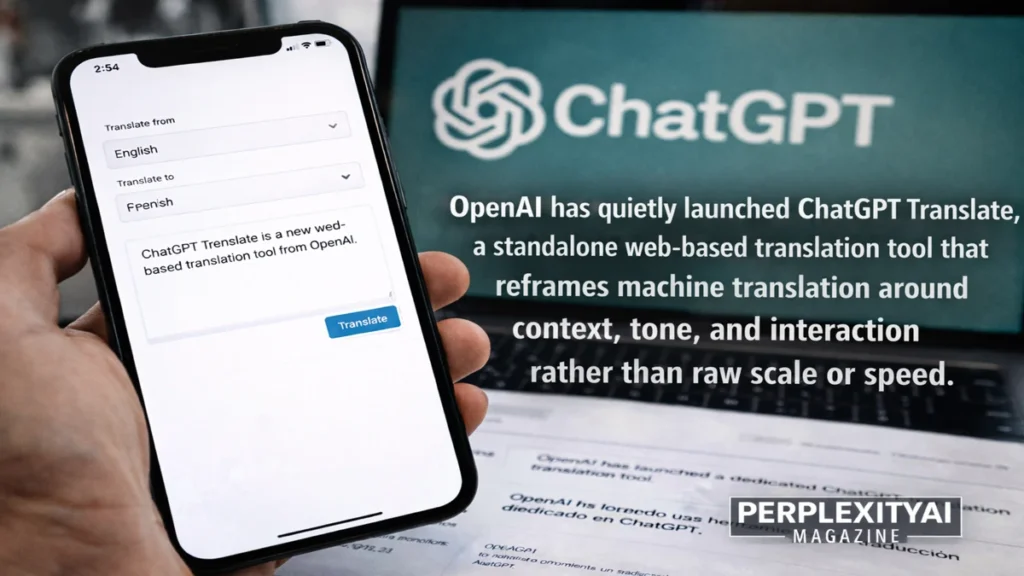
I start with the simplest version of the news because that is how OpenAI appears to want it understood. OpenAI has quietly launched a dedicated, standalone translation product called ChatGPT Translate, accessible at chatgpt.com/translate. It is a clean, dual-pane web interface that looks immediately familiar to anyone who has used Google Translate or DeepL. Two text boxes face each other. Languages can be selected or automatically detected. Text goes in, a translation comes out.
Yet the significance of ChatGPT Translate lies not in novelty but in intention. For years, users have relied on ChatGPT itself to translate text, often preferring it to traditional tools because it handled nuance, tone, and idioms more naturally. This new product does not introduce fundamentally new translation capabilities. Instead, it packages an existing strength into a single-purpose tool designed for speed, clarity, and everyday use.
In the first moments after launch, OpenAI offered no formal announcement, press release, or marketing campaign. Coverage quickly described the release as a quiet launch, suggesting experimentation rather than a declaration of war on entrenched competitors. The tool is free, web-only, and focused exclusively on text. There are no camera features, no voice input, and no offline modes.
What this launch reveals is how OpenAI is thinking about product strategy in 2026. ChatGPT Translate represents a shift away from one monolithic chat interface toward specialized, task-optimized tools that borrow ChatGPT’s intelligence while removing conversational friction. Translation, one of the oldest and most contested problems in computing, is becoming OpenAI’s next proving ground.
What ChatGPT Translate Is
I think of ChatGPT Translate as a distillation rather than an expansion. It is a standalone web product that separates translation from the broader ChatGPT conversation experience. Users are not greeted by a prompt or a chat history. Instead, they see a purpose-built interface designed for immediate use.
The design mirrors established translation tools. A source text box sits on the left. A target text box sits on the right. Drop-down menus allow users to select source and target languages, with automatic language detection enabled by default. The simplicity is intentional. OpenAI appears to be signaling that translation does not need explanation, onboarding, or conversational framing.
What distinguishes the tool is how it handles language internally. Rather than optimizing solely for literal accuracy, ChatGPT Translate emphasizes meaning, context, and tone. Users can guide the translation style, asking for business formal phrasing, academic clarity, or simplified explanations. This reflects the strengths that made ChatGPT popular for translation inside the main chat interface.
In effect, ChatGPT Translate turns a general-purpose language model into a point solution. It does not replace ChatGPT’s broader capabilities. It complements them by giving users a fast, bookmarkable destination for one of the most common tasks they already perform.
Read: Amazon OpenAI Investment Talks Signal New AI Power Shift
Why a Separate Translation Tool Now
I see this launch as a response to user behavior rather than competitive pressure alone. Millions of users have already been using ChatGPT as an informal translation engine. They paste text, ask for refinements, and iterate until the translation feels right. That workflow works well, but it carries friction.
A dedicated translation site removes that friction. It eliminates the need to explain the task. It reduces cognitive overhead. It also positions OpenAI to compete directly with Google Translate and DeepL on their own terms, without forcing users into a chat-based paradigm.
Timing matters. By 2026, ChatGPT’s multilingual performance has matured significantly. Early criticisms from 2022 and 2023, particularly around Asian languages, have largely faded. With GPT-4 and later models, OpenAI reached a level of fluency that made translation one of its most consistently praised capabilities.
Launching ChatGPT Translate now suggests confidence. OpenAI is no longer testing whether its models can translate well. It is testing whether users will adopt an OpenAI-branded translation destination as part of their daily workflow.
Core Features and Design Philosophy
I approach the feature set with an appreciation for restraint. ChatGPT Translate does not attempt to replicate every function offered by its competitors. Instead, it focuses on a small set of capabilities that align with OpenAI’s strengths.
The dual-pane interface is the foundation. Automatic language detection reduces friction for casual use. Manual language selection allows precision when needed. The translation appears almost instantly, reinforcing the sense of a utility rather than a conversation.
Tone and style controls represent the most distinctive feature. Unlike traditional translation tools that prioritize neutrality, ChatGPT Translate invites users to shape the output. A sentence can be made more fluent, more formal, or simpler without rewriting the prompt. This reflects a philosophical shift from translation as conversion to translation as interpretation.
Another defining element is the implicit invitation to refine. While the tool itself remains focused, users can move into the main ChatGPT interface to ask follow-up questions, adjust phrasing, or explore alternatives. The product ecosystem is designed to flow outward rather than remain self-contained.
Supported Platforms and Access Model
I note what the tool does not do as much as what it does. At launch, ChatGPT Translate is available only on the web. There is no dedicated mobile app for iOS or Android. Voice input and image-based translation, such as translating signs or menus via photos, are not supported.
The focus is strictly on text. Users type or paste content and receive translations. This narrow scope suggests OpenAI is prioritizing quality and usability over feature breadth in its early iteration.
Access is free. There is no requirement to sign up for ChatGPT Plus or Pro. This decision positions ChatGPT Translate as a mass-market entry point rather than a premium offering. It also aligns with OpenAI’s broader pattern of using free tools to establish habits before introducing monetization or enterprise layers.
By keeping the barrier to entry low, OpenAI maximizes the likelihood that users will compare the tool directly with incumbents and form preferences based on experience rather than brand loyalty alone.
Language Coverage and Multilingual Depth
I approach language support with careful framing because OpenAI has not published an official, exhaustive list. What is known is that ChatGPT Translate supports more than 50 languages, covering major global languages as well as many regional and emerging ones.
The supported set likely includes widely spoken languages such as English, Spanish, French, Arabic, Chinese, Hindi, Japanese, Korean, and Portuguese. It also appears to extend to European languages like Polish, Dutch, Greek, and Nordic languages, along with South and Southeast Asian languages such as Thai, Vietnamese, Tamil, and Bengali.
African languages, including Swahili, Yoruba, Hausa, and Amharic, are also part of the broader multilingual capabilities inherited from ChatGPT’s underlying models. This breadth reflects years of training and fine-tuning rather than a sudden expansion.
What matters most is not the number of languages but the quality of handling idioms, register, and context. For many users, especially bilingual professionals, these subtleties determine whether a translation feels usable or artificial.
A Brief History of ChatGPT’s Translation Ability
I find it useful to situate this launch within ChatGPT’s longer evolution. When ChatGPT debuted in late 2022 using GPT-3.5, it already supported many non-English languages, including Japanese, Korean, Hindi, and Chinese. However, the quality varied. Translations were often literal and occasionally awkward.
The release of GPT-4 in 2023 marked a significant improvement. Multilingual understanding deepened. Context handling improved. Idiomatic expressions became more natural. Subsequent refinements and the introduction of models like GPT-4o further enhanced performance across languages.
By 2024 and 2025, ChatGPT had become a reliable translation tool for many users, even in professional contexts. The launch of ChatGPT Translate in January 2026 packages these accumulated improvements into a product that feels ready for mainstream adoption.
How It Compares to Google Translate and DeepL
I frame this comparison not as a battle of features but as a divergence of priorities. Google Translate excels at scale. It supports hundreds of languages, offers camera and voice translation, and integrates deeply into Android and Chrome. DeepL has built a reputation for quality, particularly in European languages, with a focus on business users.
ChatGPT Translate enters the same space with a different emphasis. It prioritizes tone, context, and interactivity over media support and offline functionality. It does not attempt to replace all translation use cases. It targets users who care about how something sounds, not just what it says.
This positioning may limit its appeal for travelers needing instant camera translation, but it strengthens its value for writers, students, professionals, and anyone working with nuanced text.
Comparative Overview
| Tool | Primary Strength | Key Limitation |
|---|---|---|
| ChatGPT Translate | Contextual, tone-aware translation | No voice or image input |
| Google Translate | Massive language and media support | Limited tone control |
| DeepL | High-quality European translations | Narrower language coverage |
Strategic Implications for OpenAI
I interpret ChatGPT Translate as part of a broader strategy to unbundle ChatGPT into specialized tools. Translation is a logical starting point because it is both ubiquitous and well understood.
By launching a focused translation site, OpenAI can study user behavior, performance expectations, and competitive dynamics without overhauling its core product. It can also lay the groundwork for future expansion into enterprise localization, document workflows, or API-driven translation services.
The quiet nature of the launch suggests experimentation rather than finality. OpenAI appears to be testing whether specialization increases adoption and satisfaction compared with an all-in-one interface.
Timeline of Key Developments
| Year | Milestone |
|---|---|
| 2022 | ChatGPT launches with basic multilingual support |
| 2023 | GPT-4 significantly improves translation quality |
| 2024 | GPT-4o enhances tone and idiomatic handling |
| Jan 2026 | ChatGPT Translate launches as a standalone tool |
Expert Perspectives
A computational linguist at a U.S. university has described large language models as “the first translation systems that genuinely understand intent, not just words.” A localization industry consultant notes that tone control is increasingly important as translation moves beyond travel and into work and education.
A product strategist specializing in AI tools argues that specialization is inevitable. As she puts it, general-purpose chat interfaces are powerful, but users still want simple tools that do one thing well.
Takeaways
• OpenAI has launched ChatGPT Translate as a standalone web-based translation tool.
• The product emphasizes context, tone, and refinement over raw feature breadth.
• It supports more than 50 languages and is free to use at launch.
• The tool reflects years of improvement in ChatGPT’s multilingual capabilities.
• ChatGPT Translate competes with Google Translate and DeepL on different priorities.
• The launch signals OpenAI’s move toward specialized, task-focused products.
Conclusion
I see ChatGPT Translate not as a disruptive shock but as a quiet assertion of maturity. OpenAI is no longer proving that its models can translate. It is proving that they can be packaged, focused, and trusted for everyday use. In doing so, the company is redefining translation less as a mechanical conversion and more as an act of understanding.
Whether ChatGPT Translate becomes a daily destination for millions will depend on how well it balances simplicity with depth. Its early design choices suggest confidence in the underlying intelligence and restraint in presentation. In a crowded field dominated by familiar names, OpenAI is betting that nuance, tone, and interaction can still carve out meaningful space.
FAQs
What is ChatGPT Translate?
It is a standalone web-based translation tool built on ChatGPT’s translation capabilities.
Is ChatGPT Translate free?
Yes, it is currently free and does not require a paid subscription.
How many languages does it support?
It supports more than 50 languages, though no official full list has been published.
Does it support voice or image translation?
No, at launch it supports text input only.
How is it different from using ChatGPT directly?
It offers a simplified, purpose-built interface optimized specifically for translation.