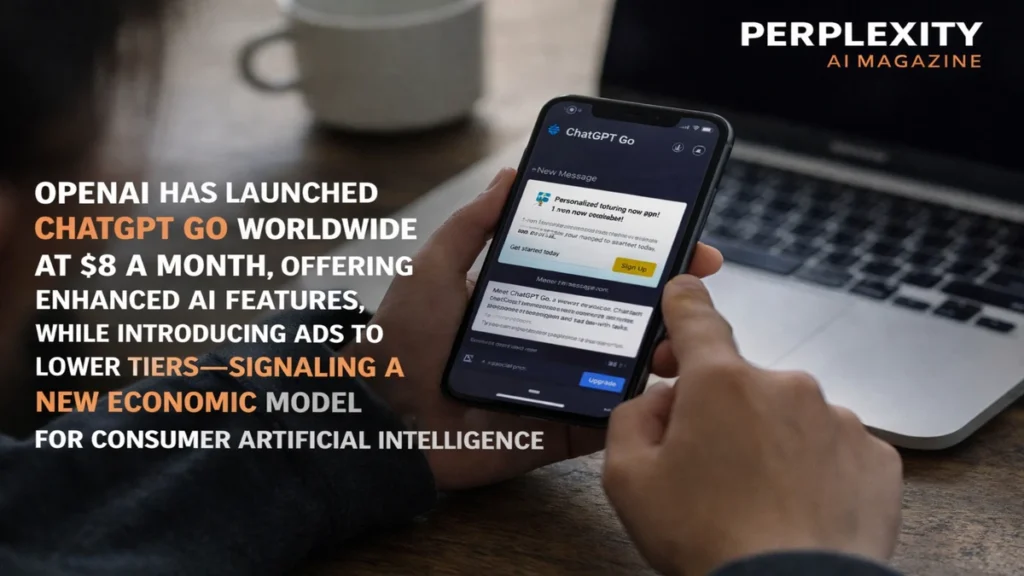
On January 16, 2026, OpenAI made one of the most consequential business decisions in the short history of consumer artificial intelligence. The company rolled out ChatGPT Go worldwide, an eight-dollar-per-month subscription tier designed for everyday users who want more power than the free plan but do not need the premium features of higher-priced tiers. At the same time, OpenAI confirmed that advertising will soon appear inside ChatGPT for free and Go users, beginning in the United States and expanding globally. – ChatGPT Go global ads.
For millions of people who now rely on ChatGPT for writing, studying, planning trips, coding, or thinking through daily problems, the announcement reshapes expectations. ChatGPT Go offers access to GPT-5.2 Instant, dramatically higher usage limits, longer conversational memory, and expanded image generation. In exchange, users accept ads as part of the experience unless they upgrade to higher, ad-free tiers.
Within the first hundred words of the announcement, the core tension was clear. OpenAI wants to keep AI affordable while facing rising infrastructure costs tied to increasingly powerful models. Advertising, long resisted by the company, has become a tool to subsidize access without sharply raising subscription prices. The result is a hybrid model that blends subscriptions, personalization, and ads inside a conversational interface many users treat less like a website and more like a thinking partner.
This moment matters because it signals where consumer AI is heading. ChatGPT Go is not just another pricing option. It represents a recalibration of trust, value, and control at a time when artificial intelligence is becoming woven into everyday cognition. – ChatGPT Go global ads.
The Logic Behind ChatGPT Go
ChatGPT Go exists to fill a widening gap. Over time, the free tier of ChatGPT has become more constrained, while ChatGPT Plus, priced at twenty dollars per month, targets power users, professionals, and creators. OpenAI’s internal usage patterns showed that most people fall somewhere in between. They use ChatGPT daily, often for practical tasks, but not at a scale that justifies premium pricing.
The Go tier is designed for that middle. Subscribers receive access to GPT-5.2 Instant, a model optimized for speed and reliability rather than experimental depth. Message limits are roughly ten times higher than the free tier, making all-day use realistic. File and image uploads become routine, and the system can retain more memory across conversations, allowing responses to feel more personalized over time.
Importantly, Go does not compete directly with higher tiers. The twenty-dollar Plus plan and the two-hundred-dollar Pro plan continue to offer the most advanced models, earliest feature access, and a completely ad-free environment. ChatGPT Go is positioned as comfort rather than cutting edge, stability rather than experimentation.
This distinction reflects how OpenAI increasingly segments its audience. AI is no longer a single product but a spectrum of experiences calibrated to price, tolerance for friction, and desired control.
Read: Nearly One in Four Hong Kong Students Depend on AI for Homework
How the Subscription Tiers Compare
| Tier | Price per Month | Intended User | Core Experience |
|---|---|---|---|
| Free | $0 | Casual or infrequent users | Basic access, strict limits |
| ChatGPT Go | $8 | Everyday users | GPT-5.2 Instant, high limits, ads |
| ChatGPT Plus | $20 | Power users | Advanced models, no ads |
| ChatGPT Pro | $200 | Professionals and teams | Maximum limits, fastest access |
This structure borrows from streaming platforms and productivity software, but the product here is different. The value proposition is not entertainment or storage. It is assistance with thinking itself.
Advertising Enters the Chat
The most controversial aspect of ChatGPT Go is not the price or features but the ads. OpenAI has confirmed that advertisements will appear for free and Go users, while Plus and Pro users will never see them. The ads will be clearly labeled, visually separated from AI responses, and placed outside the conversational text itself.
Still, the shift is profound. Advertising inside a conversational interface feels more intimate than ads on a webpage or in a feed. ChatGPT is often used in moments of uncertainty, planning, or reflection. Introducing ads into that space changes the emotional texture of the experience. – ChatGPT Go global ads.
OpenAI frames the decision as pragmatic rather than ideological. Running frontier AI models at global scale is expensive. Ads provide a way to keep entry-level access affordable without pushing prices beyond what most users are willing to pay. The company has emphasized that AI responses themselves will not be altered to favor advertisers.
Whether users perceive that separation as meaningful will shape the long-term success of the model.
How Ad Personalization Works
Advertising in ChatGPT Go is not random. OpenAI plans to tailor ads based on the general context of conversations and past interactions. A user planning a vacation might see hotel or airline ads. Someone discussing productivity could see software promotions. This personalization is designed to feel relevant rather than intrusive.
At the same time, OpenAI has drawn explicit boundaries. Sensitive topics such as health, politics, religion, and sexuality are excluded from ad targeting. Ads are kept separate from AI responses, and the assistant does not recommend products as part of its answers.
Crucially, users retain control. Ad personalization can be fully disabled in settings, switching ads to a generic mode that does not rely on conversation history or user data. Users can also delete ad-related data at any time and dismiss individual ads. – ChatGPT Go global ads.
OpenAI has stated repeatedly that conversations and personal data are not sold to advertisers. Ad targeting relies on internal systems and does not give advertisers access to user content.
Personalization Does Not Affect AI Performance
One of the most persistent user concerns is whether opting out of ad personalization will degrade the AI experience. OpenAI’s position is unambiguous. Disabling personalization does not affect model quality, memory, response speed, or access to features such as GPT-5.2 or image generation.
Advertising systems and AI systems operate through separate mechanisms. Data used for ad targeting is not used to train models, and advertising preferences have no influence on how the assistant responds. Even users who opt out entirely continue to receive the same level of AI capability as other Go subscribers.
This separation is central to OpenAI’s attempt to preserve trust. The company is betting that transparency and user control can coexist with advertising without fundamentally compromising the assistant’s perceived neutrality.
Expert Reactions to Ads in AI
Industry observers are divided. Some see the move as overdue.
“Once AI becomes a daily utility, the economics start to resemble search and social media,” said one technology analyst. “Ads are the most scalable way to subsidize mass usage.”
Others are more cautious.
“Advertising inside an AI assistant is qualitatively different from advertising in a feed,” noted a digital ethics researcher. “The conversational context creates a sense of intimacy that demands much stricter safeguards.”
A third camp sees the decision as a necessary experiment.
“The real question isn’t whether ads appear,” said an AI researcher who studies human-computer interaction. “It’s whether users feel their thinking is being influenced rather than supported.”
These reactions reflect a broader uncertainty about how far traditional internet business models can be stretched before they clash with the unique role AI now plays. – ChatGPT Go global ads.
Legal Protections and Age Restrictions
Advertising in ChatGPT is constrained by a web of legal limits, especially for younger users. In the United States, federal and state laws restrict targeted advertising to minors. Children under thirteen are protected by COPPA, which prohibits personalized ads without parental consent. Some states go further, banning targeted ads for all users under eighteen.
OpenAI has confirmed that users under eighteen will see no ads at all, regardless of tier. This policy aligns with international standards as well. In Europe, GDPR-K requires parental consent for data processing involving children under sixteen and sharply limits profiling. Many platforms already restrict ad targeting for minors to basic demographics or disable it entirely.
These safeguards shape not just compliance but design. By excluding minors and sensitive categories, OpenAI limits both risk and revenue, signaling that advertising is a tool of last resort rather than a growth engine.
A Broader Shift in the AI Economy
ChatGPT Go is part of a wider rethinking of how AI services are funded. Early AI platforms relied on venture capital and optimism. As usage scaled, the costs of compute, energy, and infrastructure became impossible to ignore. Subscriptions alone proved insufficient for mass adoption.
The hybrid model now emerging blends free access, low-cost subscriptions, premium tiers, and advertising. This approach mirrors the evolution of search engines and social platforms, but with higher stakes. AI systems do not just show information. They help users decide, plan, and create.
The success or failure of ChatGPT Go will influence competitors and shape expectations. If users accept ads as a fair trade for affordability, advertising may become a standard feature of consumer AI. If trust erodes, companies may be forced back toward higher prices and narrower audiences.
Timeline of the Transition
| Date | Development |
|---|---|
| Early 2024 | Subscription model dominates consumer AI |
| 2025 | Rising infrastructure costs pressure pricing |
| January 16, 2026 | ChatGPT Go launches globally |
| Early 2026 | Ads announced for Free and Go tiers |
| Later 2026 | Gradual international ad rollout |
Trust, Choice, and the Future Interface
The central question raised by ChatGPT Go is not whether ads belong in AI, but whether users feel empowered rather than exploited. OpenAI’s design emphasizes choice. Users can upgrade, opt out of personalization, clear data, or accept ads as the cost of affordability.
Yet trust is fragile. Once an AI assistant becomes part of daily thinking, even subtle changes in incentives matter. OpenAI’s challenge is to demonstrate, over time, that advertising does not distort answers or quietly reshape priorities. – ChatGPT Go global ads.
If it succeeds, ChatGPT Go may be remembered as the moment AI became a sustainable public utility rather than a luxury product.
Takeaways
- ChatGPT Go launched globally on January 16, 2026, at eight dollars per month
- The tier targets everyday users with higher limits and GPT-5.2 Instant access
- Ads will appear only for Free and Go users, not Plus or Pro
- Ad personalization is optional and fully controllable
- Conversations and personal data are not sold to advertisers
- Minors are completely excluded from advertising
- The model signals a long-term shift in how AI will be funded
Conclusion
ChatGPT Go represents a turning point in the economics of artificial intelligence. It acknowledges a reality many users already sensed: powerful AI cannot remain both free and ad-free forever. By introducing a lower-cost tier supported in part by advertising, OpenAI is attempting to strike a delicate balance between access, sustainability, and trust.
Whether that balance holds will depend on execution. Clear labeling, strong privacy controls, and a firm separation between ads and answers are not optional details. They are the foundation of credibility in a system that increasingly shapes how people think.
The launch of ChatGPT Go does not end the debate about ads in AI. It begins it. In doing so, it offers a glimpse of an AI future that is more affordable, more commercial, and more intertwined with everyday life than ever before.
FAQs
What is ChatGPT Go?
ChatGPT Go is an eight-dollar monthly subscription offering higher usage limits, GPT-5.2 Instant access, longer memory, and image tools.
Will ChatGPT Go show ads?
Yes. Ads will appear for Free and Go users, while higher tiers remain ad-free.
Can I disable ad personalization?
Yes. Users can opt out of personalization and still keep full AI functionality.
Does opting out affect AI performance?
No. Model quality, memory, and features remain unchanged.
Do users under eighteen see ads?
No. Minors are completely excluded from advertising across all tiers.