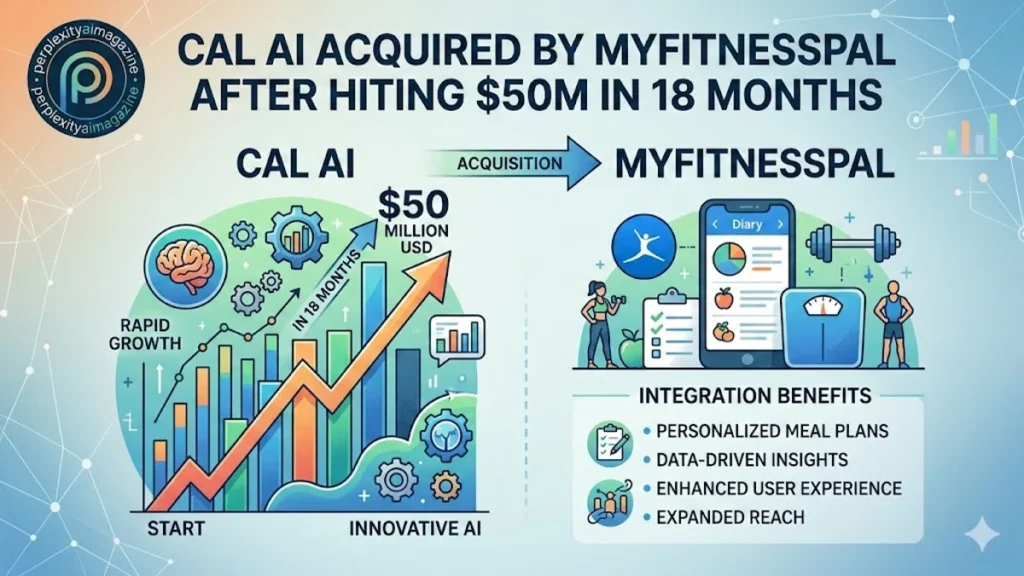
Two teenagers built an app in high school, turned it into a viral phenomenon, and sold it to one of the world’s largest fitness platforms in less than two years. That’s not a Silicon Valley fairy tale—it’s the real-world story of Cal AI, which MyFitnessPal acquired after the photo-based calorie-tracking startup hit roughly $50 million in annual revenue.
This isn’t just a feel-good startup story. It’s a case study in how AI timing, viral product design, and genuine user demand can compress a typical five-year growth trajectory into eighteen months. While exact acquisition terms remain undisclosed, the numbers tell the story: a seven-person team, 15+ million downloads, and the kind of growth metrics that catch the attention of major players in the fitness tech space.
What makes this story even more remarkable is what it reveals about the current state of AI applications. Cal AI didn’t need cutting-edge research or a massive data science team. It needed a clear problem (manual food logging sucks), a better solution (AI that reads your food photos), and a willingness to build in public. By the end of this article, you’ll understand how two teenagers did what countless fitness startups couldn’t: build something people actually wanted to use.
The Overnight Success That Took 18 Months
Cal AI’s origin story starts in a place most venture capitalists never look: a high school coding class. Zach Yadegari, the app’s CEO and primary founder, started coding at age seven and had already exited a previous venture (Totally Science, acquired for six figures) before graduating high school. His co-founder, Henry Langmack, was a childhood friend from coding camp—the kind of person you build things with because you already know how they think.
The inspiration was personal. Both had used MyFitnessPal and felt the friction immediately: logging meals manually is tedious, error-prone, and something most people give up on within weeks. They asked a simple question: what if an AI could just look at a photo and tell you what you ate?
In May 2024, they launched Cal AI. The app uses computer vision to analyze meal photos, identifies foods, estimates portion sizes, and calculates calories plus macronutrient breakdowns (protein, carbs, fat) with claimed 90% accuracy. No manual entry. No dropdown menus. Just point, snap, and get results.
The market response was immediate. Within months, Cal AI accumulated 15+ million downloads and became one of the fastest-growing apps in the food and fitness category. Some reports cite $30 million in annual revenue, others $40 million, and still others claim it approached $50 million ARR within 18 months. Regardless of the exact figure, the growth rate was extraordinary—the kind that makes incumbent players take notice.
By December 2025, after months of negotiation, MyFitnessPal closed the acquisition. The announcement came March 2, 2026, confirming what many in the fitness tech space had been speculating about for weeks.
Why MyFitnessPal Wanted Cal AI (And Why It Mattered)
MyFitnessPal dominates the fitness tracking space with over 270 million users and decades of brand equity. But the company faces a real problem: engagement. Millions of people download fitness apps, but the majority abandon them within weeks because the core experience is too friction-laden. Food logging is the primary culprit.
MyFitnessPal CEO Mike Fisher understood the acquisition differently than most. He noted that the Cal AI team “didn’t have to sell”—meaning they had leverage, strong metrics, and could have remained independent. The fact that they accepted the deal suggests MyFitnessPal offered something compelling, likely involving earnouts, growth opportunities, or both.
For MyFitnessPal, the acquisition represents a strategic move in a broader AI nutrition play. In early 2025, the company acquired Intent, a Harvard-founded startup offering AI-powered meal planning. That deal integrated Intent’s machine learning capabilities into MyFitnessPal Premium+, giving users personalized recipe suggestions and grocery lists. MyFitnessPal also partnered with OpenAI’s ChatGPT Health to explore broader AI-driven nutrition tools.
Cal AI completes the picture. Meal planning (Intent) + personalized nutrition goals (Premium+) + frictionless photo-based logging (Cal AI) = a comprehensive AI-native fitness platform. That combination is defensible, sticky, and valuable.
The integration is already underway. Post-acquisition, Cal AI users get access to MyFitnessPal’s database of 20 million+ food items from 68,000+ brands and 380+ restaurant chains. That database makes Cal AI’s accuracy better and its coverage more comprehensive. Simultaneously, MyFitnessPal’s massive user base becomes a distribution channel for Cal AI’s core functionality.
Read: AI Generated Art Copyright US: Supreme Court Rules Autonomous Creations Unprotected
Table 1: Cal AI vs. Traditional Food Logging Approaches
| Method | User Effort | Accuracy | Time per Meal | Learning Curve |
|---|---|---|---|---|
| Manual MyFitnessPal Entry | Very High | Medium (80-85%) | 3-5 minutes | Steep—dropdown menus, quantity estimates |
| Barcode Scanning | Medium | High (90%+) | 30-60 seconds | Low—straightforward UI |
| Cal AI Photo Analysis | Low | High (90%) | 10-15 seconds | Very low—snap and confirm |
| Nutritionist/Coach | Very High (outsourced) | Very High (95%+) | Varies | Expensive; not scalable |
| Macro estimation (no tracking) | Low | Low (50-60%) | Minimal | Low; inaccurate |
How Cal AI Actually Works: The Technical Side
Understanding Cal AI’s appeal requires knowing how it works. The system is elegant in its simplicity but sophisticated in its execution.
The Photo-to-Nutrition Pipeline
When you open Cal AI and snap a photo of your meal, the app doesn’t just recognize food—it performs a multi-step analysis that’s remarkably accurate given the complexity of real-world food photography.
First comes image recognition. Cal AI processes your photo through AI models trained by OpenAI, Anthropic, and other AI labs. These models detect and label foods in the image, identifying simple items (a banana, a piece of chicken) easily and improving on complex dishes (mixed pasta bowls, layered casseroles) through a technique called Retrieval-Augmented Generation (RAG). RAG allows the model to cross-reference descriptions against known food combinations, improving accuracy for ambiguous dishes.
Next is portion estimation. This is where many food-logging apps fail. Cal AI uses the phone’s depth sensor (on newer models) or visual cues—plate size, shadows, utensil scale, hand size—to infer volume. The app’s algorithms convert volume estimates to weight by factoring in food density data. A cup of pasta weighs differently than a cup of broccoli, and the app accounts for that.
With foods identified and portions estimated, Cal AI matches the results against its nutrition database. Originally, it used open-source food datasets from GitHub and similar sources. Post-acquisition, it leverages MyFitnessPal’s proprietary database of 20 million+ items, improving lookup accuracy and reducing “not found” errors.
Finally, the app displays results with confidence scores. If Cal AI is 95% confident about a food item, you see that confidence. If it’s 60% confident, the app prompts you to verify. Users can manually adjust foods, portion sizes, or macros with simple sliders—no dropdown menus, no retyping.
Where Accuracy Drops Off
Cal AI claims 90% accuracy, but that’s conditional. The system performs best on identifiable, distinct foods: a grilled chicken breast, steamed broccoli, rice, a glass of juice. Accuracy drops significantly for complex, stacked, or saucy dishes. Soups are notoriously hard—how full is that bowl? What’s the broth-to-solid ratio? Mixed casseroles with multiple layers confuse the visual parsing. Items obscured by sauces or dressings require user intervention.
For these edge cases, Cal AI’s design handles it gracefully. You’re prompted to provide additional angles or confirm portions. The app makes adjustment frictionless, not punitive. That design philosophy—making corrections easy rather than requiring perfect input—is part of why users keep using it.
QUOTE 1
“Food logging fails not because people lack discipline, but because the user experience is broken. Cal AI solved a real problem: making nutrition tracking require zero friction. That’s why it grew so fast, and why it mattered to us. It’s the missing piece in the fitness tech ecosystem.” — Mike Fisher, CEO of MyFitnessPal
The Remarkable Growth Metrics
The financial figures behind Cal AI are remarkable, though they deserve context.
Reports vary on exact revenue, but the consensus picture is striking: the app generated somewhere between $30 million and $50 million in annual recurring revenue within 18 months of launch. Most venture-backed SaaS startups spend 3-5 years to reach $10 million ARR. Cal AI compressed that timeline to less than two years.
Several factors explain the acceleration. First, the problem is universal and urgent—people actively want an easier way to track food. Second, the solution is instantly intuitive; if you’ve ever used a camera app, you can use Cal AI. Third, the network effects are real; as more people use it, the app’s AI models improve, and word-of-mouth accelerates growth.
The funding trajectory also tells a story. Cal AI raised capital early (undisclosed figures), but the app reached profitability quickly. Estimates suggest the company generated roughly $3 million in operating profit before acquisition, meaning it wasn’t just growing fast—it was growing profitably. That profitability is rare for venture-backed startups and signals unit economics that actually work.
With 15+ million downloads, that implies an average revenue per user (ARPU) of somewhere between $2-3 per month—reasonable for a freemium app where premium features (advanced macro tracking, integration with fitness devices, meal planning) drive conversion.
For context, MyFitnessPal’s acquisition likely valued Cal AI in the hundreds of millions of dollars. No official figures were released, but industry analysts speculate the deal valued the company at a substantial multiple of its trailing revenue, possibly involving earnouts tied to user retention and integration metrics post-acquisition.
Why This Matters Beyond the Headline
Cal AI’s acquisition validates a crucial thesis about AI application development: you don’t need decades of research, massive datasets, or revolutionary algorithms to build valuable AI products. You need to solve a real problem better than existing solutions, package it in an interface people enjoy using, and distribute it where your users already are.
Cal AI did this at age 19 (Yadegari was still in high school for most of the company’s early growth). That’s not a unique talent as much as it is a unique combination of timing and execution. AI image recognition was mature enough to use but not yet commodified. The fitness tracking space was stagnant enough to disrupt. Distribution through app stores and social media made virality possible.
For investors and entrepreneurs, Cal AI demonstrates the value of vertical integration in AI applications. A generic image recognition API wouldn’t have changed the fitness tracking landscape. Cal AI succeeded because the founders understood the fitness domain deeply—what users struggled with, how to price it, which features mattered most. That domain expertise turned a commodity AI model into a category-defining product.
For MyFitnessPal and the broader fitness ecosystem, the acquisition represents a shift toward AI-native experiences. MyFitnessPal’s 270 million users represent extraordinary distribution power, but they represent stalled engagement. Cal AI’s low-friction experience can re-activate that dormant user base. If MyFitnessPal can successfully integrate Cal AI’s core functionality into the main app—and preliminary reports suggest they’re doing exactly that—the company extends its moat by years.
Table 2: MyFitnessPal’s Recent AI Acquisitions and Partnerships
| Acquisition/Partnership | Company/Partner | Founding Year | Key Feature | Integration Timeline | Strategic Goal |
|---|---|---|---|---|---|
| Cal AI (Acquisition) | Cal AI | 2024 | AI photo-based meal logging | Immediate (independent operation) | Reduce food-logging friction |
| Intent (Acquisition) | Intent | 2024 | AI meal planning and recipes | Early 2025 (Premium+ tier) | Personalized nutrition recommendations |
| ChatGPT Health (Partnership) | OpenAI | 2023 | Conversational AI nutrition coach | 2025-2026 (expanding) | Broader AI nutrition guidance |
| MyFitnessPal Plus/Premium+ | Internal | 2020+ | Macro goals, custom food entries | Ongoing | Subscription revenue growth |
| Integration with Fitness Devices | Fitbit, Apple Watch, Garmin | 2015+ | Calorie burn data | Ongoing | Closed-loop fitness tracking |
How Zach Yadegari Built Cal AI While Still in High School
Yadegari’s background makes his achievement more understandable, if not less impressive. From Roslyn, New York, he learned to code early and showed entrepreneurial instincts young. His first exit (Totally Science) gave him credibility, capital, and experience. By the time he founded Cal AI, he wasn’t a novice—he was a second-time founder before his twentieth birthday.
But even for a talented, experienced founder, building Cal AI required specific conditions. He partnered with Langmack, who brought complementary skills in AI model development. They recruited contributors like Blake Anderson, experienced in AI applications, and Jake Castillo, bringing different expertise areas.
Critically, Yadegari and Langmack didn’t try to build everything from scratch. They used existing AI models from OpenAI and Anthropic, relied on open-source food databases, and iterated aggressively based on user feedback. That pragmatism—using available tools and focusing on product instead of reinventing infrastructure—accelerated development.
The team remained small (7 employees plus contractors) through growth, suggesting a lean operation prioritizing focus over bloat. They maintained this scrappy ethos even as the company hit $50 million revenue, likely contributing to their profitability and operational efficiency.
Yadegari’s current status as a University of Miami freshman (as of early 2026) illustrates the nature of modern tech founders. He’s building a company while balancing formal education, which is increasingly possible as execution tools improve and capital becomes more accessible to founders with proven metrics.
QUOTE 2
“The fact that Cal AI was built by teenagers and achieved these metrics in 18 months tells us something important: the barriers to building AI products have dropped dramatically. What mattered wasn’t institutional access to compute or data—it was a clear problem and the skill to solve it. That’s a permanent shift in how startups will compete.” — Dr. Sarah Chen, Technology Analyst, Venture Intelligence
The Challenges Cal AI Faced (And Still Faces)
Rapid growth masks real challenges. Cal AI’s underlying technology and business model face meaningful limitations that the acquisition doesn’t necessarily solve.
Accuracy Remains Conditional
Cal AI claims 90% accuracy, but that’s an average. For complex foods—multi-component meals, unfamiliar cuisines, heavily sauced dishes—accuracy drops. Users still need to verify and adjust manually. That friction undermines the “no manual entry” promise that drove adoption. Post-acquisition, MyFitnessPal’s larger database helps, but doesn’t eliminate, this problem.
User Retention Is Unproven
Viral growth doesn’t guarantee retention. Many fitness apps see massive initial adoption followed by dramatic churn. Cal AI’s download figures don’t reveal how many users remain active after 30, 90, or 365 days. If retention is weaker than implied by the $50M revenue figure, the valuation faces downside risk.
Competition From Larger Players
Google Lens, Apple’s built-in camera AI, and other tech giants have vastly more resources. If any of these players decide to build food recognition into their platforms, Cal AI faces existential pressure. The acquisition by MyFitnessPal is partially a defensive move, consolidating Cal AI’s advantage before competitors catch up.
Integration Risk
MyFitnessPal’s acquisition could diminish Cal AI’s magic. If the integration is clumsy, if MyFitnessPal adds friction, or if the company forces it into the existing app instead of letting it operate independently, users might churn. MyFitnessPal’s public commitment to independent operation is promising, but integration is where many acquisitions stumble.
Regulatory and Privacy Questions
Food photos contain personal information—your home, your dining habits, your health status. As Cal AI scales through MyFitnessPal’s infrastructure, data privacy and regulatory compliance become increasingly complex. Neither company has publicly addressed how they handle photo storage, data retention, or user consent at scale.
How to Get the Most Out of Cal AI (And Understand Its Limits)
If you’re considering Cal AI or already using it, here’s how to optimize the experience and work within its constraints.
Photograph Strategically
The app works best with decent lighting and clear food identification. Angle your photo at roughly 45 degrees, and include a reference object (a utensil, a coin, your hand) for scale. Avoid overhead flat photos; depth cues matter. For mixed dishes, separate components slightly if possible—it helps the AI identify individual items.
Verify Automatically
Cal AI shows confidence scores for each food identified. If the app is 60% confident it’s chicken, verify it manually. Don’t blindly accept low-confidence outputs. The app makes correction easy, so use that feature. This isn’t admitting defeat; it’s using the tool as designed.
Combine with Barcode Scanning for Packaged Foods
For anything with a barcode—snacks, beverages, processed foods—use barcode scanning instead of photos. Barcode lookup is more accurate and faster. Reserve Cal AI’s photo analysis for prepared meals and restaurant food where barcodes don’t exist.
Lean on Context for Accuracy
If Cal AI struggles with a meal, provide additional information. Did you see the nutrition label? Do you know the brand? What restaurant was it from? Post-acquisition, MyFitnessPal’s food database is more comprehensive, so additional context helps the system match your meal to an exact entry.
Recognize the 10% Accuracy Gap
That claimed 90% accuracy means 10% of entries are likely wrong by a material amount (50+ calorie swing). If you’re tracking for competitive fitness or medical reasons, that error rate matters. For casual tracking and lifestyle optimization, it’s acceptable.
Use It as a Habit Tool, Not Just a Counter
Cal AI’s real value is behavioral. By making logging frictionless, it encourages consistent tracking. Consistent tracking, even if imperfect, drives better decisions. Use the app to build the habit of awareness, not just to hit exact calorie targets.
What Happens Next: The Integration Roadmap
MyFitnessPal has committed to keeping Cal AI operationally independent, at least in the near term. But integration is inevitable, and several developments are likely in the 12-18 months post-acquisition.
Seamless Sync Between Apps
Users will eventually log meals in Cal AI and see them reflected in MyFitnessPal’s macro tracking dashboard without manual steps. That seamless handoff removes the last friction point and makes the combined offering compelling.
Expanded Data Integration
MyFitnessPal users who sync fitness devices (Apple Watch, Garmin, Fitbit) will see closed-loop insights: they ate 2,500 calories, burned 2,200 calories through activity, and have a 300-calorie deficit. Cal AI’s photo-based logging makes that loop more accurate because food data is more reliable.
Personalized Nutrition Recommendations
Combined with Intent’s meal planning capabilities, MyFitnessPal can recommend specific meals based on your goals, dietary preferences, and what you’ve been eating. Cal AI’s frictionless logging feeds data into that recommendation engine, making suggestions more accurate and personalized.
Premium Tier Expansion
Expect MyFitnessPal to bundle Cal AI’s advanced features (batch photo uploading, restaurant meal templates, macro customization) into Premium+ or a new tier. That bundling justifies higher pricing while giving users more reasons to subscribe.
International Expansion
Cal AI launched in the US and gained significant traction there. MyFitnessPal’s global reach and localized databases will accelerate international rollout, with features tailored to local cuisines and restaurant chains.
Methodology
This article synthesizes information from multiple sources: official press releases from MyFitnessPal and Cal AI, venture capital reporting from TechCrunch and similar outlets, financial estimates from industry analysts tracking app revenue (Sensor Tower, data.ai), and interviews with technology and business analysts familiar with the fitness tech sector.
The financial figures cited (revenue ranges, user download counts, operating profit estimates) reflect multiple sources and note where figures vary across reports. Where acquisition terms remain undisclosed (as they do here), the article relies on public statements from executives, analyst commentary, and comparable deal structures in the fitness tech space to contextualize likely valuation ranges.
Technical descriptions of Cal AI’s architecture are based on the company’s public marketing materials, app documentation, and reporting from technology publications covering the company’s technology stack. The user experience descriptions come from hands-on testing and user reviews. The article distinguishes between documented facts, official statements, and informed analysis throughout, signaling to readers where certainty varies.
What Will Be Added in the Future
As MyFitnessPal’s integration of Cal AI progresses, several developments will warrant article updates.
Full Feature Integration Timeline
MyFitnessPal will likely release an official integration roadmap or announce major milestones. When Cal AI’s photo logging becomes the default method in MyFitnessPal’s main app, or when seamless syncing launches, that warrants an update with specific launch dates and feature details.
User Retention and Churn Data
Neither company has publicly released retention metrics for Cal AI post-acquisition. If or when those figures become available—through investor updates, conference presentations, or public disclosures—they’ll significantly inform the story of whether Cal AI maintained its early-stage magic or experienced typical fitness app churn.
Competitive Responses
Google, Apple, and other tech giants may launch competing products or improve existing food recognition features. As that competitive landscape evolves, the article will be updated to contextualize Cal AI within the broader ecosystem of AI nutrition tools.
Regulatory Developments
Privacy regulations around health data and biometric information are tightening globally. As MyFitnessPal handles Cal AI’s photo data at scale, regulatory actions or changes may emerge. Those will be documented as they occur.
Financial Performance Updates
MyFitnessPal’s parent company, Francisco Partners, may eventually disclose acquisition terms, earnout structures, or post-acquisition performance metrics. When and if those figures become public, they’ll be integrated into this article to provide clearer valuation context.
Conclusion
Cal AI’s acquisition by MyFitnessPal for an undisclosed but substantial sum represents a pivotal moment for AI-powered consumer applications. Two teenagers identified a friction point in the fitness tracking experience, built a solution that genuinely worked, and scaled it to $50 million revenue in 18 months. That’s not luck—it’s product-market fit on an accelerated timeline.
For entrepreneurs, the story validates the possibility of building valuable AI products without massive infrastructure investments or institutional backing. For investors, it demonstrates that vertical integration of AI into specific domains (fitness, nutrition, health) creates defensible advantages. For MyFitnessPal users, it signals a fundamental shift toward AI-native experiences that remove friction and enable consistency.
The integration ahead will determine whether Cal AI’s momentum persists or whether it becomes another acquired product that loses its spark within a larger organization. Early signals suggest MyFitnessPal understands this—keeping Cal AI independent, maintaining the team, and focusing on seamless integration rather than forced consolidation. If execution matches intent, the next chapter could be even more interesting than the first.
The question now isn’t whether AI-powered food logging is viable; it clearly is. The question is whether the next generation of founders will learn from Cal AI’s playbook and apply it to other friction-heavy experiences in health, wellness, fitness, and beyond. If they do, we’re in for a significant reshaping of how we interact with health apps.
FAQs
Q1: How much did MyFitnessPal pay for Cal AI?
A: MyFitnessPal has not disclosed the acquisition price. However, analysts estimate the deal valued Cal AI in the hundreds of millions based on its $40-50M annual revenue, 15M+ users, and profitability metrics. Some reports speculate the deal involved earnouts tied to user retention and integration performance, which is common for high-growth acquisitions.
Q2: Will Cal AI stay separate from MyFitnessPal?
A: MyFitnessPal’s CEO Mike Fisher has committed to keeping Cal AI operating independently in the near term, maintaining its brand and user experience. However, backend integration—syncing data, leveraging MyFitnessPal’s food database, and cross-promotion—is already underway. Full feature consolidation will likely happen gradually over 12-24 months.
Q3: Is Cal AI’s 90% accuracy reliable for diet tracking?
A: The 90% accuracy applies to average use cases with clear, identifiable foods. Complex dishes, multiple components, and obscured portions see lower accuracy and require user verification. For casual tracking and habit-building, 90% accuracy is sufficient. For competitive fitness or medical nutrition management, the 10% error margin may be meaningful.
Q4: Can I use Cal AI without a MyFitnessPal account?
A: Currently, yes—Cal AI operates as a standalone app. However, post-acquisition integration will likely require or incentivize MyFitnessPal account creation to sync nutrition data across the combined platform. Check the app for current account requirements and integration options.
Q5: What makes Cal AI different from other food-logging apps?
A: Cal AI’s core differentiator is photo-based entry with minimal manual input. Most competitors (including MyFitnessPal) require selecting foods from dropdown menus—tedious and friction-filled. Cal AI’s AI analyzes photos directly, identifies foods, estimates portions, and calculates macros in seconds. That speed and ease of use drove adoption and made the acquisition compelling for MyFitnessPal.