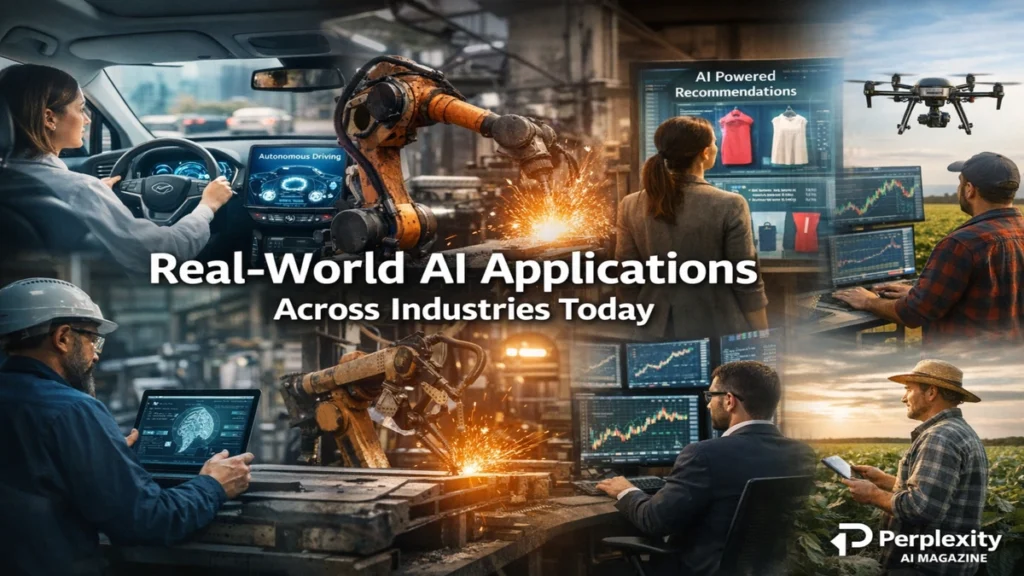
I have watched artificial intelligence move from buzzword to backbone in a surprisingly ordinary way. It did not arrive with a single breakthrough moment for most people. It arrived as little conveniences and quiet interventions: a fraud alert that came before a loss, a recommended show that felt uncannily right, a customer-service chat that solved a problem at 1 a.m., a scan flagged faster than a waiting specialist could review it. If you are searching for what AI actually does in real life, the answer is straightforward: it powers a wide range of applications across industries by finding patterns in data and turning those patterns into predictions, classifications and decisions. – artificial intelligence applications.
Most “AI applications” are built from three core technical approaches. Machine learning learns from historical examples to forecast outcomes and detect anomalies. Computer vision interprets images and video, from medical scans to traffic cameras. Natural language processing helps machines work with text and speech, enabling chatbots, voice assistants and automated summaries. These tools are combined to solve complex problems faster than traditional methods, often improving efficiency and accuracy.
Still, AI is not magic and it is not neutral. It can amplify bias, create new privacy risks and fail in high-stakes settings if deployed without guardrails. The real story is not simply where AI works, but how organizations build oversight, measure performance and keep humans accountable for automated decisions. AI’s promise sits beside its responsibility, and the difference between benefit and harm often comes down to governance.
How AI Applications Actually Work
I describe AI applications as pipelines because it keeps the conversation grounded. In the first stage, the system gathers inputs, such as images, sensor readings, transaction logs or customer messages. In the second stage, a model interprets that data. It might classify an image, predict a risk score or rank possible recommendations. In the third stage, the system triggers an action, such as flagging a scan for review, blocking a suspicious payment, rerouting deliveries or answering a customer question. – artificial intelligence applications.
This structure helps explain why AI can feel impressive in controlled demos and fragile in the wild. Models learn patterns from training data, and when real-world conditions change, performance can drift. A healthcare model trained on one hospital’s population may struggle in another. A fraud model may need constant updates as criminals change tactics. A recommendation engine may unintentionally narrow what a user sees if it over-optimizes for engagement.
Here is the practical takeaway. Successful AI is not just a model. It is data quality, monitoring, escalation paths and human oversight. When organizations invest in the full pipeline, AI becomes a dependable tool. When they treat it as a plug-and-play miracle, AI becomes a risk.
Read: Anthropic vs OpenAI: Safety, Coding, and the AI Divide
Healthcare Applications
I speak about healthcare first because it captures both the promise and the stakes. AI can enhance diagnostics, personalize treatment and streamline operations, but mistakes are measured in human consequences. The most established healthcare applications center on medical imaging, predictive analytics and drug discovery. These uses are designed to assist clinicians, not replace them, by spotting patterns quickly and consistently.
A major appeal is scale. Hospitals generate enormous volumes of scans and records, and clinicians face time pressure. AI can triage, highlight suspicious regions and reduce repetitive workload. Yet healthcare also demands reliability, interpretability and careful validation. The same system that performs well in one environment can fail in another if workflows, equipment or patient populations differ. That is why healthcare AI tends to move slower than consumer AI, with more emphasis on evaluation, compliance and clinical accountability.
Medical Imaging
I have seen medical imaging described as the “sweet spot” for healthcare AI because the input format is consistent and the tasks can be well defined. AI algorithms analyze X-rays, MRIs and CT scans to detect abnormalities such as tumors, fractures and lung nodules. The value is speed and pattern recognition. Systems can scan for subtle signals, support radiologists and reduce missed findings.
Your provided examples reflect how this is used in practice: platforms that assist radiologists in identifying issues, tools that improve detection accuracy and systems that speed up the search for lung nodules. The core idea is decision support. A model flags, a clinician verifies, and the workflow becomes more efficient.
Expert quote: “Imaging AI works best when it is treated like a second reader with clear accountability, not a final judge,” said a radiology informatics consultant who advises hospitals on clinical deployments.
Diagnostics and Treatment Support
I think treatment support is where enthusiasm can run ahead of reality. Systems that synthesize electronic medical records and medical literature can help clinicians generate differential diagnoses and compare therapy options. In your brief, examples include oncology decision-support tools and “clinical co-pilot” systems that summarize records to help clinicians work faster. – artificial intelligence applications.
These tools can be useful when they are grounded in verified medical knowledge and transparently show what information they relied on. They become dangerous when they hallucinate, overstate certainty or quietly omit key context. The best implementations use AI to organize and summarize, while clinicians retain responsibility for diagnosis and treatment decisions.
Expert quote: “The safest clinical copilots do not pretend to be doctors,” said a health AI policy researcher. “They act like fast, careful assistants who show their work.”
Predictive Analytics in Hospitals
I find predictive analytics to be both powerful and sensitive because it turns care into probability management. Predictive models forecast patient risks using historical data, vital signs and lab values. They can estimate the likelihood of readmission, deterioration or acute events, helping staff triage and intervene earlier.
Your examples describe remote monitoring systems and predictive tools that reduced critical events in specific settings. The benefit is earlier intervention and better resource allocation. The risk is alert fatigue and bias. If a model over-alerts, clinicians stop trusting it. If it under-alerts for certain populations, it can worsen inequities. Responsible deployment requires continuous monitoring, recalibration and performance checks across subgroups.
Drug Discovery and Research
I have watched drug discovery become more computational as AI helps identify candidate compounds and simulate interactions. The promise is acceleration. Instead of exploring chemical space through brute-force trial and error, AI narrows the search space, highlighting promising candidates faster.
Your brief notes AI simulating interactions and shortening timelines from years to months in early research phases. That is plausible in discovery and preclinical workflows, especially when AI is used to prioritize what to test. However, it does not erase clinical reality. Biological complexity, toxicity and trial outcomes can still derail promising candidates. AI helps researchers choose smarter experiments. It does not eliminate uncertainty.
E-Commerce and Personalization
I notice AI most in e-commerce because it shapes what people see, and what people see shapes what they buy. Recommendation engines analyze behavior such as searches, clicks and purchases to suggest products. This can boost sales and improve user experience by reducing friction. The same approach powers personalization across streaming, music and news feeds, where algorithms tailor content to preferences.
Your examples cite Amazon-like recommendations and Netflix or Spotify-style personalization. These systems typically combine collaborative filtering, embeddings and ranking models to predict what a user is most likely to engage with. Their success depends on data volume and feedback loops. The more interaction data, the more refined the recommendations. – artificial intelligence applications.
The tradeoff is influence. Personalization can reduce discovery diversity and intensify filter bubbles. Platforms increasingly face pressure to provide transparency, such as “why you are seeing this” explanations, and to design systems that balance relevance with serendipity.
Customer Service Chatbots
I have seen chatbots evolve from rigid scripts to conversational tools that handle customer queries instantly. They improve service by offering 24/7 coverage, quick answers and consistent responses. In many businesses, AI chat is used for triage: gather details, answer common questions and route complex cases to humans.
The main risk is misinformation. A chatbot that invents a policy or misstates a refund rule can create legal and reputational problems. That is why many enterprise chatbots are constrained to approved knowledge bases and use retrieval methods to ground responses. Human escalation remains critical for edge cases, disputes and emotional situations.
Expert quote: “In customer support, reliability beats personality,” said a customer-experience strategist. “A warm wrong answer costs more than a plain correct one.”
Transportation and Mobility
I have learned to separate mobility AI into two categories: autonomy and optimization. Autonomy includes self-driving cars and drones that navigate complex environments. Optimization includes route planning, traffic light timing and logistics scheduling. Both rely on real-time data and predictive models, but autonomy carries higher safety stakes.
Autonomous Vehicles
I see autonomous vehicles as a fusion problem. Systems combine camera, radar and other sensor data to map the environment, detect objects and predict behavior. Deep learning models identify pedestrians, signs and lane boundaries, while planning systems choose safe paths. Edge processing is essential because braking and steering decisions cannot wait for cloud latency. – artificial intelligence applications.
Your brief highlights that AI handles fog and night driving through deep learning and sensor fusion. That reflects real engineering priorities: redundancy, perception robustness and fail-safe behavior. Progress continues, but widespread autonomy depends on regulation, infrastructure, cost and public trust.
Drones
I find drones to be one of the most practical autonomy stories because many drone environments are more controllable than city streets. Drones use AI for obstacle avoidance, object tracking and flight path optimization. Reinforcement learning can help with dynamic navigation, balancing wind, battery life and route constraints.
Your examples include agricultural monitoring and search-and-rescue tracking. These applications show why AI works well in drones: tasks can be specialized, and operational zones can be defined. Still, safety and airspace regulation remain constraints. Drones can scale fastest where rules are clear and environments are controlled.
Finance and Security
I think finance is one of the strongest cases for AI because the data is structured and the feedback is immediate. Fraud detection, risk assessment and cybersecurity use machine learning to identify anomalies in real time. These systems can outperform rule-based methods because they adapt to changing patterns.
Fraud Detection
I have seen how fraud models look for deviations that signal threats: unusual purchase locations, sudden high-value transfers or patterns across multiple accounts. Your brief includes examples of coordinated account takeovers, identical purchases across accounts and anomaly detection that flags unusual onboarding patterns. These are typical fraud scenarios where adaptive models can add value.
The challenge is false positives. If systems block too many legitimate transactions, customer trust suffers. Financial institutions therefore use risk scoring and tiered responses: flag for review, request additional authentication or block outright. Effective systems prioritize high-risk alerts for human review and learn from feedback over time.
Account Opening, KYC and Lending
I consider AI in KYC and lending to be high-impact and high-risk. AI can verify documents, detect fakes and spot suspicious application patterns quickly. Your brief mentions clustered applications from one IP and other signals that can halt fraud schemes. – artificial intelligence applications.
In lending, AI can also assess risk and automate decisions, which raises fairness and explainability concerns. Models trained on historical outcomes can reflect structural inequalities. Responsible lenders add governance: bias testing, model documentation and human appeals. Here, AI is not merely a tool. It becomes a gatekeeper for opportunity.
Cybersecurity
I have watched cybersecurity become more automated because attackers scale faster than defenders can manually respond. AI can detect malware patterns, identify vulnerabilities and triage alerts. In many organizations, the biggest benefit is reducing alert fatigue by clustering events and prioritizing likely threats.
The risk is overreliance. AI tools can miss novel attacks or generate misleading guidance if used without expert review. The strongest security teams treat AI as a decision-support layer, not an authority, and maintain robust logging and oversight.
Smart Cities and Robotics
I find smart-city AI compelling because it reveals AI as infrastructure. Smart cities combine AI with IoT sensors to process data in real time, forecast congestion and optimize energy use. Digital twins, virtual replicas of city systems, allow planners to simulate scenarios for transport, climate and infrastructure planning. – artificial intelligence applications.
Smart Cities
Your brief emphasizes AIoT, 5G integration, digital twins and green AI for sustainability. These trends reflect a push toward real-time decision-making and efficiency. The goal is reduced congestion, cleaner energy use and better urban services.
But smart cities also raise governance questions. Sensor networks can become surveillance systems if rules are unclear. Predictive tools can amplify bias if used for policing without safeguards. The best smart city is not the one with the most data, but the one with clear, enforceable constraints on how data is used.
Singapore and Dubai as Examples
I have seen Singapore referenced as a leader in smart-city programs, with Smart Nation initiatives integrating sensors, analytics and digital twins. Your brief describes broad deployment, digital twin usage and AI-driven optimization of routes and services. Dubai is described as using digital twins and real-time mobility analytics, with high rankings in smart-city indices. – artificial intelligence applications.
These examples highlight a pattern: successful smart-city AI depends on public-private coordination, governance, and sustained investment in data infrastructure. It is less about flashy tech and more about operational discipline.
Robotics and Swarm Systems
I see robotics as the physical counterpart to smart-city analytics. AI-powered robots can handle last-mile delivery, sanitation and maintenance, especially when paired with edge computing for low-latency navigation. Predictive maintenance can extend robot lifespan and reduce downtime. Swarm robotics, coordinating multiple units, can optimize tasks like waste management and emergency response.
These systems work best when tasks are structured. The moment a robot must interpret ambiguous human environments, risk rises. That is why near-term growth is likely in controlled domains: warehouses, campuses and managed delivery corridors.
A Practical Comparison of AI Application Areas
| Industry | Common AI Methods | Typical Use Cases | Key Benefits | Main Risks |
|---|---|---|---|---|
| Healthcare | Computer vision, predictive ML, NLP | Imaging support, risk prediction, clinical copilots | Faster detection, triage, operational efficiency | Clinical errors, bias, overreliance |
| E-commerce | Ranking models, embeddings, NLP | Recommendations, chatbots, personalization | Higher relevance, better service | Filter bubbles, manipulation, privacy |
| Transportation | Sensor fusion, planning, RL | Self-driving, drones, logistics routing | Safer navigation, efficiency | Safety incidents, regulation gaps |
| Finance | Anomaly detection, supervised ML | Fraud blocking, KYC verification, risk scoring | Real-time prevention, reduced losses | False positives, fairness concerns |
| Smart cities | AIoT, predictive analytics | Traffic optimization, energy planning, digital twins | Sustainability, reduced congestion | Surveillance, governance failures |
What the Future Looks Like in Applications
I describe the next phase of AI applications as integration, not invention. Many of the breakthroughs now are about wiring AI into workflows: hospitals integrating copilots into electronic records, banks fusing fraud signals across onboarding and spending, cities linking sensors to predictive maintenance, and robotics systems coordinating fleets rather than single machines. – artificial intelligence applications.
Your brief points to an “AIoT” future, more edge computing, and sustainability-driven AI. That aligns with practical constraints. Systems must respond in real time, which pushes computation closer to devices. Systems must scale without ballooning energy costs, which pushes efficiency. Systems must earn trust, which pushes monitoring and governance.
The winners will not be the most dramatic demos. They will be the applications that keep working after the novelty fades, across messy real-world conditions, with clear accountability when something goes wrong.
Takeaways
- AI applications rely on machine learning, computer vision and natural language processing working together in real pipelines.
- Healthcare AI helps with imaging, predictive risk and research, but needs strict oversight and continuous evaluation.
- Recommendations and chatbots improve personalization and service, while raising concerns about influence and accuracy.
- Mobility AI advances autonomy and logistics optimization, with safety and regulation as core constraints.
- Financial AI excels at fraud detection and verification, but must be governed for fairness and transparency.
- Smart-city and robotics applications can boost efficiency, but require strong privacy protections and public accountability.
Conclusion
I think the most honest way to describe AI applications is that they are practical instruments with extraordinary reach. They can spot patterns in scans, forecast risks in hospitals, block fraud in milliseconds, optimize deliveries, and personalize the media people consume. In many places, they already do. The question is not whether AI can be useful, but whether it can remain reliable and accountable as it becomes embedded into critical systems.
What separates responsible AI from risky AI is rarely the model alone. It is the surrounding discipline: quality data, monitoring, bias testing, human oversight and clear responsibility for decisions. AI can raise the floor of performance, but it can also amplify hidden failures when deployed carelessly. The future will belong to organizations and governments that treat AI as infrastructure, invest in guardrails and prove that efficiency does not have to come at the expense of trust. – artificial intelligence applications.
FAQs
What are the most common AI applications today?
Recommendations, fraud detection, chatbots, medical imaging support, route optimization and voice assistants are among the most common.
How does AI help in healthcare?
AI supports imaging analysis, predicts patient risks, assists clinical documentation and accelerates early-stage drug discovery by narrowing search spaces.
Why do recommendation systems matter?
They reduce search friction and personalize feeds, but can also narrow exposure and shape culture by steering attention.
How does AI detect fraud?
AI learns normal spending patterns and flags anomalies, such as unusual merchants, locations or coordinated behaviors across accounts.
What are the biggest risks of AI applications?
Bias, privacy loss, overreliance, weak accountability and failures in high-stakes settings are the largest risks.