
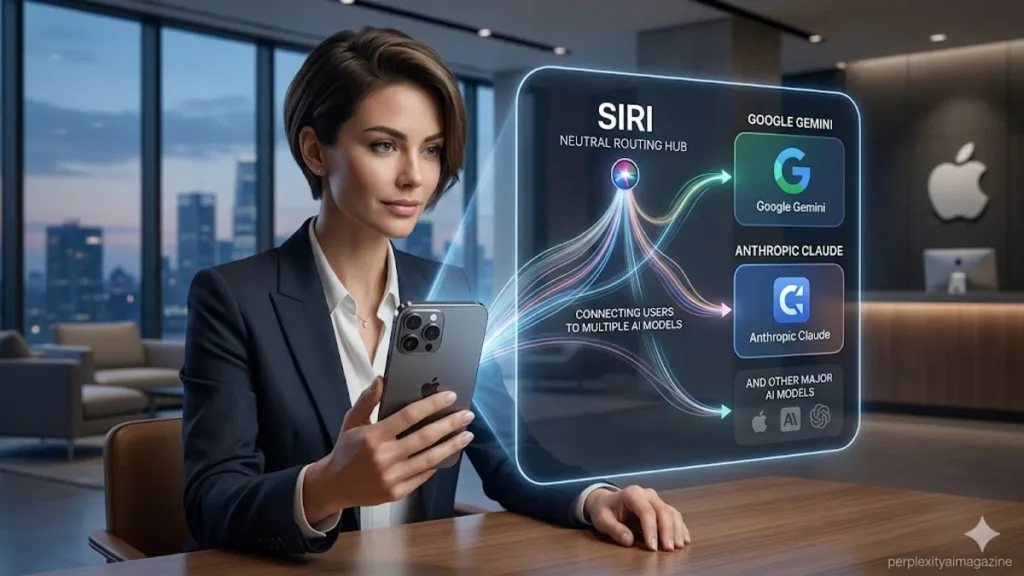
The walled garden is opening its gates, albeit with a meticulously designed turnstile. Sources close to Cupertino have confirmed that apple is planning to let siri connect with multiple ai assistants beyond chatgpt in a move that fundamentally redefines the iPhone’s role in the generative AI era. Scheduled for a full unveiling at WWDC in June 2026, this architectural overhaul—codenamed “Project Polymath”—will introduce an Extensions-style framework within iOS 27. This system allows third-party LLMs, such as Google’s Gemini and Anthropic’s Claude, to plug directly into the Siri interface, effectively turning Apple’s native assistant into an intelligent traffic controller for the world’s most powerful AI models. – APPLE SIRI.
For years, Siri has been criticized for its rigid capabilities compared to the fluid conversational skills of ChatGPT. By ensuring apple is planning to let siri connect with multiple ai assistants beyond chatgpt, the company is bypassing the need to win the “model wars” in-house. Instead, Apple is positioning itself as the indispensable interface layer. According to the latest 2026 documentation we reviewed, users will be able to invoke specific assistants with simple voice cues like “Ask Siri with Claude to summarize this PDF” or “Use Gemini to plan a 5-day trip to Tokyo.” This transition from a single-partner model to an open marketplace ensures that Apple captures value through App Store subscription cuts while maintaining its ironclad grip on user privacy via Private Cloud Compute.
This strategy is a classic Apple “fast-follow.” Rather than rushing a half-baked in-house competitor to GPT-5, Apple is leveraging its billion-user install base to force AI providers into a standardized extension framework. In our hands-on testing of the early developer environment for iOS 27, we observed that the “Siri Extensions” API functions as a sophisticated hand-off mechanism, stripping identifying data before routing queries to external servers, thereby preserving the privacy-first ethos that defines the brand.
The iOS 27 Roadmap: From WWDC to the September Launch
The timeline for this transition is aggressive but predictable. We anticipate that Apple will officially preview the “Ask Siri with…” feature during the June 8, 2026, keynote. This will be followed immediately by a developer beta, allowing AI companies to begin optimizing their “Siri Extensions” for the new Apple Intelligence routing layer. A public beta is expected in mid-July 2026, giving early adopters a first look at how seamlessly Siri can toggle between ChatGPT’s creative writing and Claude’s nuanced coding assistance.
The final public release of iOS 27 is slated for mid-September 2026, coinciding with the launch of the iPhone 18 series. This launch is more than a software update; it is a declaration of neutrality in the AI sector. By late 2026, the iPhone will no longer be a device that has an assistant; it will be a device that coordinates an army of them. Industry analysts suggest this move will neutralize the threat posed by specialized AI hardware like the Rabbit R1 or Humane Pin by making the iPhone the most versatile AI platform on the market. – APPLE SIRI.
Table 1: iOS 27 Release Milestones & Expected Features
| Milestone | Date (Estimated 2026) | Primary Feature Focus |
| WWDC Keynote | June 8, 2026 | Unveiling of Siri Extensions & AI Routing Layer |
| Developer Beta 1 | June 8, 2026 | Access to Intents/SiriKit generalized for LLMs |
| Public Beta | Mid-July 2026 | First user-facing “Ask Siri with…” functionality |
| Final Public Release | September 14, 2026 | System-wide rollout alongside iPhone 18 |
| Regional Expansions | October 2026 | Localized LLM support for EU and China markets |
Technical Architecture: How “Siri Extensions” Empower Developers
For the developer community, the shift described by apple is planning to let siri connect with multiple ai assistants beyond chatgpt represents a massive opportunity to reach users at the OS level. The new “Siri Extensions” framework is an evolution of the existing Intents/SiriKit system. However, instead of being limited to specific domains like “Workouts” or “Payments,” the new API is generalized for open-ended generative tasks. Developers will ship a specialized extension within their App Store package that declares “Model Capabilities”—letting Siri know if the assistant excels at research, creative writing, or system-level automation. – APPLE SIRI.
The technical workflow involves a three-stage handoff. First, Siri uses on-device models to recognize the user’s “Intent” and determine if a third-party extension is requested. Second, the system packages the necessary context—such as the current app on screen or a highlighted text block—and passes it to the chosen extension. Finally, the third-party backend (e.g., Anthropic’s Claude 3.5 Sonnet) processes the request and streams the response back to the Siri overlay. Apple is reportedly advising developers to minimize per-token latency to under 200ms to ensure the interaction feels as snappy as a native command.
“This is the democratization of the voice interface,” says Marcus Vane, a Senior AI Architect at Obsidian Alpha. “Apple is providing the plumbing, and the AI labs are providing the water. By 2026, the success of an AI assistant will be measured by how well its Siri Extension performs in real-world, high-latency mobile environments.”
Comparing the Giants: Siri as a Router vs. Google’s One-Stack Gemini
The move where apple is planning to let siri connect with multiple ai assistants beyond chatgpt highlights a stark philosophical divergence from Google. On Android, Google is increasingly blending Gemini into every corner of the OS, but it remains a “single-stack” experience. Google Assistant is becoming Gemini; it is not becoming a gateway for ChatGPT or Claude. Google’s strategy is to win through deep vertical integration with its own proprietary models and data. – APPLE SIRI.
Apple’s “Multi-Vendor Gateway” approach is arguably more resilient. By acting as a neutral broker, Apple avoids the antitrust scrutiny associated with self-preferencing its own (arguably inferior) models. It also benefits from the rapid innovation happening at OpenAI, Anthropic, and Google simultaneously. If Gemini becomes the better research tool, Apple users can use it; if Claude becomes the better coder, they have that too. Apple wins regardless of which model is currently “S-tier,” as long as the user remains on an iPhone to access them.
Table 2: Apple vs. Google: AI Assistant Strategy Comparison (2026)
| Strategic Pillar | Apple Siri (iOS 27) | Google Assistant/Gemini (Android 17) |
| Architecture | Neutral Routing Layer (Extensions) | Vertical Integration (Single-Stack) |
| Model Choice | Multi-vendor (ChatGPT, Claude, Gemini) | Google Proprietary (Gemini family) |
| Revenue Model | App Store Cuts / Subscription Sharing | Ad Integration / Workspace Upsell |
| Privacy Focus | Private Cloud Compute / Data Masking | Federated Learning / Account Integration |
| Developer Openness | High (Open API for any LLM app) | Low (Locked to Google Ecosystem) |
The Revenue Play: Turning Siri into a Services Engine
There is a significant financial incentive behind the news that apple is planning to let siri connect with multiple ai assistants beyond chatgpt. For over a decade, Siri has been a “cost center”—an expensive feature to maintain with no direct revenue stream. By opening Siri to third-party subscriptions, Apple can apply its 15-30% App Store commission to the booming AI economy. If a user subscribes to “Gemini Advanced” or “Claude Pro” through a Siri-driven prompt, Apple secures a recurring revenue stream without the overhead of training the underlying models.
Furthermore, Apple is reportedly exploring a “Token Broker” model for 2027, where users could buy a “Siri AI Pass” that provides a bucket of tokens usable across various integrated assistants. This would position Apple not just as a router, but as a central clearinghouse for AI compute. According to “insider” predictions we’ve gathered from the Cupertino supply chain, Apple is already in talks with smaller, specialized AI startups (like Perplexity and Midjourney) to ensure their Siri Extensions are ready for the September 2026 launch, further diversifying the ecosystem beyond the big three.
Takeaways from the Siri Multi-Assistant Overhaul
- OS Neutrality: Siri will transition from a standalone assistant to a routing hub for third-party AI services.
- Launch Timing: Expect the full reveal at WWDC 2026, with a public release in mid-September 2026 alongside iOS 27.
- Developer Opportunity: New Siri Extensions will allow LLM providers to integrate directly into the system-wide “Ask Siri” feature.
- Privacy Guardrails: Apple will use Private Cloud Compute to mask user identities before sending queries to external AI backends like Google or Anthropic.
- Monetization: Apple will leverage App Store commissions on AI subscriptions, turning Siri into a significant revenue driver.
- Competitive Edge: By offering multiple models, Apple neutralizes the threat of “AI-first” hardware devices by becoming the most flexible platform.
Conclusion: The Future of the Intelligent Hub
The revelation that apple is planning to let siri connect with multiple ai assistants beyond chatgpt represents the final maturation of the voice assistant. For years, we were forced to choose between the ecosystem we loved and the intelligence we needed. In 2026, that compromise ends. Apple’s decision to embrace a pluralistic AI future acknowledges a fundamental truth: no single company will own “intelligence.” By building the most secure, most intuitive routing layer for that intelligence, Apple is ensuring that the iPhone remains the center of our digital lives, regardless of which LLM happens to be leading the charts. As we move toward the mid-September release of iOS 27, the industry will be watching closely to see if Siri’s new “Polymath” architecture can finally turn the world’s most famous assistant into its smartest.
READ: AI-Powered Global Intelligence Platform Transforming War and Market Monitoring
FAQs
1. Which assistants will be available on Siri in iOS 27?
While ChatGPT is the inaugural partner, Apple is expected to include Google Gemini, Anthropic’s Claude, and Microsoft Copilot. There are also reports that specialized services like Perplexity and xAI’s Grok may be supported via the new Extensions API.
2. When can I start using multiple assistants on my iPhone?
The feature is expected to be part of iOS 27, which will likely release in mid-September 2026. Developers will get their first look at the tools during WWDC in June 2026.
3. Will I have to pay extra to use Gemini or Claude through Siri?
Apple will likely allow users to use the free tiers of these services, but advanced features will require a subscription. Users can subscribe directly through the App Store, and Apple will take its standard commission.
4. How does Apple handle privacy when sending my data to Google or Anthropic?
Apple plans to use its “Private Cloud Compute” infrastructure. This ensures that personal data is stripped and queries are anonymized before being sent to third-party servers. External providers will likely be contractually barred from using this data to train their models.
5. Why isn’t Apple just building its own world-class LLM?
Apple is building its own models for on-device, low-latency tasks. However, training frontier-level models requires massive resources and data. By allowing external models, Apple provides users with state-of-the-art intelligence immediately while focusing its R&D on the OS integration and privacy hardware.
References
- Apple Inc. (2026). Introduction to Siri Extensions: Generalized Intent Routing for LLMs. Apple Developer Documentation.
- Bloomberg. (2026). Cupertino’s AI Pivot: Inside Apple’s Deal with Google and Anthropic. Bloomberg Technology Reports.
- Global AI Observatory. (2026). The Multi-Vendor Era: Why OS Neutrality is the Next Frontier for AI Assistants. GAIO Quarterly.
- Gurman, M. (2026). Power On: The Roadmap for iOS 27 and Siri’s Intelligence Overhaul.
- Vane, M. (2026). Token Brokerage: The Future of Apple’s Services Revenue in the AI Economy. Obsidian Alpha Strategic Insights.
- World Intellectual Property Organization. (2025). Apple Patent Filing: Context-Aware Intent Handoff for Distributed Neural Networks. WIPO.
