
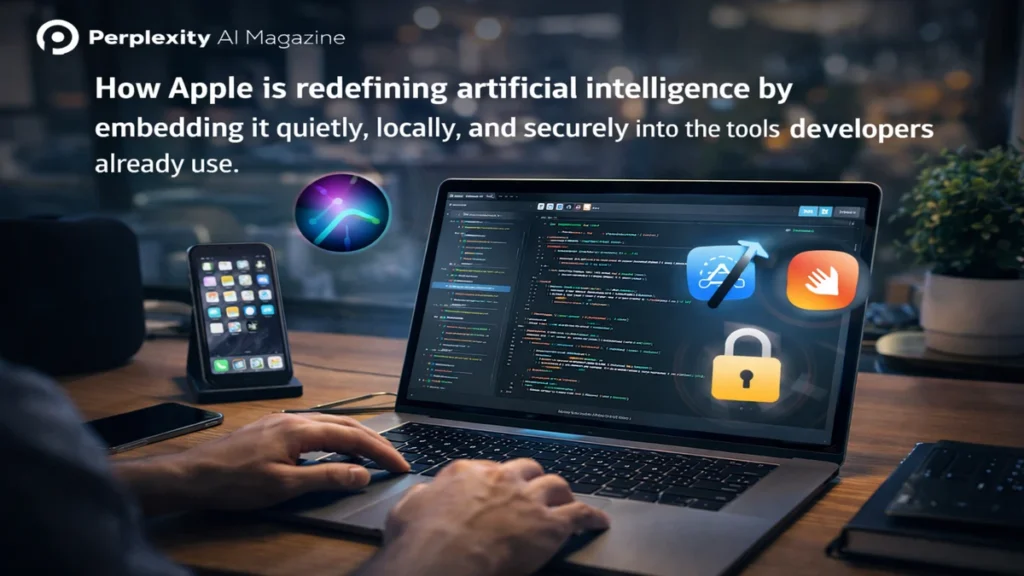
Apple AI news in early 2026 reflects a deliberate, characteristically Apple-shaped turn in the artificial intelligence race. Rather than competing on model size or public-facing chatbots, Apple has focused on something more structural: making AI invisible, embedded, and trustworthy for developers and users alike. The result is a platform-level transformation that reshapes how apps are built, how data is handled, and how intelligence operates across devices.
The centerpiece of this shift traces back to announcements at WWDC 2025, where Apple introduced a broad expansion of developer tools designed to bring AI directly into the software creation process. Xcode 26 integrates AI assistance at the IDE level, enabling contextual code generation, bug fixes, and interface previews without forcing developers into separate tools or workflows. At the same time, Apple opened the door to third-party large language models, including ChatGPT and Claude, while maintaining strong privacy defaults and local execution whenever possible.
For developers, especially those building healthcare, enterprise, robotics, and edge AI applications, the message is clear: Apple wants AI to be useful without being intrusive. On-device processing, opt-in permissions, and strict data minimization are not side features; they are the foundation. This approach aligns with broader trends toward secure AI tooling, agentic workflows, and enterprise-grade governance discussed across the developer ecosystem.
Interest in “apple ai news” has grown alongside these changes, particularly among developers seeking clarity on how Apple’s strategy compares to cloud-first AI platforms. This article examines Apple’s AI direction through its developer tools, privacy architecture, and ecosystem impact, showing how Apple is shaping a distinct, privacy-centric model of AI development as 2026 unfolds.
Apple’s Strategic Approach to AI
Apple’s approach to artificial intelligence has long differed from its competitors, and that divergence became more pronounced entering 2026. Rather than positioning AI as a standalone product, Apple treats it as an enabling layer woven throughout its platforms. The emphasis is on utility, context, and restraint.
At the core of this strategy is the belief that most AI tasks should run locally on Apple Silicon. Advances in custom chips have made it feasible to perform sophisticated inference on-device, reducing latency and keeping personal data out of centralized servers. For Apple, this is both a technical and philosophical stance. By minimizing data movement, the company reduces risk while preserving performance.
This strategy also shapes how Apple communicates AI to users. Features are framed as enhancements—better writing tools, smarter photo organization, more capable Siri—rather than as disruptive replacements. For developers, this translates into APIs and frameworks that expose AI capabilities without forcing radical changes in app architecture.
In a market increasingly dominated by cloud-based AI services, Apple’s insistence on local intelligence positions it as a counterweight. It appeals particularly to developers working in regulated environments, where data sovereignty and compliance are non-negotiable.
Read: AI Developer Tools News 2026: Agentic Coding Takes Over
Xcode 26 and the Evolution of the Developer IDE
Xcode 26 represents one of the most consequential updates to Apple’s developer tooling in years. By embedding AI directly into the IDE, Apple has transformed how developers interact with code, design interfaces, and debug applications.
Contextual code generation is now integrated into everyday workflows. Developers can describe functionality in natural language and receive suggestions that reflect the current project’s structure, conventions, and dependencies. Bug detection and fixes are similarly context-aware, reducing the friction of navigating large codebases. – apple ai news.
Crucially, Xcode 26 supports both Apple’s on-device models and third-party large language models. Basic access to ChatGPT-style assistance does not require separate accounts, lowering the barrier to entry. For more advanced use cases, developers can choose external APIs while still operating within Apple’s permission and privacy framework.
SwiftUI previews benefit significantly from these updates. Interface changes can be generated, tested, and refined with AI assistance, accelerating iteration without breaking established workflows. For teams building complex applications, Xcode 26 functions less like a static editor and more like an intelligent collaborator.
Foundation Models Framework and On-Device LLMs
At the heart of Apple’s AI developer story is the Foundation Models framework. This framework exposes Apple’s on-device large language model to developers with minimal friction. In many cases, integrating generative capabilities requires only a few lines of Swift code.
The framework supports guided generation, tool calling, and multi-turn interactions, all while keeping data local. Developers can define structured outputs using Swift annotations, enabling predictable results suitable for production apps. This structure is particularly valuable in applications like journaling, education, and productivity, where free-form generation must still adhere to constraints. – apple ai news.
The on-device model, optimized for Apple Silicon, is designed to handle everyday generative tasks without relying on cloud inference. For developers, this means lower latency, offline functionality, and reduced compliance overhead.
By providing a first-party framework for local generative AI, Apple lowers the risk associated with third-party integrations while still allowing flexibility. Developers can choose when to stay entirely on-device and when to route tasks through approved external services.
Integration Workflow and Developer Experience
Apple has paired its AI frameworks with improvements across the development workflow. Swift 6.2 introduces enhanced concurrency features that simplify asynchronous AI calls, making it easier to integrate generative functionality into responsive apps.
The App Intents API connects AI outputs directly to system features like Siri and Spotlight, enabling visual intelligence and contextual actions without custom glue code. This tight integration reinforces Apple’s platform-centric approach, where AI capabilities feel native rather than bolted on. – apple ai news.
Xcode Playgrounds further support experimentation, allowing developers to prototype edge AI and generative features quickly. This immediacy is especially valuable for teams exploring new interaction models, such as spatial interfaces or voice-driven workflows.
Together, these tools create a cohesive environment where AI experimentation does not require abandoning established practices. Apple’s goal is not to disrupt developer habits, but to extend them.
Privacy Architecture and Apple Intelligence
Privacy remains the defining pillar of Apple’s AI strategy. Apple Intelligence features are designed to minimize data exposure by default, relying on local processing whenever possible. When tasks exceed on-device capabilities, Apple uses Private Cloud Compute, a system built around end-to-end encryption and ephemeral processing.
Under this model, data sent to Apple’s servers is encrypted, processed, and discarded without being stored. Apple has emphasized transparency and verifiability in this system, positioning it as a safer alternative to traditional cloud AI processing. – apple ai news.
For developers, this architecture imposes clear constraints. Apps leveraging Apple’s AI frameworks must adhere to strict data minimization and consent requirements. User opt-in is mandatory, and sensitive contexts can be excluded from AI processing entirely.
These design choices influence how apps are built. Developers must think carefully about what data is truly necessary, reinforcing privacy-by-design principles across the ecosystem.
Impacts on App Controls and User Trust
Apple’s AI updates introduce new controls that affect both developers and users. AI-powered features require explicit user approval, extending existing permission models to generative capabilities. Writing summaries, image analysis, and content suggestions all operate within these opt-in frameworks.
New system-level controls allow users to lock or hide apps from AI scanning or sharing, providing additional layers of protection in enterprise or personal contexts. These features are particularly relevant for corporate devices and regulated workflows.
When third-party models like ChatGPT are involved, Apple applies safeguards such as IP address obfuscation and restrictions on request storage when routed through system features like Siri. However, developers must still account for external privacy policies when integrating third-party services.
This layered approach enhances trust but also increases responsibility. Developers must clearly communicate how AI features work and what data they use, aligning transparency with functionality.
Enterprise and Regulated Use Cases
Apple’s AI tooling has particular resonance in enterprise and healthcare environments. On-device processing aligns naturally with HIPAA-aligned workflows, reducing the risk associated with transmitting sensitive data.
Apps built for electronic health records, CRM systems, and internal enterprise tools benefit from the ability to perform intelligent tasks locally. Summarization, classification, and contextual assistance can operate without exposing personal information to external servers.
This approach mirrors trends in secure AI developer tools across the industry, where governance and auditability are increasingly integrated into the development process. Apple’s contribution is to make these guarantees part of the platform itself rather than optional add-ons.
For enterprises already invested in Apple hardware, the result is a cohesive stack that spans devices, development tools, and privacy controls.
AR, Spatial Computing, and Edge AI
Apple’s AI strategy extends beyond traditional apps into spatial computing and edge interfaces. Enhancements to ARKit and RealityKit support higher-resolution video, improved LiDAR placement, and simplified spatial app development.
These tools are particularly relevant for Vision Pro and potential industrial or robotic interfaces. Real-time perception, gesture recognition, and spatial awareness rely heavily on edge AI, making local processing essential.
Developers building cobot interfaces or spatial dashboards benefit from Apple’s emphasis on low-latency, on-device intelligence. AI features enhance interaction without introducing network dependencies that could compromise safety or usability.
This convergence of AI, AR, and edge computing reflects Apple’s long-term vision of intelligent interfaces embedded in physical space.
Siri’s Evolution and the “Campos” Project
One of the most closely watched aspects of Apple AI news is the evolution of Siri. Internally referred to as the “Campos” project, efforts are underway to transform Siri into a more conversational, context-aware assistant by late 2026.
For developers, a more capable Siri represents both an interface and an integration point. App Intents and AI-generated actions allow Siri to interact more deeply with applications, bridging voice interaction and functionality.
While Apple has moved cautiously, the trajectory suggests a gradual expansion rather than a sudden overhaul. Siri’s evolution mirrors Apple’s broader AI philosophy: incremental improvements grounded in reliability and privacy.
Expert Perspectives
A veteran Apple platform developer notes that Apple’s AI tools “feel designed to disappear into the workflow, which is exactly what enterprise teams want.” Another industry observer emphasizes that on-device models change the economics of compliance, making advanced features accessible without legal complexity.
A third expert highlights the cultural impact, arguing that Apple’s approach raises expectations for privacy across the industry. By making local inference the default, Apple reframes what responsible AI deployment looks like.
These perspectives underscore that Apple’s influence extends beyond its own ecosystem.
Comparative View of Apple’s AI Tools
| Area | Apple’s Approach | Industry Trend |
|---|---|---|
| Inference | On-device by default | Cloud-first |
| Privacy | Opt-in, minimized data | Varies by provider |
| IDE Integration | Native in Xcode | External plugins |
| Enterprise Fit | Strong | Fragmented |
| Spatial AI | Integrated | Emerging |
Takeaways
- Apple AI in 2026 prioritizes on-device intelligence and privacy by design.
- Xcode 26 embeds AI directly into the developer workflow.
- Foundation Models enable generative features with minimal code.
- Private Cloud Compute handles complex tasks without persistent data storage.
- Enterprise and healthcare apps benefit from reduced compliance risk.
- Apple’s AI strategy emphasizes utility over spectacle.
Conclusion
Apple AI news in 2026 tells a story of restraint and intention. While competitors race to deploy ever-larger models and public-facing chatbots, Apple has focused on building a foundation that integrates intelligence quietly and securely into its platforms. For developers, this translates into powerful tools that respect existing workflows and legal realities.
Xcode 26, Foundation Models, and Private Cloud Compute form a cohesive ecosystem where AI enhances productivity without demanding trust leaps from users or organizations. This balance positions Apple uniquely in the AI landscape, particularly for regulated and enterprise environments.
As AI continues to evolve, Apple’s approach offers an alternative vision—one where intelligence is local, consent-driven, and deeply integrated. Whether this model scales as broadly as cloud-first approaches remains to be seen, but its influence on standards and expectations is already evident.
FAQs
What is new in Apple AI for developers in 2026?
Xcode 26 introduces embedded AI assistance, on-device LLM access, and third-party model support.
Do Apple AI features run in the cloud?
Most run on-device. Complex tasks may use Private Cloud Compute with encrypted, ephemeral processing.
Can developers use ChatGPT in Xcode?
Yes. Xcode 26 supports third-party LLMs alongside Apple’s own models.
Is Apple AI suitable for healthcare apps?
Yes. On-device processing and strict consent controls align well with regulated environments.
How does Apple’s AI strategy differ from others?
Apple emphasizes privacy, local inference, and platform integration over standalone AI services.
