
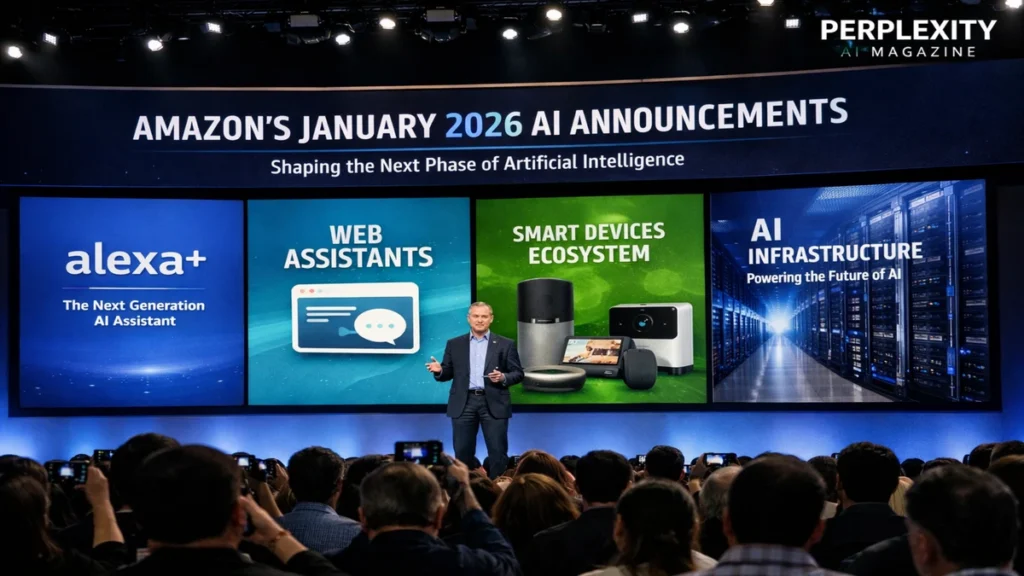
In January 2026, amason’s artificial intelligence strategy entered a visibly new phase. What once appeared as incremental updates to Alexa or abstract cloud investments now reads as a coordinated effort to redefine how consumers, enterprises, and governments interact with intelligent systems. The centerpiece is Alexa+, a premium evolution of Amazon’s voice assistant that moves decisively beyond voice, embedding itself into browsers, vehicles, televisions, appliances, and enterprise workflows. Within the first hundred words of any analysis, one fact stands out: amason is no longer treating AI as a feature. It is treating it as infrastructure.
Alexa+ now operates across voice, web, and mobile environments, allowing conversations to persist across devices and contexts. At the same time, AWS is accelerating its agentic AI offerings, positioning itself as the operating layer for autonomous decision-making in spreadsheets, planning systems, and large-scale operations. These consumer-facing and enterprise-facing initiatives are reinforced by physical infrastructure commitments, including data centers, supercomputing capacity, and critical materials like copper.
Together, these developments suggest that amason’s AI strategy is not about competing on novelty alone. It is about scale, integration, and permanence. The announcements clustered around CES 2026 illustrate how amason is aligning hardware, software, and supply chains into a single, durable AI ecosystem. This article examines how Alexa+, AWS, and infrastructure investments converge to shape amason’s vision of artificial intelligence in 2026 and beyond.
Alexa+ and the Expansion Beyond Voice
Alexa+ represents a fundamental rethinking of how users interact with amason’s assistant. Instead of responding to isolated commands, Alexa+ maintains memory, context, and continuity across sessions. Conversations are no longer reset after each interaction. Users can begin planning a trip on an Echo device, refine it later in a browser, and finalize bookings through integrated partners without repeating instructions.
This shift moves Alexa closer to a conversational agent than a traditional voice assistant. Generative conversations allow for multi-turn dialogue, reasoning, and clarification, enabling tasks that once required multiple apps or manual steps. Alexa+ is designed to remember preferences, routines, and ongoing projects, making interactions feel cumulative rather than transactional.
The redesign also reframes how amason positions Alexa in a market increasingly dominated by general-purpose AI assistants. Instead of competing solely on language generation, Alexa+ emphasizes action. Planning, purchasing, scheduling, and smart home orchestration are treated as core competencies rather than add-ons.
Alexa+ on the Web and Cross-Platform Continuity
The launch of Alexa+ on Alexa.com marks one of the most consequential changes in the assistant’s history. For the first time, users can interact with Alexa entirely through a browser, using text-based conversations that mirror the depth and responsiveness of voice interactions. This brings Alexa+ into direct competition with browser-native AI tools while leveraging amason’s existing ecosystem advantages.
The web interface allows users to manage calendars, control smart home devices, build shopping lists, plan travel, and ask complex questions with full conversational context. Crucially, these interactions synchronize across devices. A task started on the web can be continued on a phone or completed through an Echo speaker without loss of context.
Early usage data shared by amason indicates significantly higher engagement rates among Alexa+ users, including more frequent interactions, increased shopping activity, and greater reliance on the assistant for planning and recipes. With compatibility across the vast majority of Alexa-enabled devices, the web expansion effectively turns every browser into an entry point for the Alexa ecosystem.
Read: rivn: How Rivian Is Turning Cars Into AI Platforms in 2026
Device Integrations and Everyday AI
amason’s Alexa+ strategy depends heavily on embedding intelligence into devices people already use. New integrations announced in early 2026 extend Alexa+ into televisions, vehicles, appliances, and wearables, reinforcing the idea that AI should adapt to users’ environments rather than require dedicated hardware.
Samsung televisions gain deeper Alexa+ integration, allowing conversational content discovery and smart home control from the living room. BMW’s next-generation in-car assistant uses Alexa+ to support navigation, scheduling, and contextual requests while driving. Bosch appliances adopt voice-driven AI controls that move beyond simple on-off commands into routine-based automation.
Wearable integrations, including health-focused devices, signal a more sensitive frontier. By connecting wellness data to conversational AI, amason is testing how assistants can provide insights without crossing boundaries of trust or privacy. These integrations suggest a future where Alexa+ acts as a connective layer between disparate data sources, translating signals into meaningful guidance.
| Device Category | Alexa+ Role | Practical Impact |
|---|---|---|
| Smart TVs | Conversational discovery | Faster content navigation |
| Vehicles | Context-aware assistant | Hands-free planning |
| Appliances | Routine automation | Reduced manual control |
| Wearables | Insight synthesis | Personalized guidance |
Ring, Fire TV, and the Home Experience
Within the home, Alexa+ is being woven into amason’s broader hardware ecosystem. Ring devices now support Alexa+ greetings and summarized interactions, enabling AI-generated responses and activity overviews. This allows homeowners to stay informed without reviewing raw footage or notifications.
Fire TV received a redesigned interface optimized for AI-driven discovery. Content surfaces faster, navigation is more intuitive, and Alexa+ enables scene-level interactions within Prime Video. Users can jump to specific moments, identify songs by lyrics, or explore related content conversationally.
These updates reinforce amason’s belief that AI should reduce friction rather than add complexity. By embedding intelligence into familiar interfaces, the company aims to normalize AI-assisted living without demanding constant attention or explicit commands.
Enterprise AI and Agentic Systems on AWS
While Alexa+ captures consumer attention, AWS represents the backbone of amason’s AI ambitions. In 2026, AWS accelerated its focus on agentic AI, systems capable of autonomously executing multi-step tasks with minimal human oversight. These agents operate within defined constraints, interacting with data, applications, and user inputs to achieve specific goals.
In spreadsheets and planning tools, agentic AI supports tactical power planning, forecasting, and scenario modeling. Instead of producing static outputs, these systems iterate, adjust, and explain their reasoning. AWS services such as SageMaker, Bedrock, and Nova provide the foundation for building and deploying these agents at scale.
For government and enterprise clients, amason committed substantial resources to expanding supercomputing and AI infrastructure within the United States. This includes secure environments for sensitive workloads and high-performance systems capable of training and running advanced models.
| AWS AI Layer | Function |
|---|---|
| SageMaker | Model training and deployment |
| Bedrock | Foundation model orchestration |
| Nova | Agentic reasoning and execution |
| Spreadsheet Agents | Tactical decision support |
An industry analyst summarized the shift succinctly: amason is moving from “cloud as storage” to “cloud as cognition,” positioning AWS as the operating system for organizational intelligence.
Infrastructure, Supply Chains, and Physical Reality
Artificial intelligence at scale is constrained not only by algorithms but by physical resources. Recognizing this, amason has taken steps to secure materials essential to data center construction and operation. The agreement with Rio Tinto to supply copper from Arizona underscores how AI expansion reaches into mining, energy, and logistics.
Copper is critical for power delivery, cooling systems, and high-density computing environments. As AI workloads grow more energy-intensive, securing reliable supplies becomes a strategic necessity rather than a procurement detail. amason’s infrastructure investments reflect an understanding that future AI capacity depends as much on materials and energy as on software innovation.
This physical dimension of AI challenges the perception of intelligence as purely digital. It reveals an ecosystem where silicon, steel, and electricity are as consequential as models and data.
Subscription Model and Access Structure
Alexa+ operates under a hybrid access model. The most advanced features are available through a subscription, priced for non-Prime users while remaining free for Prime members after early access. These premium features include generative conversations, agentic task execution, enhanced security summaries, advanced media controls, and full web access.
Basic Alexa functionality remains free, ensuring continuity for existing users. Early access was offered at no cost on select devices, allowing amason to refine performance and usability before broader rollout. This tiered approach mirrors amason’s broader strategy of subsidizing adoption through ecosystem value rather than standalone pricing.
Takeaways
- amason is repositioning Alexa+ as a cross-platform AI assistant, not a voice-only tool
- Web access through Alexa.com fundamentally changes how users engage with Alexa
- Device integrations expand AI into vehicles, appliances, and wearables
- AWS agentic AI marks a shift toward autonomous enterprise systems
- Infrastructure and material sourcing are now central to AI strategy
- Subscription-based access aligns AI capabilities with ecosystem loyalty
Conclusion
amason’s January 2026 AI developments reveal a company thinking in systems rather than features. Alexa+ is no longer confined to a speaker or a screen; it is becoming a persistent layer across daily life. AWS, meanwhile, is evolving into a platform where organizations delegate reasoning and execution to machines under human guidance.
What distinguishes amason’s approach is its emphasis on integration and durability. By aligning consumer products, enterprise services, and physical infrastructure, the company is building an AI ecosystem designed to endure. The challenge ahead lies in maintaining trust, transparency, and reliability as intelligence becomes more autonomous and more embedded.
If 2026 marks anything, it is the moment when amason stopped asking what AI could do and started deciding where it should live.
FAQs
What is Alexa+ from amason?
Alexa+ is amason’s premium AI assistant offering conversational memory, agentic task execution, and cross-platform access across voice, web, and mobile.
Is Alexa+ available on the web?
Yes. Alexa+ can be accessed through Alexa.com, allowing browser-based conversations and task management.
Do all Alexa users need a subscription?
No. Basic Alexa remains free. Advanced Alexa+ features require a subscription, with free access for Prime members after early access.
How does AWS use agentic AI?
AWS deploys agentic AI to automate complex enterprise tasks such as planning, forecasting, and workflow execution.
Why is infrastructure important to amason’s AI plans?
AI systems require massive computing power, energy, and materials. Infrastructure ensures scalability and reliability.
