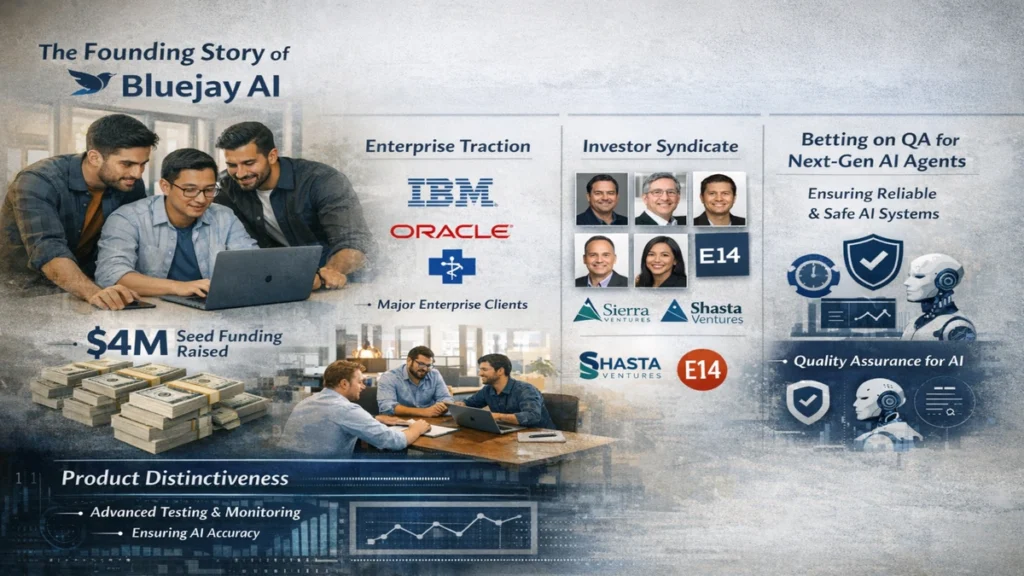
I first noticed Bluejay AI not because of a flashy model launch, but because of a quiet shift in what venture capital was beginning to reward. Two 23-year-old engineers leaving Amazon and Microsoft to build infrastructure for testing AI agents felt less like a startup story and more like a signal that artificial intelligence had crossed into a new phase. Bluejay was not trying to make AI smarter. It was trying to make AI reliable. That distinction, subtle as it sounds, is what attracted Floodgate, Y Combinator, Peak XV, Homebrew, and a group of experienced AI operators to back the company with a $4 million seed round in August 2025. – ai startup bluejay funding.
In the first few weeks after its Y Combinator demo day, Bluejay reached six-figure revenue weeks, a pace that is unusual for infrastructure startups and telling about how urgent the problem is becoming. Enterprises are increasingly deploying voice and text agents in customer service, healthcare, finance, and internal operations, and they are discovering that failures are not theoretical. Accents break speech recognition. Edge cases cause hallucinations. Tone shifts create compliance risks. What used to be a research problem has become a business risk.
Bluejay positions itself as a “trust layer” for AI agents, using synthetic customer simulations to recreate thousands of real-world interactions across languages, accents, noise conditions, and emotional states. The company claims it can simulate a month’s worth of customer conversations in minutes, allowing teams to find failure modes before they reach users. This article examines how that idea became a venture-backed company, why its investor syndicate matters, what differentiates its product, and what its early success reveals about where enterprise AI is heading.
Founding Story and Early Traction
Bluejay was founded in San Francisco in 2025 by Rohan Vasishth and Faraz Siddiqi, both 23, after they left engineering roles at Amazon and Microsoft. Their motivation was not dissatisfaction with large companies, but frustration with how difficult it was to test AI systems in realistic conditions. Traditional QA workflows rely on scripted tests and limited datasets, which fail to capture the unpredictability of human conversation.
During Y Combinator’s Spring 2025 batch, the founders reframed QA as a simulation problem. Instead of manually writing tests, Bluejay’s system generates synthetic users who behave like real customers, complete with linguistic variation, emotional shifts, interruptions, and ambiguity. This allowed the team to compress weeks of testing into minutes, giving engineers rapid feedback on how their agents behave in production-like conditions. – ai startup bluejay funding.
That framing resonated quickly with customers. Within weeks of launch, Bluejay began reporting six-figure revenue weeks from a mix of Fortune 500 companies and startups building voice AI. The speed of this traction suggests that reliability has become a bottleneck in enterprise AI adoption. Companies are willing to pay not just for intelligence, but for confidence that intelligence will behave consistently.
The $4 Million Seed Round
Bluejay closed its $4 million seed round in August 2025. The round was led by Floodgate, an early-stage venture firm known for backing companies that create new categories rather than incremental improvements. Y Combinator participated as a strategic investor following Bluejay’s inclusion in the X25 batch, alongside Peak XV and Homebrew. A group of angels from the AI ecosystem, including executives from Hippocratic AI, Deepgram, and PathAI, filled out the syndicate.
While individual check sizes were not disclosed, industry norms suggest the lead investor typically commits 30 to 50 percent of the round, with the remainder split among strategic funds and angels. More important than the exact allocation is what the composition of the round signals. The mix of generalist VCs and domain-specific operators suggests that Bluejay’s value is both market-level and technical. It is seen not just as a company, but as a missing layer in the AI stack.
Estimated Round Structure
| Investor | Role | Estimated Contribution |
|---|---|---|
| Floodgate | Lead | $1.5M–$2M |
| Y Combinator | Strategic | ~$500K |
| Peak XV | Strategic | $500K–$1M |
| Homebrew | Strategic | $300K–$500K |
| Angels | Fill | Balance |
The capital is being used to expand engineering, build enterprise-grade tooling for regulated industries like healthcare and fintech, and integrate across multiple model providers so customers can test agents regardless of which underlying AI they use.
Product Differentiation
Bluejay’s core technology is a simulation engine for conversational systems. Instead of testing an AI agent with a few scripted prompts, teams can run thousands of synthetic conversations that vary in language, accent, sentiment, noise, and intent. The system measures where the agent fails, degrades, or behaves unexpectedly, turning qualitative impressions into quantitative metrics. – ai startup bluejay funding.
This approach differs from observability tools that focus on monitoring models in production. Bluejay focuses on pre-deployment reliability. It is less about watching what happened and more about preventing what might happen. That distinction places it closer to traditional software testing platforms, but adapted to the probabilistic nature of AI.
Traditional QA vs Bluejay
| Dimension | Traditional QA | Bluejay |
|---|---|---|
| Scenario Diversity | Low | High |
| Speed | Slow | Fast |
| Manual Effort | High | Low |
| Predictive Power | Limited | Strong |
By making failure visible before launch, Bluejay reduces risk, shortens release cycles, and gives enterprises a way to treat AI systems with the same rigor they apply to financial or security infrastructure.
Market Context and Competition
Bluejay operates in a broader shift toward AI reliability and governance. As conversational agents become customer-facing, errors become reputational, legal, and financial risks. This has created a growing market for tools that monitor, test, and validate AI systems. Competitors focus on model monitoring, performance dashboards, or bias detection. Bluejay’s niche is synthetic scenario generation, which addresses a gap upstream of deployment.
The founders describe this space as a trust layer for AI. Without it, enterprises are forced to choose between speed and safety. With it, they can move faster with less risk. This framing resonates in industries where compliance and reliability are non-negotiable, such as healthcare, finance, and insurance. – ai startup bluejay funding.
Expert Perspectives
“AI reliability is becoming as important as AI capability,” says an infrastructure architect at a large enterprise software firm.
“Simulation-based testing is how we learned to trust airplanes and financial systems. Applying that logic to AI makes sense,” notes a researcher in human-computer interaction.
“Bluejay’s approach treats AI agents like complex systems, not magic boxes, and that’s exactly the mindset enterprises need,” says a product leader at a Fortune 500 company.
Takeaways
- Bluejay focuses on reliability, not model intelligence.
- The founders left Big Tech to address a systemic gap in AI testing.
- A $4 million seed round led by Floodgate signals category-level ambition.
- Synthetic simulations replace slow, manual QA processes.
- Early six-figure revenue weeks indicate strong market demand.
- AI quality assurance is emerging as a core enterprise infrastructure layer.
Conclusion
Bluejay’s rise reflects a maturation of the AI industry. As models become more powerful, the limiting factor is no longer what AI can do, but how safely and predictably it can do it. Bluejay’s bet is that reliability will become as valuable as intelligence, and that companies will invest accordingly.
The startup’s early traction and investor support suggest that this bet is well placed. In a world where AI agents increasingly speak, decide, and act on behalf of organizations, trust is not an abstract value. It is a technical requirement. Bluejay’s platform turns that requirement into something measurable, testable, and improvable.
If the last decade was about making machines intelligent, the next may be about making them dependable. Bluejay’s story sits at that inflection point.
FAQs
What does Bluejay AI do?
It provides automated testing for AI voice and text agents using synthetic customer simulations.
Who founded Bluejay?
Rohan Vasishth and Faraz Siddiqi, former engineers from Amazon and Microsoft.
How much funding did Bluejay raise?
$4 million in a seed round closed in August 2025.
Who invested in Bluejay?
Floodgate led the round, with Y Combinator, Peak XV, Homebrew, and AI industry angels participating.
Why is AI testing important?
Because AI systems interact unpredictably with users, making reliability and safety essential for enterprise adoption.