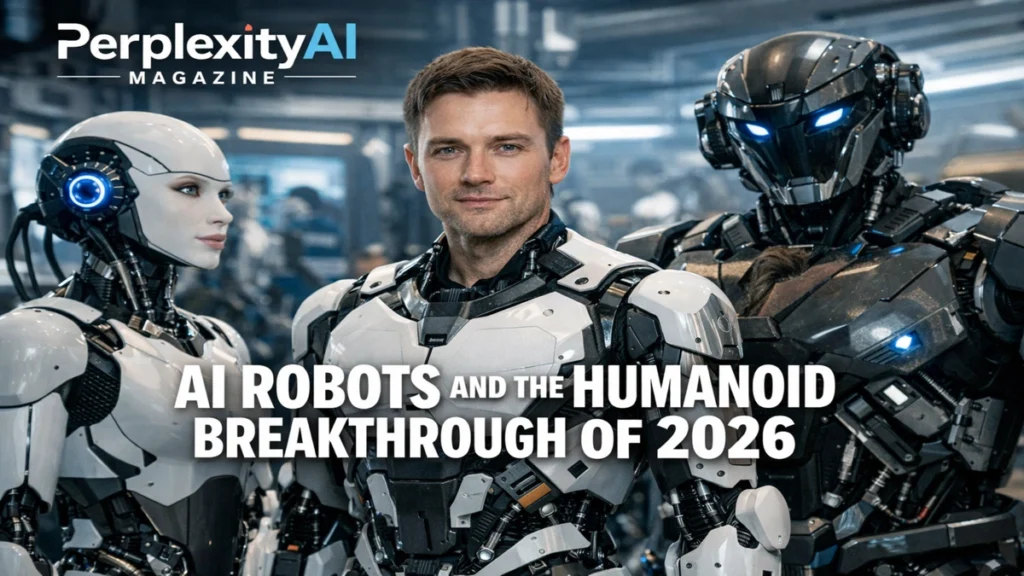
i used to think of humanoid robots as technological theater. They appeared at conferences, performed carefully scripted movements, then disappeared back into labs. That assumption no longer holds. By early 2026, AI robots, especially humanoid models, are transitioning into limited but real commercial deployment. This shift is not driven by novelty. It is driven by labor economics, advances in physical AI, and the convergence of machine learning with manufacturing scale.
Within the first hundred words, the intent is straightforward. AI robots are reaching a point where autonomy, dexterity, and cost intersect. Breakthroughs in agentic AI allow machines to make decisions in unstructured environments. Generative AI enables robots to learn tasks in simulation rather than through years of manual programming. Physical AI lets them move through human spaces without redesigning the world around them.
The scale of investment reflects this change. According to the International Federation of Robotics, global industrial robot installations reached a record market value of approximately 16.7 billion dollars, with AI increasingly embedded into logistics, maintenance, and quality control. China, facing demographic pressure and labor shortages, leads deployments. Europe and the United States follow, driven by reshoring and productivity concerns.
i approach this story not as futurism, but as industrial reporting. Humanoid robots are not replacing entire workforces. They are filling gaps where repetition, risk, and labor scarcity converge. The question is no longer whether they will be deployed, but how quickly societies adapt to their presence.
From Industrial Arms to Physical Intelligence
i find it useful to separate traditional robotics from what is now emerging. Industrial robots have existed for decades. They are precise, fast, and blind to anything outside predefined conditions. The new generation of AI robots is different. They perceive, reason, and adapt.
Physical AI represents the fusion of perception, control, and learning. Instead of programming every motion, engineers train policies that generalize across tasks. Vision, tactile sensing, and proprioception feed unified neural networks. This allows robots to adjust grip strength, recover balance, and navigate cluttered spaces.
A senior researcher at MIT’s Computer Science and Artificial Intelligence Laboratory described this shift as moving from automation to embodiment. The robot no longer executes instructions. It interprets intent. That distinction matters in factories, warehouses, and eventually homes.
Agentic AI builds on this foundation. These systems plan sequences of actions toward goals rather than reacting step by step. A humanoid tasked with clearing a workstation decides what to pick up first, where to place items, and how to recover from mistakes.- ai robots.
This capability marks a qualitative leap. It reduces the cost of deployment because environments require fewer constraints. Instead of redesigning factories for robots, robots adapt to factories.
Read: SailPoint Technologies and the Future of Identity Governance
Economic Pressure and the Labor Gap
i rarely see technology advance without economic pressure behind it. Humanoid robots are no exception. Aging populations, declining birth rates, and physically demanding jobs create labor shortages across manufacturing, logistics, and sanitation.
China illustrates this dynamic most clearly. Municipal deployments of humanoid and semi humanoid robots in sanitation and inspection roles exceed 200 units in pilot programs, according to Chinese state media and local government disclosures. These robots perform night shifts, hazardous cleaning, and repetitive transport tasks.
In Europe, manufacturers face similar constraints. Automotive plants struggle to staff night and weekend shifts. Service roles experience high turnover. Robots that can lift, carry, and manipulate without extensive retooling offer a partial solution.
An economist at the London School of Economics noted in 2024 that automation driven by labor scarcity differs fundamentally from automation driven by cost cutting. In scarcity driven contexts, adoption tends to be faster and socially tolerated because alternatives are limited.
This explains why humanoid robots target narrow tasks first. They do not need to outperform humans broadly. They only need to be reliable where humans are unavailable or unwilling.
Major Trends Shaping 2026 Deployment
i see three technical trends converging as humanoid robots approach commercial viability.
Agentic AI enables independent decision making in unstructured environments. Robots no longer rely on teleoperation or rigid scripts. They plan and adapt.
Generative AI changes how robots learn. Instead of programming tasks explicitly, developers simulate thousands of scenarios. Policies trained in virtual environments transfer to physical robots, reducing training time and cost.
Physical AI grounds intelligence in the body. Balance, dexterity, and spatial awareness emerge from end to end training rather than handcrafted control loops.
These trends align with hardware improvements. Actuators become lighter and more energy efficient. Batteries extend operational time to eight or more hours. Sensors provide richer feedback.
The result is not general intelligence, but functional competence. Robots can perform sequences of tasks without constant supervision. That threshold matters more than human likeness.
Leading Humanoid Robots in 2026
The current field is small but competitive. A handful of companies dominate attention due to funding, talent, and manufacturing access.
| Robot | Developer | Key 2026 Milestones |
|---|---|---|
| Optimus Gen 3 | Tesla | Factory autonomy trials, advanced dexterity, internal production |
| Figure 02 | Figure AI | BMW factory pilots, enterprise scaling |
| Atlas | Boston Dynamics | Enhanced balance and manipulation demos |
| Unitree G2 | Unitree | High speed locomotion, autonomous navigation |
| H1 and G1 | Unitree and AgileX | Commercial rollout for sanitation and industry |
Each platform emphasizes different strengths. Tesla focuses on manufacturing scale and AI reuse. Figure prioritizes full body autonomy. Boston Dynamics remains the benchmark for dynamic movement. Chinese firms emphasize cost and deployment speed.
Tesla Optimus Gen 3 and the Manufacturing Thesis
i consider Tesla Optimus Gen 3 the most controversial humanoid project. Skepticism follows Tesla closely, yet its manufacturing capability cannot be ignored.
Optimus Gen 3 is expected to be unveiled in the first quarter of 2026, with low volume internal production beginning mid year. Elon Musk has stated publicly that Tesla aims for high volume production capacity approaching one million units annually by late 2026, though analysts view that figure as aspirational.
The robot features hands with over twenty two degrees of freedom, enabling complex manipulation. Running speeds reportedly reach around five miles per hour with a natural gait. Autonomy is driven by Tesla’s Full Self Driving stack adapted for humanoid perception. – ai robots.
Tesla claims over three thousand learned skills derived from video imitation and neural simulation. Integration with its Grok language model enables natural language interaction.
An AI robotics analyst at Morgan Stanley wrote in 2025 that Tesla’s advantage lies not in robotics novelty but in supply chain control. If costs reach the projected ten to thirty thousand dollar range, market dynamics change rapidly.
Figure AI and the Helix 02 Breakthrough
i find Figure AI’s progress quieter but technically striking. In January 2026, the company announced Helix 02, a unified visuomotor model enabling full sequence autonomy.
In demonstrations, a Figure robot unloaded and reloaded a dishwasher in a real kitchen without resets or human input. The task involved over sixty coordinated actions including walking, bending, grasping, and placement.
Figure 03 hardware, launched in late 2025, introduced tactile fingertip sensors, palm cameras, and soft exteriors designed for human environments. Demos showed bimanual coordination and delicate tasks such as pill extraction and syringe handling.
An unusual innovation is inductive charging through the robot’s feet. Instead of plugging in, the robot steps onto a charging platform, reducing downtime and wear.
Figure’s BotQ factory targets twelve thousand units annually initially, with plans to scale to one hundred thousand. BMW factory pilots suggest early enterprise validation.
A robotics professor at Stanford described Figure’s approach as system level elegance rather than brute force. Integration, not spectacle, defines its progress.
Boston Dynamics Atlas and the Benchmark Effect
i cannot discuss humanoid robots without addressing Boston Dynamics Atlas. Atlas is not the most commercial platform, but it sets expectations.
At CES 2026, Boston Dynamics demonstrated an electrically powered Atlas performing real world tasks involving balance recovery, object manipulation, and dynamic movement. The company emphasizes safety, control, and robustness over speed to market.
Atlas benefits from decades of research into locomotion and control. Its influence extends beyond sales. Competing teams benchmark against Atlas performance even when pursuing different markets.
Boston Dynamics executives have consistently framed Atlas as a research platform rather than a product. That may change, but its role as a technical reference point remains critical.
China’s Acceleration and Cost Advantage
i observe China’s humanoid robotics push as pragmatic and fast. Companies like Unitree and AgileX focus on deployable systems rather than perfection.
Unitree’s G2 emphasizes running and jumping speed. The H1 and G1 series target industrial and sanitation tasks with pricing reported between sixteen thousand and eighty thousand dollars depending on configuration.
Municipal deployments prioritize reliability and replaceability over finesse. Robots clean streets, inspect infrastructure, and patrol facilities.
Government support accelerates iteration. Pilots expand quickly when results meet expectations. This environment favors rapid learning cycles.
An analyst at the Center for Strategic and International Studies noted in 2025 that China’s robotics strategy mirrors its electric vehicle playbook. Scale first, refinement later.
Safety, Regulation, and Human Trust
i believe regulation will shape humanoid adoption as much as technology. Robots operating in human spaces raise safety, liability, and labor questions.
Current deployments rely on geofencing, speed limits, and emergency stops. Standards bodies such as ISO continue to update safety frameworks for collaborative robots.
Public trust depends on transparency. When robots fail, accountability must be clear. Manufacturers, operators, and regulators share responsibility.
A European Union policy paper from 2024 emphasized the need for certification regimes covering physical AI systems. Unlike software, embodied systems can cause direct harm.
These constraints slow deployment, but also legitimize it. Without standards, adoption stalls.
Expert Perspectives on the Humanoid Moment
“Embodied intelligence is the next frontier of AI deployment,” said Rodney Brooks, cofounder of iRobot and former director of MIT CSAIL, in a 2024 interview. “The challenge is not intelligence alone, but robustness in the real world.”
Agnieszka Slawinska, an automation economist at the OECD, noted that humanoid robots address demographic decline rather than unemployment. “In many regions, there are simply not enough workers willing to perform certain jobs.”
NVIDIA CEO Jensen Huang stated during GTC 2025 that physical AI will be the largest application of AI this decade, surpassing purely digital agents in economic impact.
These perspectives converge on one point. Humanoid robots are not science fiction. They are infrastructure.
Takeaways
- Humanoid robots are moving from demos to limited commercial deployment by 2026.
- Agentic AI, generative learning, and physical intelligence drive this shift.
- Labor shortages accelerate adoption more than cost savings alone.
- Tesla, Figure AI, Boston Dynamics, and Chinese firms lead distinct strategies.
- Safety standards and regulation shape trust and scalability.
- The near term focus is narrow tasks, not general purpose labor.
Conclusion
i view the current moment as a threshold rather than a revolution. Humanoid robots are not about replacing humans wholesale. They are about filling structural gaps created by demographic change and industrial complexity.
What makes 2026 different is not intelligence alone. It is the alignment of autonomy, hardware reliability, and economic justification. Robots can now operate long enough, safely enough, and cheaply enough to matter.
The transition will be uneven. Factories will adopt before homes. Sanitation and logistics will move faster than caregiving. Public perception will oscillate between fascination and anxiety.
Yet history suggests that once a technology crosses from possibility to utility, retreat is unlikely. Humanoid robots are crossing that line quietly, one task at a time.
The question for society is not whether to stop them, but how to integrate them with dignity, safety, and purpose.
FAQs
What are AI humanoid robots
They are robots with human like form factors that use artificial intelligence to perceive, decide, and act in real world environments.
Why is 2026 important for humanoid robots
Several platforms reach commercial readiness due to advances in autonomy, dexterity, and manufacturing scale.
Will humanoid robots replace human jobs
They primarily target labor shortages and hazardous tasks rather than broad workforce replacement.
Which companies lead humanoid robotics
Tesla, Figure AI, Boston Dynamics, and Chinese manufacturers like Unitree are key players.
Are humanoid robots safe
Safety depends on regulation, design, and deployment. Standards continue to evolve alongside adoption.