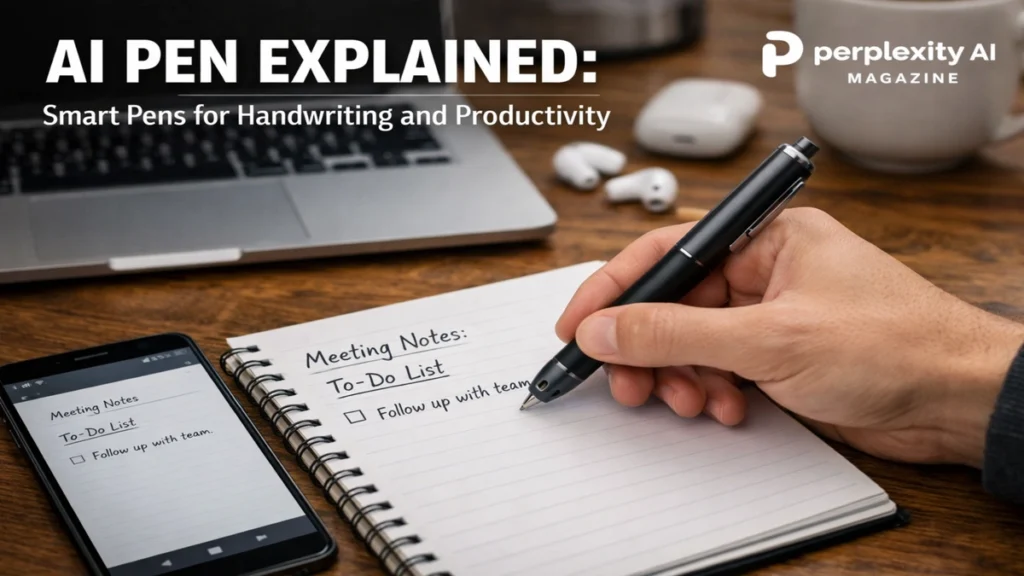
I have always found it revealing that, even as laptops and tablets dominate offices and classrooms, people continue to reach for pens. The search interest around the term “ai pen” reflects that tension. Readers want to know what an AI pen actually is, whether it works reliably, and if it can truly replace typing without forcing them back into another glowing screen. Within the first hundred words, the intent is practical rather than futuristic: can a smart pen digitize handwriting, save time, and improve productivity without changing how people naturally think and write.
AI pens are not tablets disguised as stationery. They are writing instruments that look and feel like traditional pens but capture handwriting digitally and enhance it with artificial intelligence. Most models sync notes to apps, convert handwriting into editable text, and organize pages automatically. Newer versions add microphones, translation, reminders, and conversational AI features. The promise is subtle but powerful: write the way you always have, and let AI handle everything that happens afterward.
This article examines how ai pen work, why they are gaining attention now, and which models stand out. It explores Livescribe, Neo, One AI Smart Pen, XNote, and newer entrants like Nuwa, explaining their strengths, tradeoffs, and real-world use cases. Rather than treating AI pens as novelty gadgets, I look at them as a response to screen fatigue and the enduring cognitive value of handwriting in a digital age.
Why Handwriting Still Matters in a Digital World
Handwriting has survived every wave of digital productivity tools, and I believe that endurance explains the renewed interest in AI pens. Research over the past decade has shown that writing by hand improves memory retention, comprehension, and creative thinking compared with typing. People process ideas differently when the hand moves freely across a page.
AI pens attempt to preserve those benefits while removing the friction that comes afterward. Traditionally, handwritten notes are difficult to search, share, or organize. AI fills that gap. By capturing strokes in real time and applying optical character recognition and language models, ai pen translate analog thinking into digital structure.
This combination appeals to students, journalists, researchers, and professionals who think best on paper but work in digital ecosystems. Rather than forcing users to adapt to screens, AI pens adapt technology to existing habits.
Read: why choose ziptie ai search performance tool for AI SEO
How ai pen Work Behind the Scenes
At a technical level, AI pens rely on sensors, cameras, or specialized paper to track movement. Some models record audio simultaneously, linking spoken context to written notes. Once data is captured, companion apps process handwriting using machine learning trained on diverse writing styles.
More advanced AI layers clean up text, add punctuation, correct spelling, and sometimes summarize content. In pens with microphones, speech recognition converts spoken words into text, while translation models allow real-time language conversion.
What stands out to me is that most processing happens after writing, not during. The pen remains responsive and natural, while AI works quietly in the background. This design choice distinguishes AI pens from tablets, which demand constant attention and interaction.
Livescribe and the Appeal of Natural Writing
Livescribe has long been associated with digital pens, and its AI-enhanced models build on that legacy. Livescribe pens write with real ink on paper, preserving the familiar feel many users prefer. Notes sync to mobile devices via Bluetooth, where AI transcription converts handwriting into searchable text.
Livescribe’s strength lies in accuracy. Its transcription engine handles messy handwriting surprisingly well and automatically adds punctuation and formatting. Audio recording can be linked to specific notes, allowing users to tap a word and replay what was said at that moment.
For everyday note-taking, Livescribe’s reliability stands out. I see it as the option for people who want AI assistance without changing their workflow.
The One AI Smart Pen and Voice-First Features
The One AI Smart Pen gained attention through a successful Kickstarter campaign, reflecting demand for more ambitious features at a lower price point. Unlike Livescribe, it integrates a microphone directly into the pen, enabling voice dictation, translation across more than fifty languages, and reminders.
This pen targets meetings, lectures, and interviews where spoken context matters as much as written notes. Bluetooth syncing connects it to smartphones, while onboard storage allows offline recording. Battery life of roughly thirty hours supports extended use.
Kickstarter backers were drawn to its promise of combining handwriting with conversational AI. While delivery timelines extend into late 2025, the campaign’s success suggests growing appetite for pens that listen as well as write.
Neo Smartpen and Structured Academic Use
Neo Smartpen takes a different approach by using dotted paper that allows precise stroke capture. This requirement limits flexibility but increases accuracy. Neo pens support multi-language transcription and offer editing features such as highlighting, copying, and rotating text within the app.
Students and researchers benefit from Neo’s structured organization. Notes can be searched across devices, tagged by subject, and exported to platforms like Notion or GoodNotes. I see Neo as appealing to people willing to adapt to specific notebooks in exchange for powerful organization.
The tradeoff is dependency on special paper, which some users find restrictive. Still, for academic and professional environments, the precision is often worth it.
XNote and Minimalist Digitization
XNote positions itself as a lightweight solution focused on instant digitization and organization. Rather than emphasizing advanced AI features like translation or summaries, it concentrates on capturing handwriting quickly and making it searchable.
This approach suits users who want digital backup without complexity. Notes sync to an app where they can be categorized and retrieved later. I view XNote as a bridge product for people curious about ai pen but wary of feature overload.
Nuwa Pen and Camera-Based Innovation
Nuwa Pen represents a newer design philosophy. Instead of relying on special paper, it uses embedded cameras and sensors to capture writing on almost any surface. AI processing interprets strokes and context, supporting multilingual transcription and quick note capture.
For mobile professionals, this flexibility is appealing. Writing on hotel notepads or scrap paper no longer limits digitization. Battery life and accuracy vary depending on conditions, but the concept signals where AI pens may be headed.
Comparing Leading AI Pens
| Pen | Standout AI Feature | Paper Requirement | Battery Life | Price Range | Best For |
|---|---|---|---|---|---|
| Livescribe Symphony AI | High-accuracy transcription | Standard paper | Full day | $150–250 | Meetings, lectures |
| One AI Smart Pen | Translation, voice AI | Any paper | ~30 hours | ~$50–65 | Interviews, travel |
| Neo Smartpen Dimo | Multi-language OCR | Dotted paper | Long | $100–200 | Students |
| XNote AI Pen | Fast organization | Any paper | Varies | N/A | Idea capture |
| Nuwa Pen Pro | Camera-based capture | Any surface | Moderate | $80–150 | Mobile professionals |
Productivity Without Screens
What draws many users to AI pens is screen fatigue. I notice a growing desire to reduce device switching and notifications. Writing with a pen offers focus, while AI handles organization later.
ai pen fit into this cultural moment. They acknowledge that productivity is not just about speed, but about mental space. By removing the need to type or format in real time, they allow ideas to flow uninterrupted.
Expert Perspectives on ai pen
“Handwriting engages the brain differently than typing,” said Dr. Virginia Berninger, an educational psychologist known for her research on writing and cognition. “Tools that preserve handwriting while adding digital benefits can support learning.”
According to product designer Don Norman, “The best technology disappears. AI pens succeed when users forget the tech and focus on thinking.”
Technology analyst Ben Thompson has noted that “Hybrid devices often win not by replacing habits, but by enhancing them.”
These views reinforce why AI pens resonate with users who value both analog and digital strengths.
Use Cases Across Professions
Students use AI pens to capture lectures and review searchable notes. Journalists rely on audio-linked handwriting for interviews. Designers sketch ideas freely, then organize them digitally. Business professionals document meetings without laptops.
Across these use cases, the common thread is flexibility. ai pen do not demand new behaviors. They augment existing ones.
Limitations and Tradeoffs
AI pens are not without drawbacks. Accuracy varies with handwriting quality. Some models require special paper. Companion apps may lock users into ecosystems. Voice features raise privacy considerations.
Battery life and syncing reliability also matter. These devices work best when supported by well-designed software. Choosing the right pen depends on priorities rather than hype.
Takeaways
- AI pens digitize handwriting without screens
- Livescribe leads in reliability and transcription accuracy
- One AI Smart Pen emphasizes voice and translation
- Neo excels in structured academic workflows
- Nuwa shows the future of paper-agnostic capture
- AI pens suit users who value focus and flexibility
Conclusion
I see AI pens as quiet technology. They do not announce themselves with bright displays or constant updates. Instead, they sit in the hand, doing what pens have always done, while AI works in the background. That restraint is their strength.
As artificial intelligence becomes more pervasive, tools that respect human habits may matter more than those that demand change. AI pens suggest that progress does not always mean replacing the old. Sometimes it means listening to why people still hold on to it.
In classrooms, offices, and creative spaces, AI pens offer a compromise between analog thinking and digital efficiency. Their future depends not on novelty, but on how seamlessly they fit into daily life.
FAQs
What is an AI pen?
An AI pen is a smart writing device that digitizes handwriting and enhances it with transcription, organization, and sometimes voice features.
Do AI pens require special paper?
Some do, like Neo Smartpen, while others work on standard paper.
Are AI pens better than tablets?
They suit users who prefer handwriting and want fewer screens.
Can AI pens translate languages?
Certain models, such as the One AI Smart Pen, offer real-time translation.
Who benefits most from AI pens?
Students, professionals, and creatives who take handwritten notes regularly.