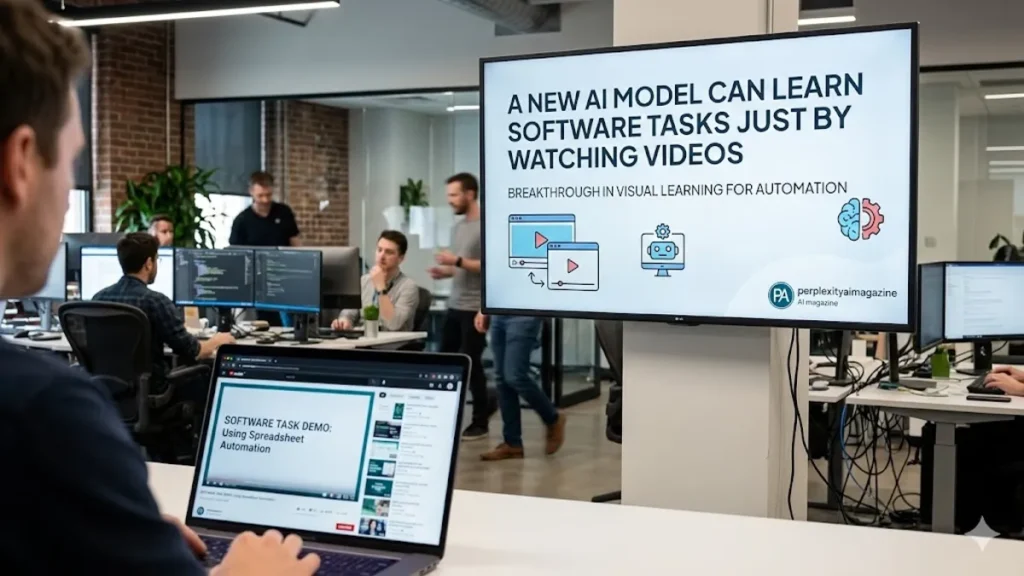
A new artificial intelligence model can now learn how to perform software tasks simply by watching videos. I find this development both startling and strangely intuitive. Humans have long learned by observing others navigate spreadsheets, edit videos or debug code. Now, researchers at Google have introduced a framework called Watch & Learn, or W&L, that enables AI systems to do much the same. By analyzing tutorial videos from platforms such as YouTube, the model converts human demonstrations into structured action sequences, allowing AI agents to replicate complex digital workflows. – AI learns software tasks from videos.
The system works by transforming raw screen recordings into executable user interface trajectories. An inverse dynamics model trained on more than 630,000 web interaction transitions predicts actions such as clicks, scrolling and typing by comparing consecutive screen states. It achieves 91.6 percent action accuracy on benchmark tests, outperforming earlier baselines. The implications stretch far beyond novelty. If machines can learn software the way humans do, then training data no longer needs to be manually annotated at scale. Instead, the internet’s vast archive of tutorials becomes an open classroom for digital agents.
The rise of observation-driven AI reflects a broader shift in machine learning. Rather than relying solely on labeled datasets or reinforcement signals, models increasingly extract structure from natural demonstrations. Watch & Learn situates itself within this evolution, suggesting that the future of computer-use agents may depend less on curated datasets and more on passive observation of how people already work.
How Watch & Learn Works
Watch & Learn converts video demonstrations into machine-readable action sequences using a vision-only approach. I was struck by the elegance of its architecture. Instead of relying on structured interface trees or developer-provided metadata, the model examines consecutive frames of a screen recording and predicts the user’s likely action between them. The inverse dynamics model, trained on more than 630,000 state transitions from web interaction datasets such as Mind2Web, maps visual change to discrete commands like click(x,y), scroll or type(text).
This approach allows the system to generalize across software environments without direct integration. It processes tutorials across 69 applications spanning programming, productivity, design and system utilities. Approximately 53,000 task trajectories are labeled automatically, reducing the need for manual annotation. As AI researcher Fei-Fei Li has noted, “Vision is the dominant sense for humans and AI alike,” emphasizing the centrality of visual reasoning in intelligent systems. Watch & Learn operationalizes that principle within the desktop environment.
The framework’s ability to derive structured action sequences from unstructured videos marks a step toward scalable digital apprenticeship. – AI learns software tasks from videos
Read: Vibe Coding Plane & Satellite Tracking Revolution
Performance Gains in Real-World Benchmarks
Performance metrics reveal meaningful improvements. On OSWorld, a benchmark consisting of 466 real-desktop tasks across Ubuntu, Windows and macOS, agents augmented with Watch & Learn trajectories outperform their base configurations.
| Model | Base Success Rate | With W&L | Improvement |
|---|---|---|---|
| Gemini 2.5 Flash (ICL) | 19.0% | 22.0% | +3.0% |
| OpenAI o3 (ICL) | 21.8% | 24.3% | +2.5% |
| Jedi Framework (ICL) | 50.6% | 52.8% | +2.2% |
| Qwen 2.5-VL 7B (SFT) | 1.9% | 13.0% | +11.1% |
| UI-TARS-7B (SFT) | 27.3% | 31.1% | +3.8% |
The gains stem from high-quality action labels that provide planning priors and domain familiarity. In programming environments such as VS Code or PyCharm, improvements are particularly notable. According to Andrew Ng, founder of DeepLearning.AI, “Data-centric AI is the key to building reliable systems.” Watch & Learn exemplifies that philosophy by transforming abundant tutorial content into structured training signals.
The performance boost is not uniform, however. Complex multi-step workflows remain challenging, especially when exceeding 15 sequential actions. – AI learns software tasks from videos.
Task Domains and Application Scope
Watch & Learn processes tutorial videos across seven major categories. These include productivity tools like Microsoft Office, programming environments such as VS Code and Jupyter Notebook, design platforms like Photoshop and Figma, screen editing software including Premiere Pro and OBS Studio, audio production tools like Audacity, system utilities such as Docker and Task Manager, and scientific platforms including MATLAB and Tableau.
| Category | Example Apps | Typical Tasks |
|---|---|---|
| Productivity | Microsoft Office, Google Workspace | Document editing, spreadsheet formulas |
| Programming | VS Code, PyCharm | Debugging, script execution |
| Design | Photoshop, Figma | Image manipulation, prototyping |
| Screen Editing | Premiere Pro, OBS | Video trimming, recording setup |
| Audio Production | Audacity, FL Studio | Waveform editing, mixing |
| System Utilities | Docker, Finder | File navigation, container setup |
| Science & Data | MATLAB, Tableau | Data visualization, analysis |
By learning from tutorial patterns, AI agents gain domain knowledge without explicit programming. Yet reliance on common workflows also introduces bias toward mainstream use cases.
Comparison With V-JEPA and Video-Centric Models
The emergence of Watch & Learn parallels advances in video representation learning. Meta’s V-JEPA, released in February 2024, introduced a non-generative framework that learns predictive representations from unlabeled videos by forecasting missing segments. Unlike generative models that reconstruct pixels, V-JEPA operates in latent space, focusing on high-level understanding. In June 2025, V-JEPA 2 expanded the concept with 1.2 billion parameters trained on one million hours of video, enhancing robotic planning and embodied AI. – AI learns software tasks from videos.
While V-JEPA emphasizes physical intuition and world modeling, Watch & Learn targets digital environments. Both models demonstrate that observation can substitute for annotation. As Yann LeCun has argued, “Self-supervised learning is the future of AI,” highlighting the power of predictive modeling without explicit labels.
Together, these systems illustrate a broader shift toward learning from demonstration, whether in physical robotics or software interfaces.
Generalization Limits and Technical Constraints
Despite impressive gains, Watch & Learn faces limitations. I noticed that models trained primarily on tutorial-heavy domains struggle with unfamiliar interfaces. Accuracy declines when tasks diverge from popular patterns or extend beyond 15 steps. Temporal inconsistency can cause drifting mouse paths or flickering actions in long sequences.
Action precision also poses challenges. Misaligned clicks or incomplete text inputs occur when screen resolution or layout differs from training data. Inference latency remains high, often between one and two seconds per action on consumer hardware. – AI learns software tasks from videos.
These limitations reflect deeper issues in imitation learning. As computer scientist Stuart Russell has observed, “Imitation without understanding can lead to brittle systems.” Watch & Learn excels at pattern replication but lacks causal reasoning about why actions succeed. Complex planning and error recovery remain open research challenges.
Bias and Data Scarcity
Video-based training data introduces representational bias. Tutorials disproportionately feature popular applications, Western creators and English-language narration. Rare tasks such as advanced debugging in PyCharm may receive less than one percent coverage. This imbalance leads to lower recall for underrepresented workflows.
Environmental bias further compounds the issue. High-resolution indoor setups dominate tutorial videos, limiting generalization to mobile or low-light contexts. Historical skew toward specific user styles can amplify systematic errors. Underrepresentation reduces performance on minority use cases, while overexposure increases false positives in familiar domains. – AI learns software tasks from videos.
Mitigation strategies include synthetic data augmentation and targeted sampling, yet scaling diverse video datasets remains resource intensive. Without broader sourcing, video-learning AI risks perpetuating digital inequality embedded in tutorial culture.
Ethical and Practical Implications
Observation-based AI introduces ethical complexity. If models learn from publicly available videos, questions arise about consent and attribution. While tutorial content is accessible, creators may not anticipate its use for large-scale machine training.
There is also the risk of amplifying flawed or insecure workflows demonstrated in videos. AI agents may replicate unsafe system configurations or inefficient coding patterns. Evaluation metrics for task fidelity remain underdeveloped, making it difficult to assess whether agents truly understand objectives or merely reproduce surface behavior.
Nevertheless, the potential productivity gains are significant. Automating repetitive software tasks could assist individuals with limited technical expertise and expand digital accessibility. The challenge lies in balancing empowerment with oversight. – AI learns software tasks from videos.
The Future of Learning by Watching
The trajectory of AI suggests continued convergence between human and machine learning processes. I see Watch & Learn not as an endpoint but as an early stage in a broader transformation. As video datasets grow and inverse dynamics models improve, digital agents may master increasingly complex workflows.
Integration with reasoning systems could bridge the gap between imitation and planning. Hybrid models combining predictive representation learning with symbolic reasoning may reduce brittleness. Hardware acceleration will also play a role in lowering latency and enabling real-time desktop assistance.
For now, Watch & Learn demonstrates that the web’s vast archive of human demonstration is more than entertainment or instruction. It is training data at planetary scale.
Takeaways
- Watch & Learn enables AI to learn software tasks from tutorial videos.
- The inverse dynamics model predicts UI actions with 91.6 percent accuracy.
- Performance improves across OSWorld benchmarks with trajectory augmentation.
- Generalization declines in unfamiliar or multi-step workflows.
- Bias emerges from uneven representation in online tutorial datasets.
- Observation-driven AI reflects a shift toward self-supervised learning paradigms.
Conclusion
Artificial intelligence has long depended on carefully labeled datasets and reward-driven training. I find Watch & Learn compelling because it reimagines that dependency. Instead of curating every instruction, researchers allow models to observe the world as humans have documented it. The desktop becomes a stage, and tutorial creators unwitting instructors.
The approach remains imperfect. Precision gaps, latency and bias underscore the complexity of translating observation into competence. Yet the core idea feels transformative. If machines can learn by watching, the barrier between demonstration and automation narrows. Software, once a tool guided entirely by human hands, may increasingly operate with learned autonomy.
The question ahead is not whether AI can imitate us on screen. It is whether it can develop the judgment, fairness and adaptability to act responsibly in our digital spaces.
FAQs
What is Watch & Learn?
Watch & Learn is an AI framework developed by Google researchers that enables models to learn software tasks by analyzing tutorial videos and converting them into executable UI actions.
How accurate is the model?
The inverse dynamics model achieves 91.6 percent action prediction accuracy on benchmark datasets derived from web interactions.
What benchmark evaluates these agents?
OSWorld, a suite of 466 real-desktop tasks across major operating systems, measures task completion success rates.
How does it differ from V-JEPA?
V-JEPA focuses on predictive video representation learning for embodied AI, while Watch & Learn targets digital interface imitation.
What are its main limitations?
Challenges include generalization to unseen apps, temporal inconsistency in long tasks, action precision errors and dataset bias.