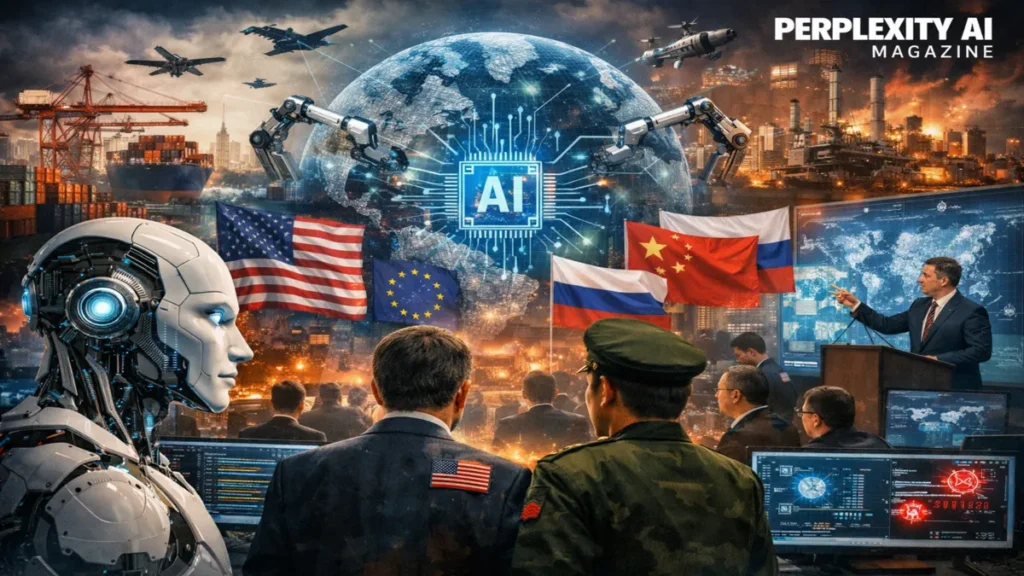
I began to understand that artificial intelligence had crossed a threshold when governments stopped speaking about it as innovation and started speaking about it as infrastructure, security, and power. In 2026, AI is no longer just a product of research labs or technology companies. It has become a strategic resource that nations treat with the same seriousness once reserved for oil, steel, and nuclear capacity. Countries are reorganizing alliances, trade relationships, immigration policies, and regulatory frameworks around AI capabilities. – AI Power Politics.
The competition is not only about who builds the best models. It is about who controls the chips, the data centers, the research talent, the standards, and the rules that shape how AI is deployed. Supply chains are being securitized. Immigration policies are being rewritten to attract engineers and scientists. Defense strategies are being updated to integrate algorithmic systems into planning and operations. Diplomacy now includes negotiations over data flows and computing infrastructure.
This shift is not speculative. It is visible in the creation of new technology alliances, in the reorientation of industrial policy, and in the emergence of AI sovereignty as a political goal. The world is moving from a phase where AI was a competitive advantage to a phase where AI is a structural determinant of power.
The result is a new geopolitical landscape in which influence is no longer defined solely by territory, population, or military strength, but by computational capacity, institutional design, and the ability to coordinate complex technological systems at scale. – AI Power Politics.
Strategic alliances and AI supply chains
In 2026, alliances are no longer only military or economic. They are technological.
Countries are forming coalitions to secure access to semiconductors, advanced computing hardware, energy for data centers, and the minerals that make modern electronics possible. These coalitions aim to reduce dependence on geopolitical rivals and ensure continuity of critical infrastructure during crises.
The logic is simple. AI systems require massive computing power. Computing power requires chips. Chips require factories, raw materials, logistics, and stable political relationships. Whoever controls these layers controls the pace and direction of AI development.
As a result, supply chains are treated as national security assets. Governments coordinate industrial policy, share risk, and sometimes restrict exports not only to protect domestic industries but to shape global power balances.
This marks a departure from the free market logic that dominated technology for decades. The new model blends market incentives with state strategy, turning infrastructure into diplomacy.
Read: McKinsey Hybrid Workforce and AI Agents
Talent mobility and the new brain circulation
While hardware and supply chains are territorial, talent is not.
Researchers, engineers, and entrepreneurs move across borders in search of opportunity, freedom, and resources. In the AI era, this mobility has become a geopolitical factor. Countries that attract talent gain innovation capacity. Countries that repel it lose relevance. – AI Power Politics.
As a result, immigration policy has become innovation policy. Universities have become strategic assets. Cities have become nodes in global networks of expertise.
This circulation of talent undermines purely nationalist technology strategies. Even the most protectionist states struggle to isolate knowledge. At the same time, open systems face pressures to protect sensitive research from strategic competitors.
The tension between openness and control defines the talent dimension of AI geopolitics.
Tech sovereignty and regional autonomy
Europe’s response to the AI race is framed around sovereignty.
Rather than choosing between U.S. and Chinese platforms, European institutions seek to build their own infrastructure, standards, and capabilities. This includes investments in domestic computing, open-source models, regulatory frameworks, and data governance.
The goal is not isolation but autonomy. European leaders argue that without independent technological capacity, political independence becomes fragile.
This model emphasizes resilience over speed, coordination over competition, and governance over dominance. It reflects a different vision of technological power, one rooted in institutions rather than markets alone. – AI Power Politics. – AI Power Politics.
Global governance as a strategic arena
AI governance is no longer a technical discussion. It is a diplomatic one.
Countries negotiate standards for safety, ethics, export controls, liability, and data sharing. These negotiations shape who can deploy advanced systems, under what conditions, and with what accountability.
Unlike earlier technological revolutions, AI’s risks are immediate and global. Autonomous systems affect security. Misinformation affects elections. Automation affects labor markets.
This forces governments to engage with one another, even as they compete. The result is a fragmented governance landscape where regional norms coexist uneasily, and middle powers act as brokers between regimes.
Table: Regional AI strategies
| Region | Strategic focus | Core approach |
|---|---|---|
| United States | Supply chain security | Alliances and industrial policy |
| European Union | Sovereignty and regulation | Regional infrastructure and law |
| Asia | Scale and integration | State-supported innovation |
| Middle East | Diversification and investment | Capital and partnerships |
Economic competition and security
AI is both an economic engine and a security tool.
It drives productivity, creates new industries, and reshapes markets. At the same time, it enables surveillance, cyber operations, autonomous weapons, and strategic planning.
This dual-use nature blurs the boundary between civilian and military technology. Economic competition becomes security competition. Trade policy becomes defense policy.
As a result, states increasingly treat AI as a strategic sector requiring coordination between ministries of economy, defense, education, and foreign affairs. – AI Power Politics.
Innovation blocs and multipolar power
The world is not dividing into two camps. It is fragmenting into multiple innovation blocs.
Some are anchored around superpowers. Others form around regional hubs that combine capital, talent, and infrastructure.
These blocs cooperate internally and compete externally. They shape standards, research agendas, and market access. They influence which technologies spread and which remain local.
Power becomes networked rather than hierarchical.
Table: Innovation bloc characteristics
| Bloc type | Strength | Risk |
|---|---|---|
| Superpower-led | Scale and resources | Dependence and rigidity |
| Regional | Flexibility and coordination | Limited global reach |
| City-based | Talent and creativity | Political vulnerability |
Expert perspectives
A geopolitical analyst observes that computational capacity is becoming as significant as industrial capacity once was.
A policy scholar notes that technology governance now shapes diplomacy more than trade agreements did in the past.
A security expert warns that unregulated AI competition could destabilize international relations as much as nuclear proliferation once did.
Takeaways
- AI is now a core determinant of global power
- Supply chains have become strategic assets
- Talent mobility shapes innovation more than borders
- Sovereignty drives regional technology strategies
- Governance is a new field of diplomacy
- Economic and security competition are merging
- Power is becoming networked and multipolar
Conclusion
In 2026, artificial intelligence is no longer simply a tool that nations use. It is a structure within which nations operate.
It shapes how economies grow, how militaries plan, how alliances form, and how societies govern themselves. The competition over AI is not only about technology. It is about values, institutions, and the future of cooperation.
The danger is that rivalry hardens into fragmentation, undermining the global systems that enable shared progress. The opportunity is that shared challenges force new forms of coordination.
AI has become the defining geopolitical battleground not because it is powerful, but because it reorganizes power itself.
FAQs
Why is AI geopolitical now
Because it shapes economic growth, security, and institutional control.
What is AI sovereignty
The ability of a region to build and govern its own AI systems independently.
Why are supply chains political
Because disruption can weaken national capacity and influence.
Can global governance work
It is difficult but necessary to manage shared risks.
Will this competition stabilize
It depends on whether cooperation emerges alongside rivalry.