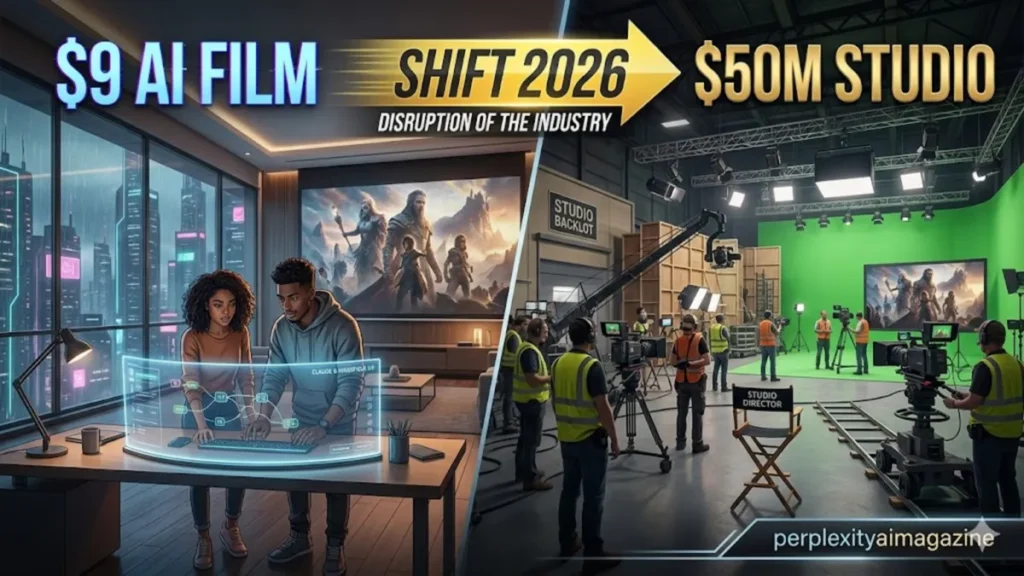
SAN FRANCISCO — The barrier to entry for high-end filmmaking has effectively collapsed. This week, a viral short film produced by a single creator for approximately $9 in AI tokens has sent shockwaves through the entertainment industry. By orchestrating Anthropic’s Claude Code alongside ByteDance’s Higgsfield Seedance 2.0, the project demonstrates that “studio-grade” visual storytelling is no longer the exclusive domain of multi-million dollar budgets and massive VFX crews.
The project, which has garnered millions of views across social platforms, serves as a proof-of-concept for the “one-person film studio.” The creator utilized AI agents to handle everything from scriptwriting and asset management to complex video generation and synchronized audio—tasks that traditionally require a workforce of hundreds. – ai film.
The “Claude-Higgsfield” Pipeline
The technical backbone of this achievement lies in the synergy between two cutting-edge AI systems. Claude Code, Anthropic’s agentic coding environment, was used as the “technical director.” It automated the workflow by writing scripts to stitch clips, manage file directories, and invoke APIs.
Meanwhile, the visual heavy lifting was performed by Higgsfield Seedance 2.0. Developed by ByteDance, this multimodal model allows for “reference-first” control, meaning a creator can input a single image or audio track to anchor the entire scene’s style and character consistency.
Breaking Down the $9 Budget
The claim of a “$50 million production value for $9” refers to the marginal cost of compute. In a traditional studio, $50 million covers salaries, physical sets, and months of post-production. In the AI-driven model:
- Orchestration: Claude Code managed the project structure for pennies in API calls.
- Generation: Seedance 2.0’s high-throughput architecture generated 2K-resolution cinematic shots at a fraction of the cost of traditional rendering.
- Editing: Automated “one-click” recreation tools removed the need for expensive manual color grading and ADR (Automated Dialogue Replacement).
What is Higgsfield Seedance 2.0?
Seedance 2.0 is currently the “gold standard” for cinematic AI video. Unlike earlier models that produced disjointed clips, Seedance 2.0 supports up to 12 simultaneous media inputs—including nine reference images and three audio tracks. This allows for:
- Native Audio-Video Sync: Lip-sync and spatial audio are generated in a single pass.
- Character Continuity: “Locking” a character’s face across multiple camera angles.
- Cinematic Multi-shot Flow: The ability to extend 15-second generations into a coherent narrative sequence.
Expert Analysis: The Democratization of “High-End Slop”
The long-term impact of this news is two-fold. First, it democratizes the “visual language” of blockbuster cinema. A teenager in a bedroom can now produce a trailer that looks indistinguishable from a Marvel production. However, industry experts warn of an impending wave of “AI slop”—content that looks expensive but lacks the soul and nuance of human-led direction.
“We are entering an era where the value of a film will no longer be measured by its visual ‘polish,’ as polish is now a commodity,” says digital media analyst Sarah Chen. “The premium will shift back to original IP, unique narrative voices, and the ‘human touch’ that AI still struggles to replicate perfectly.” For the industry, this means VFX houses must pivot to high-end creative consulting, as the technical “grunt work” of rendering and compositing is being rapidly automated out of existence. – ai film.
CHECK OUT
Mercor AI Data Breach: 4TB of Biometric Data Stolen
Apple Siri to Connect With Multiple AI Assistants Beyond ChatGPT
Someone Used Claude Code to Audit the Pentagon Budget
5 FAQs
Q: Can anyone make a movie for $9 right now? While the token costs are low, successful execution requires high-level “prompt engineering” and a deep understanding of how to orchestrate AI agents like Claude Code.
Q: Is Seedance 2.0 available to the public? Yes, it is currently accessible through the Higgsfield.ai platform, though professional-grade features (like 2K upscaling) often require a business subscription.
Q: How does Claude Code help in filmmaking? Claude Code acts as a technical assistant, writing Python scripts to automate boring tasks like renaming thousands of frames, syncing audio files, or calling video APIs in a specific order.
Q: Is this content copyrightable? Current US law generally does not allow for the copyright of purely AI-generated works. However, films that involve significant “human-to-AI” orchestration may have different legal standings in the future.
Q: Does this mean Hollywood is going out of business? Not necessarily. While “technical” roles are under threat, the demand for high-level acting, directing, and unique storytelling remains high. Hollywood will likely adopt these tools to lower their own overhead.