
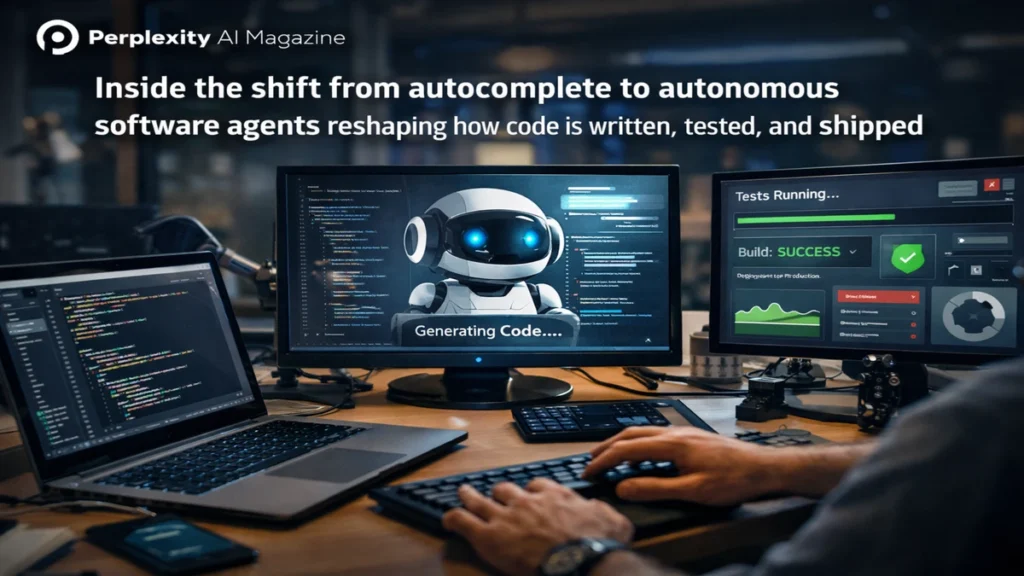
AI developer tools news in early 2026 tells a clear story: software development is entering an agentic era. Tools that once suggested single lines of code now propose entire features, refactor multi-file codebases, and coordinate with version control systems to move projects forward with minimal human prompting. For developers working in complex environments—healthcare platforms, robotics APIs, edge AI systems, and enterprise cloud stacks—these changes are not incremental. They are structural.
Within the first hundred days of 2026, AI coding tools began to show measurable productivity gains, with teams reporting 30 to 50 percent faster iteration on complex workflows. The biggest gains appeared not in greenfield demos, but in real-world scenarios: refactoring legacy systems, integrating APIs, and maintaining compliance-heavy codebases. As interest in “ai developer tools news” rises among U.S. enterprise developers, attention has shifted toward tools that understand context deeply, manage entire repositories, and integrate cleanly with Git, CI/CD pipelines, and cloud infrastructure.
This surge in interest also reflects broader economic and technical pressures. Organizations face growing software backlogs, tighter security requirements, and an expanding surface area of APIs and services. At the same time, AI capabilities have matured beyond simple completion models. Multi-model systems, diffusion-based code generation, and tool-using agents now enable AI to reason about dependencies, propose structured changes, and validate results through tests.
This article examines the state of AI developer tools in 2026 using the developments outlined above. It explores the leading platforms, the paradigm shifts underlying their design, the impact on workflows and skills, and the rising importance of security and governance. Together, these trends reveal how software development itself is being redefined.
Read: Robotics Manufacturing News 2026: AI, Humanoids, Automation
From Autocomplete to Agentic Coding
The most significant change in AI developer tools is the move from assistive autocomplete to agentic orchestration. Early coding assistants focused on predicting the next token or line. In contrast, modern tools operate at the level of intent. A developer describes a feature, bug, or refactor, and the system proposes a coordinated set of changes across files, tests, and configuration.
This shift is powered by deeper codebase awareness. Tools now ingest entire repositories, track dependency graphs, and reason about architectural patterns. Instead of generating isolated snippets, they generate plans, apply diffs, and checkpoint progress through version control. This approach mirrors how experienced developers work: making incremental changes, validating them, and revising based on feedback.
Agentic systems are particularly effective in enterprise environments, where codebases are large and tightly coupled. By managing context automatically, these tools reduce the cognitive load on developers and allow them to focus on design decisions rather than boilerplate. The result is faster iteration without sacrificing correctness, a balance that has long eluded automation.
Leading Tools Shaping 2026
Several platforms have emerged as reference points in AI developer tools news, each emphasizing different aspects of agentic development.
Cursor and Aider have gained traction for full-stack prototyping from natural language prompts. Their ability to generate checkpointed application states and manage git-based multi-file edits makes them well suited for rapid experimentation and feature development. Developers describe workflows where a single prompt yields a working scaffold, complete with tests and configuration. – ai developer tools news.
Claude Code and Windsurf focus on terminal-centric development and continuation of existing work. These tools excel at refactoring large, established codebases, including regulated systems such as FHIR-compliant healthcare platforms. By operating directly in the developer’s environment, they reduce friction and preserve existing workflows.
GitHub Copilot Workspace represents an evolution of familiar tooling. It extends chat-based assistance into debugging, planning, and cloud optimization, particularly for teams building cloud-agnostic applications. Amazon Q Developer and GitLab Duo emphasize collaboration, risk analysis, and DevOps integration, reflecting enterprise demand for tools that span the entire software lifecycle.
| Tool | Core Strength | Ideal Use Case |
|---|---|---|
| Cursor | Agentic full-stack generation | Rapid prototyping, startups |
| Aider | Git-native multi-file edits | Refactors and migrations |
| Claude Code | Terminal-based continuation | Large enterprise codebases |
| Windsurf | Context-aware refactoring | Legacy system modernization |
| GitHub Copilot Workspace | Chat-driven debugging | Cloud and platform teams |
| Amazon Q Developer | Risk and test analysis | AWS-centric enterprises |
| GitLab Duo | NLP explanations | Collaborative DevOps teams |
Multi-Model IDEs and Context Awareness
Another defining trend in 2026 is the rise of multi-model IDE integrations. Instead of relying on a single large language model, tools dynamically route tasks to specialized models optimized for planning, code generation, testing, or security analysis. This orchestration improves both speed and quality.
Context awareness has become the primary differentiator. Leading tools maintain long-lived memory of the codebase, recent commits, and architectural constraints. They understand not just syntax, but intent. When a developer requests a change, the system considers downstream effects, proposes updates to tests, and flags potential regressions.
This depth of context is particularly valuable for teams working on edge AI deployments or robotics control systems, where code interacts with hardware, sensors, and real-time constraints. AI tools that can reason across these layers reduce integration errors and accelerate deployment.
Free tiers and lightweight modes, such as basic configurations in emerging editors, have lowered the barrier to experimentation. At the same time, enterprise plans emphasize governance, auditability, and integration with existing identity and access management systems.
Paradigm Shifts in Code Generation
Under the hood, advances in model architecture are enabling new behaviors. Diffusion-based approaches to code generation allow tools to work out of order, revisiting earlier decisions as context evolves. This mirrors human editing patterns more closely than linear token prediction.
As a result, coordinated refactors across multiple files are becoming routine. Developers can request changes at the level of behavior or policy, and the tool determines how to implement them across the codebase. This capability is especially valuable in large systems where manual refactoring is risky and time-consuming.
Workflows are also moving toward cloud-native environments. AI-driven CI/CD pipelines automatically generate tests, enforce standards, and validate changes before merging. Ephemeral development environments reduce setup time and ensure consistency across teams, aligning with modern DevOps practices.
These paradigm shifts support faster iteration without compromising reliability, a key requirement for enterprise adoption.
Workflow Impacts and Productivity Gains
The impact of agentic AI tools on daily development workflows is profound. Teams report that a majority of commits are now influenced by AI suggestions, whether through generated code, refactors, or test cases. In some projects, AI proposes entire features complete with validation logic.
Agentic automation shifts the developer’s role. Instead of writing every line, developers review, guide, and validate AI-generated changes. This allows faster exploration of alternatives and earlier detection of design flaws. In complex projects, iteration speed can double or triple compared to traditional workflows.
Cloud-first collaboration is another outcome. Shared, policy-driven environments allow distributed teams to work in parallel without configuration drift. For organizations building robotics firmware or healthcare connectors, this consistency is critical.
Skill requirements are evolving accordingly. Architectural reasoning, system design, and security awareness are becoming more important than memorizing syntax. New roles focused on AI-assisted development strategy and governance are beginning to emerge.
Security and Governance in AI Coding Tools
As AI developer tools become more autonomous, security and compliance have moved to the forefront. Enterprises deploying these tools in regulated environments require assurances that code generation does not introduce vulnerabilities or intellectual property risks.
Several leading platforms now integrate vulnerability scanning, dependency analysis, and policy enforcement directly into the agentic workflow. Instead of running security checks after the fact, these tools evaluate risks as changes are proposed. This proactive approach reduces exposure and shortens remediation cycles.
| Tool | Key Security Features | Best For |
|---|---|---|
| GitHub Copilot Enterprise | Advanced scans, IP indemnity, SAML/SSO | Large GitHub-based teams |
| Snyk | AI-powered vulnerability detection | Security-first pipelines |
| Qodo | SOC 2 compliance, secure RAG | Regulated industries |
| Amazon Q Developer | Encrypted context, compliance controls | AWS-centric stacks |
| SonarQube | Continuous inspection | Quality gates in CI/CD |
By embedding governance into automation, these tools achieve both speed and safety. For projects involving edge AI or robotics, they help ensure secure deployment without slowing development.
Enterprise Adoption and Real-World Context
Enterprise adoption of AI developer tools accelerated in 2026 as organizations moved beyond pilots. Healthcare systems adopted agentic tools to maintain EHR integrations and comply with evolving standards. Manufacturing and robotics teams used them to manage complex APIs and firmware updates.
The appeal lies in predictability. Tools that understand codebases deeply and integrate with existing workflows reduce surprises. When combined with edge deployment tooling and cloud orchestration, they support end-to-end automation across the software lifecycle.
This convergence of AI tooling with enterprise infrastructure reflects a broader trend: software development is becoming a managed, intelligent process rather than a purely manual craft.
Expert Perspectives
One enterprise architect notes that AI coding tools have become “force multipliers,” allowing small teams to maintain systems once requiring dozens of engineers. A DevOps leader emphasizes that integrated testing and security are what make agentic workflows viable at scale.
Another industry observer points out that the real breakthrough is trust. As tools demonstrate consistent reliability, developers become comfortable delegating more responsibility, accelerating adoption.
These perspectives underscore that the transformation is as cultural as it is technical.
Takeaways
- AI developer tools in 2026 operate as autonomous agents, not simple assistants.
- Deep codebase awareness enables safe multi-file refactors and feature generation.
- Multi-model IDEs improve speed and quality through task specialization.
- Agentic workflows deliver 30–50 percent productivity gains in complex projects.
- Security and governance are now embedded directly into AI coding tools.
- Developer roles are shifting toward architecture and validation.
Conclusion
AI developer tools in 2026 represent a turning point in how software is built. The move from autocomplete to agentic orchestration has changed expectations around speed, scale, and reliability. Tools that once assisted now actively participate in development, proposing changes, validating outcomes, and enforcing standards.
This transformation is driven by necessity. Software systems are growing more complex, and traditional workflows struggle to keep pace. Agentic tools offer a way forward by absorbing routine complexity and allowing developers to focus on higher-level decisions. At the same time, the integration of security and governance ensures that speed does not come at the cost of trust.
As interest in AI developer tools news continues to rise, the focus will remain on real-world impact. The most successful tools will be those that blend autonomy with transparency, delivering measurable gains while respecting the constraints of enterprise software. In that balance lies the future of development.
FAQs
What are agentic AI developer tools?
They are tools that autonomously plan and execute multi-file code changes based on high-level intent.
How much productivity gain do teams see?
Reports in 2026 show 30–50 percent faster iteration on complex workflows.
Are these tools safe for regulated industries?
Yes, many now include built-in security scanning, compliance controls, and audit logs.
Do AI tools replace developers?
No. They shift developer focus toward design, review, and validation rather than boilerplate.
Which environments benefit most?
Enterprise systems, healthcare platforms, robotics APIs, and cloud-native applications see the largest gains.
