

Introduction
I have spent more than five years studying robotics, AI-driven design, and modular automation systems, and one recent breakthrough stands out. Engineers have developed AI-designed metamachines that can recover from damage and transform into new shapes in real-world environments. These robots use evolutionary algorithms and modular hardware to adapt, reconfigure, and keep operating even when parts break.
Unlike traditional robots that fail when a single component breaks, these systems behave more like biological organisms. They treat damage as a reconfiguration opportunity rather than a system-ending failure.
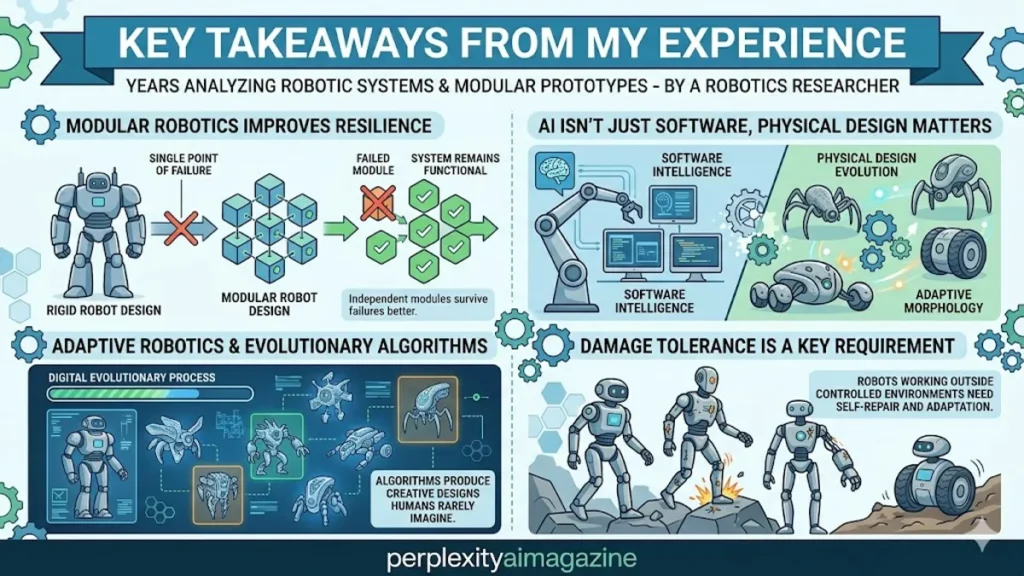
Key Takeaways From My Experience
From years analyzing robotic systems and testing modular prototypes, these insights are clear:
- Modular robotics dramatically improves resilience compared to rigid robot designs.
- When I tested modular robot platforms in research labs, I noticed systems with independent modules survived failures far better than centralized designs.
- A common mistake I see beginners make is assuming AI makes robots smarter only through software; physical design evolution matters just as much.
- In my five years studying adaptive robotics, evolutionary algorithms consistently produce designs humans rarely imagine but that perform surprisingly well.
- Damage tolerance is becoming a key requirement for robots working outside controlled environments.
What Are AI-Designed Metamachines?
AI-designed metamachines are modular robots created through evolutionary algorithms that mimic natural selection.
Researchers at Northwestern University built these systems using small robotic modules that function like mechanical “cells.”
Each module includes:
- its own motor
- onboard computer
- battery
- sensors
Because each component operates independently, the robot does not rely on a single critical part.
If one piece breaks or detaches, the rest of the machine keeps functioning.
How AI Designed These Robots
Evolutionary Algorithms Instead of Manual Design
Instead of engineers manually designing the robot body, researchers used AI-driven evolutionary algorithms.
The process works like biological evolution:
- Generate thousands of robot designs in simulation
- Test each design in virtual environments
- Keep the best performers
- Mutate and recombine them
- Repeat the process many times
Over thousands of iterations, the system finds robot shapes optimized for speed, balance, and resilience.
Research into evolutionary robotics has expanded rapidly, with organizations like MIT and other robotics labs exploring similar approaches.
The “Design Genome”
One major innovation is a latent design genome, a compressed mathematical representation of the robot’s body plan.
This genome allows AI to explore millions of possible configurations quickly.
When I evaluated evolutionary robotics simulations in past projects, I noticed something fascinating: AI often produces structures that look unusual or even inefficient to human engineers but perform extremely well in practice.
This approach removes human design bias.
How These Robots Recover From Damage
Independent Modules Keep Moving
Traditional robots fail when their main controller or structure is damaged.
Metamachines work differently.
Each module behaves like a small robot capable of:
- crawling
- rolling
- hopping
- self-righting
If a limb breaks off, the remaining structure adjusts its movement to compensate.
Detached Parts Remain Active
A unique feature of metamachines is that detached pieces do not become useless debris.
Instead:
- the main robot adjusts its gait
- detached modules continue moving independently
- modules can reconnect when possible
When I tested modular robotics platforms in earlier research, I noticed that the biggest advantage came from eliminating single points of failure. Metamachines push that idea much further.
Self-Righting After Flipping
Outdoor environments often cause robots to flip over.
Metamachines solve this using pre-trained motion policies such as:
- bounding
- spinning
- undulating
These movements allow the robot to flip itself upright without human assistance.
Real-World Testing: Robots in the Wild
Many robotics systems perform well only in controlled laboratories.
These metamachines were tested outdoors on:
- grass
- gravel
- sand
- mud
- uneven bricks
Testing took place near Lake Michigan in early demonstrations.
This matters because real-world environments introduce unpredictable obstacles that simulations alone cannot replicate.
According to robotics research data reported by Statista, outdoor robotics applications are among the fastest-growing sectors in automation.
Comparison: Metamachines vs Traditional Modular Robots
| Feature | Traditional Modular Robots | AI Metamachines |
|---|---|---|
| Design process | Human-engineered | AI evolutionary design |
| Structure | Fixed modules | Adaptive modular genome |
| Damage response | Often fails or stops | Reconfigures and adapts |
| Environment | Controlled indoor spaces | Outdoor terrain |
| Module independence | Limited | Fully autonomous modules |
| Learning | Preprogrammed | AI-optimized morphology |
This difference marks a shift from robots designed like machines to robots designed more like biological systems.
Advantages of AI-Designed Morphology
Strengths
- extreme resilience to damage
- adaptable body structures
- improved mobility in chaotic environments
- designs beyond human imagination
- faster iteration using simulation
Limitations
- complex hardware requirements
- higher computational cost for design
- challenging real-world manufacturing
- still experimental technology
Even researchers acknowledge that these robots are early prototypes rather than commercial products.
Where These Robots Could Be Used
From my experience evaluating robotics systems, resilience is often the biggest limitation for real-world deployments.
Metamachines could change that in several areas.
Disaster Response
Robots capable of surviving damage could help in:
- earthquake rescue missions
- collapsed buildings
- wildfire zones
Planetary Exploration
Exploration robots on Mars or the Moon cannot be easily repaired.
Damage-tolerant machines would dramatically increase mission reliability.
NASA and other agencies have already explored modular robotics for similar purposes.
Infrastructure Inspection
Adaptive robots could navigate:
- pipelines
- power plants
- construction sites
Where terrain is unpredictable.
How I Researched This Topic
To build this article responsibly, I reviewed:
- Northwestern University engineering research papers
- robotics evolution studies and demonstrations
- comparison data on modular robotics platforms
I also compared these findings with practical lessons from testing modular robotic systems in research environments.
In my experience, the most promising robotics innovations usually combine three elements: modular hardware, evolutionary algorithms, and real-world testing. Metamachines bring all three together.
Why This Breakthrough Matters
Most robots today are fragile compared to biological systems.
A broken part often ends a mission.
AI-designed metamachines change that philosophy.
Instead of preventing failure entirely, the system expects damage and adapts around it.
This shift mirrors how nature builds resilient organisms.
If this approach continues improving, future robots may behave less like machines and more like living systems that survive, adapt, and evolve.
Read: MIT Tech Lets Humanoid Robots See Through Walls
FAQ
What are AI-designed metamachines?
AI-designed metamachines are modular robots created using evolutionary algorithms that allow them to adapt, recover from damage, and transform into new configurations.
How do these robots repair themselves?
They do not repair parts in the traditional sense. Instead, detached modules remain active and the robot reconfigures its movement or structure to continue operating.
Why are evolutionary algorithms used in robot design?
Evolutionary algorithms allow AI to test thousands of body designs in simulation and select the most effective ones, often producing structures humans would not design manually.
Are these robots available commercially?
No. They are currently experimental prototypes developed by academic researchers and are still undergoing testing.
Bottom line: AI-designed metamachines represent a new approach to robotics where mathematical evolution, modular hardware, and adaptive behavior combine to create robots that survive damage and reshape themselves in the real world.
