
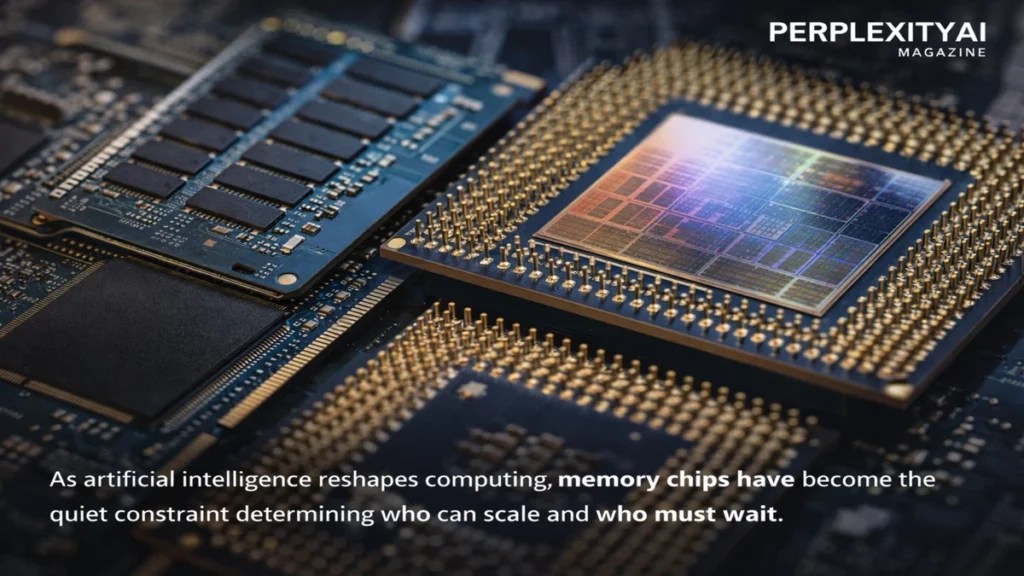
By 2026, the world’s most important computing bottleneck will not be processors, power, or even electricity. It will be memory. According to industry projections, data centers—driven overwhelmingly by artificial intelligence workloads—are on track to consume nearly 70% of all high-end memory chips produced globally. In the first hundred words, the significance is unmistakable: the rise of AI is not just changing software or models, but fundamentally reallocating the physical components of the digital economy.
For decades, memory chips such as DRAM and NAND quietly powered everything from laptops to smartphones. They were abundant, cyclical, and largely invisible to the public. That era is ending. Training and running modern AI models requires extraordinary amounts of fast, low-latency memory, tightly coupled with GPUs and specialized accelerators. High-bandwidth memory, or HBM, has emerged as the most critical ingredient in this new infrastructure, followed closely by server-class DDR5 DRAM and high-performance NVMe storage.
The consequence is a structural shift. Memory manufacturers are prioritizing long-term AI contracts with hyperscale data centers, permanently reallocating supply away from consumer markets. Even as new factories come online, demand is growing faster than capacity. Prices for premium memory surged sharply in early 2026, while PC and smartphone makers began cutting forecasts due to constrained supply.
This article examines how AI data centers came to dominate the memory market, which technologies are being prioritized, why shortages are expected to last until at least 2028, and what this means for consumers, enterprises, and the future of computing itself.
The AI Workload That Changed Memory Economics
Artificial intelligence workloads differ fundamentally from traditional computing. Training large models involves moving vast volumes of data repeatedly between processors and memory, demanding bandwidth far beyond what conventional DRAM configurations were designed to deliver. Inference at scale—serving millions or billions of queries—adds another layer of pressure, requiring both capacity and speed to minimize latency.
This is where high-bandwidth memory became indispensable. Stacked directly onto GPUs, HBM delivers orders of magnitude more bandwidth than standard DRAM while reducing energy per bit transferred. As models grew larger and more complex, memory became the limiting factor, not compute. Adding more GPUs without sufficient HBM produced diminishing returns.
Per-server memory capacity has been doubling roughly every year in leading AI data centers. Systems that once shipped with hundreds of gigabytes of DRAM now deploy multiple terabytes, while each GPU package integrates increasingly dense HBM stacks. This explosion in memory intensity explains why AI data centers are capturing such a large share of global supply. – memory chips.
The shift also changed purchasing behavior. Hyperscalers sign multi-year agreements, locking in output from memory fabs and offering manufacturers predictable margins. Consumer electronics, by contrast, buy opportunistically and remain more price sensitive. In a constrained market, the choice for suppliers is clear.
Read: Jensen Huang and the ChatGPT Moment for Digital Biology
A Permanent Reallocation Away From Consumer Devices
What distinguishes the current memory cycle from previous booms is its durability. Historically, memory shortages eased when consumer demand softened or when new fabs came online. In the AI era, neither mechanism is sufficient.
Major producers such as Samsung Electronics, Micron Technology, and SK Hynix have explicitly shifted capital expenditure toward AI-grade products, particularly HBM and server DRAM. These chips command higher margins and are sold under long-term contracts that reduce volatility.
As a result, consumer-oriented DRAM lines receive lower priority. Even when smartphone or PC demand rebounds, allocation does not automatically follow. Industry analysts increasingly describe this as a permanent reallocation rather than a temporary imbalance.
The effects are already visible. PC shipments are forecast to dip around 9% in 2026, while smartphone volumes are expected to fall roughly 5%, largely due to constrained memory availability and higher component costs. Consumers experience this as delayed product refreshes and higher prices, but the underlying cause is structural, not cyclical.
The Memory Types AI Data Centers Are Hoarding
AI infrastructure does not consume memory uniformly. Certain categories have become strategic choke points, capturing a disproportionate share of investment and capacity.
High-bandwidth memory sits at the top of the hierarchy. HBM3 and HBM3E are essential for modern GPU accelerators, delivering massive throughput required for large-scale training. Server-class DDR5 follows closely, providing the capacity needed for CPUs, data preprocessing, and inference pipelines. High-performance NAND, deployed through NVMe SSDs, completes the stack by feeding data into memory at speed.
Emerging categories such as LPDDR5X and GDDR7, once associated with mobile devices and gaming, are increasingly repurposed for specialized AI servers seeking better energy efficiency. – memory chips.
Table 1: Memory Types Prioritized by AI Data Centers in 2026
| Memory Type | Primary Use | Why It Matters for AI |
|---|---|---|
| HBM3 / HBM3E | GPU accelerators | Extreme bandwidth for model training |
| DDR5 Server DRAM | CPUs and inference | Terabyte-scale capacity per server |
| NVMe NAND SSDs | Data pipelines | Low-latency, high-throughput storage |
| LPDDR5X | Efficient AI nodes | Lower power for dense deployments |
| GDDR7 | Heterogeneous systems | High bandwidth outside traditional GPUs |
Together, these components explain how AI data centers can absorb nearly 70% of global high-end memory output.
Prices Surge as Supply Falls Behind
Despite aggressive factory expansions, global memory production cannot keep pace with AI demand. Building new fabs takes years, and HBM manufacturing is particularly complex, involving advanced packaging and tight integration with logic chips. – memory chips.
The result has been a sharp price response. In the first quarter of 2026, high-end memory prices rose between 40% and 70%, according to industry trackers. Unlike past cycles, these increases are not expected to reverse quickly. Most forecasts suggest that meaningful relief will not arrive until 2028, when new capacity fully ramps and yields improve.
For cloud providers, higher memory prices are an acceptable cost of scaling AI services. For consumer electronics makers, they are a margin-eroding threat. Many companies have responded by delaying launches, reducing configurations, or raising retail prices.
This divergence reinforces the prioritization of AI customers. Memory manufacturers follow the money, and AI infrastructure currently offers the clearest path to sustained profitability.
The AI Infrastructure Arms Race
Behind the memory surge lies an arms race among cloud providers and AI developers. Training frontier models requires massive clusters of GPUs, each tightly coupled with HBM. Falling behind on memory access effectively caps performance, regardless of compute power.
Executives have framed this as an infrastructure moment, not a software one. Jensen Huang has repeatedly emphasized that AI progress depends on full-stack optimization, from algorithms to interconnects to memory. In this framing, memory is not a commodity but a strategic asset.
The same logic applies to enterprise AI and scientific computing. Protein foundation models, climate simulations, and financial systems all demand large memory footprints. Platforms such as NVIDIA’s BioNeMo, used for biological modeling and drug discovery, require similar GPU-memory scale as language models, reinforcing demand beyond consumer AI.
Expert Perspectives on the Memory Crunch
Industry leaders are unusually candid about the shift.
“HBM has become the pacing item for AI systems,” Micron executives said during recent earnings discussions, noting that demand visibility now extends several years into the future.
SK Hynix leadership has described AI memory as a once-in-a-generation transition, arguing that server and accelerator demand will dominate capital planning well beyond the current cycle.
Analysts at Gartner have echoed this view, warning that consumer device makers should not expect a return to pre-AI memory pricing dynamics, even if end-market demand weakens.
Together, these perspectives underscore a consensus: memory scarcity is no longer an anomaly but a defining feature of the AI era.
Ripple Effects Across the Global Economy
The consequences of memory concentration extend beyond electronics. Higher component costs feed into inflation for digital services, as cloud providers pass expenses through to customers. Startups face higher barriers to entry when training models becomes prohibitively expensive without access to subsidized infrastructure.
Geopolitically, memory has become a strategic resource. Governments increasingly view advanced memory manufacturing as critical infrastructure, alongside logic chips. This adds another layer of complexity to an already fragile global supply chain.
At the same time, the concentration of memory in data centers accelerates centralization. Organizations without access to large-scale infrastructure risk falling behind in AI capabilities, deepening the divide between hyperscalers and everyone else.
Table 2: Market Projections for AI Memory in 2026
| Segment | 2026 Projection | Year-over-Year Trend |
|---|---|---|
| AI data center chip spending | $286 billion | Peak year before taper |
| HBM market size | $54 billion | 58% growth |
| Share of memory to data centers | ~70% | Structural shift |
| Consumer PC sales | –9% | Supply-constrained |
| Smartphone shipments | –5% | Memory-limited |
What Happens Next
Looking ahead, the memory market faces a delicate balancing act. Manufacturers must expand capacity without overshooting demand, while customers seek stability in pricing and supply. Innovations in packaging, yield improvement, and alternative memory architectures may ease pressure, but none offer immediate relief.
For consumers, the implications are subtle but persistent: fewer options, higher prices, and slower refresh cycles. For enterprises, memory becomes a strategic planning variable, influencing where and how AI workloads are deployed.
The deeper question is whether this concentration of physical resources ultimately slows innovation or accelerates it. By funneling memory into data centers, the industry may unlock breakthroughs that justify the imbalance. But the cost is a more centralized and capital-intensive digital economy.
Takeaways
- AI data centers are projected to consume nearly 70% of global high-end memory output in 2026.
- High-bandwidth memory has become the most critical bottleneck in AI infrastructure.
- Memory suppliers are permanently reallocating capacity away from consumer devices.
- Prices for premium memory surged sharply in early 2026 and are unlikely to normalize before 2028.
- PC and smartphone markets are already feeling the impact through lower shipments.
- Memory is emerging as a strategic asset, not a commodity, in the AI era.
Conclusion
The rise of artificial intelligence has quietly transformed memory chips from background components into frontline infrastructure. In 2026, the fact that data centers may consume nearly 70% of global memory production is not an accident or a temporary spike. It is the physical manifestation of a deeper shift in how computing value is created.
As AI models grow larger and more integrated into science, medicine, and business, the demand for fast, abundant memory will only intensify. The winners of this transition are those who control or secure access to that memory. The losers may be entire categories of devices and companies built on assumptions of abundance that no longer hold.
This moment forces a reconsideration of priorities. Memory, once cheap and taken for granted, now shapes the boundaries of innovation. How the industry manages this constraint will help determine whether AI’s benefits are widely shared or narrowly concentrated in the years ahead.
FAQs
Why do AI data centers need so much memory?
Training and inference require moving massive datasets repeatedly between processors and memory, demanding high bandwidth and large capacity.
What is high-bandwidth memory (HBM)?
HBM is a stacked memory technology integrated with GPUs, offering far higher bandwidth and efficiency than traditional DRAM.
Will memory shortages affect consumers?
Yes. Reduced allocation to consumer markets contributes to higher prices and fewer configuration options for PCs and smartphones.
When will memory shortages ease?
Most projections suggest meaningful relief will not arrive until 2028, when new capacity fully ramps.
Is this shift temporary or permanent?
Industry consensus increasingly views it as structural, with AI workloads permanently commanding a large share of supply.
