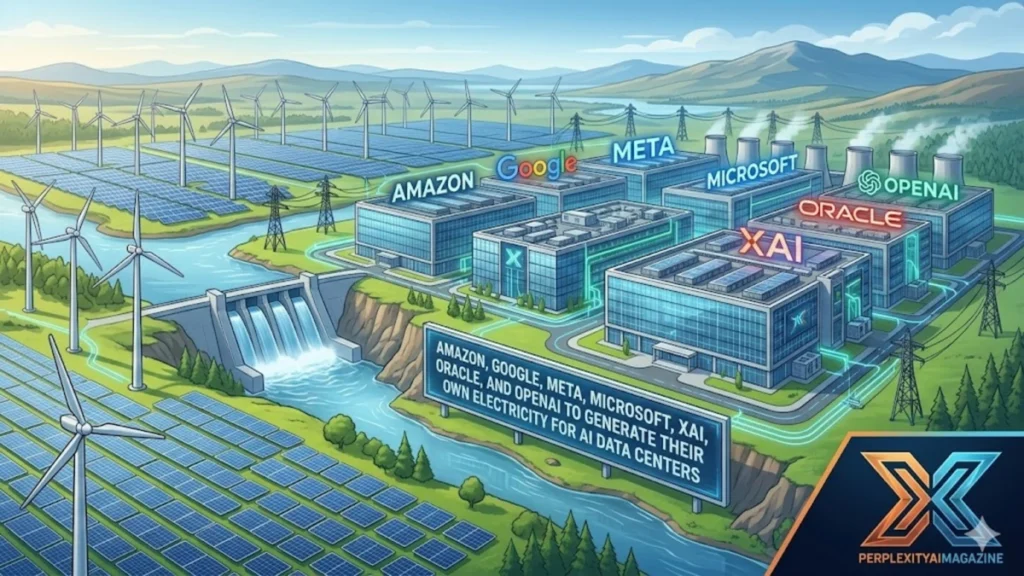
I have spent years reporting on the collision between technology and infrastructure, but few developments have felt as consequential as this one. America’s largest technology companies are preparing to generate their own electricity to power artificial intelligence data centers, marking a historic shift in how corporate energy demand is financed and supplied. On March 4, 2026, executives from Amazon, Google, Meta, Microsoft, xAI, Oracle and OpenAI are scheduled to appear at the White House to sign what President Donald Trump has called the “Rate Payer Protection Pledge.” The agreement commits them to “build, bring, or buy” dedicated electricity supplies for their AI operations rather than burden public grids. – ai-data-center-power-generation-private-plants.
At the heart of the pledge lies a simple economic concern: AI data centers require enormous amounts of electricity. Analysts estimate that AI expansion could require 50 gigawatts or more of new U.S. generating capacity in the near term, rivaling the electricity usage of entire nations. Without new private generation, utilities might pass grid expansion costs on to households, potentially increasing residential electricity bills.
Meta has already secured up to 6.6 gigawatts of nuclear capacity by 2035 through agreements with TerraPower, Oklo and Vistra. Other companies are exploring combinations of natural gas, solar, geothermal and small modular reactors. Together, they are attempting to solve one of the defining infrastructure challenges of the AI era.
The White House Agreement
The March 4, 2026, ceremony formalizes a nonbinding public private pact between the federal government and leading technology firms. President Trump has framed the initiative as a consumer protection measure, emphasizing energy independence and shielding ratepayers from rising bills. – ai-data-center-power-generation-private-plants.
Under the pledge, companies agree to finance and secure dedicated energy sources for AI data centers. The language “build, bring, or buy” allows flexibility. Firms may construct new plants, sign long-term power purchase agreements or acquire generation assets directly.
White House officials have described the initiative as a response to projections that AI expansion could demand more than 50 gigawatts of new capacity. Without private investment, utilities might upgrade transmission infrastructure and pass costs to households. Residential electricity rates rose roughly 5 percent in 2025 amid broader electrification trends.
The pledge does not constitute an executive order. Instead, it establishes reporting expectations and public accountability. Participating companies are expected to submit quarterly progress updates outlining project timelines and capacity additions.
Read: AI Learns Software Tasks From Videos With Watch & Learn Breakthrough
Meta’s Nuclear Strategy
Meta has moved fastest and most aggressively. In January 2026, the company announced nuclear agreements totaling up to 6.6 gigawatts by 2035, primarily supporting its Prometheus AI supercluster in Ohio.
Through 20-year power purchase agreements with Vistra, Meta secured 2,176 megawatts from the Perry and Davis-Besse plants in Ohio. The company also supports reactor uprates at Perry, Davis-Besse and Beaver Valley, adding approximately 433 megawatts of incremental capacity.
Meta’s partnership with TerraPower funds two Natrium sodium-cooled reactors producing 690 megawatts combined by 2032, with rights to six additional units potentially totaling 2.8 gigawatts by 2035. These reactors include molten salt storage capable of boosting peak output. – AI data center power generation.
An additional collaboration with Oklo supports the Aurora fast reactor campus in Pike County, Ohio, expected to scale to 1.2 gigawatts beginning in 2030.
Meta Nuclear Portfolio Overview
| Partner | Capacity Secured | Technology Type | Timeline |
|---|---|---|---|
| Vistra | 2.6 GW | Existing reactors + uprates | Immediate–2035 |
| TerraPower | Up to 2.8 GW | Natrium SMRs | 2032–2035 |
| Oklo | 1.2 GW | Aurora fast reactors | 2030 onward |
Combined, Meta’s portfolio could power roughly 5 million homes at peak output, though its primary purpose is data center supply.
Microsoft and Small Modular Reactors
Microsoft has invested in TerraPower and expressed support for small modular reactor deployment as a long-term carbon-free baseload strategy. While the company has not disclosed a per-project capacity figure equivalent to Meta’s 6.6 gigawatts, it is aligned with the pledge’s objective of dedicated supply.
Small modular reactors, or SMRs, promise lower capital risk and faster construction compared to traditional gigawatt-scale nuclear plants. Industry advocates argue that SMRs can be deployed near industrial loads, reducing transmission requirements.
Energy economist Severin Borenstein has cautioned that “nuclear energy remains capital intensive and subject to regulatory delay” (Borenstein, 2022). For Microsoft and others, timelines extending beyond 2030 reflect both opportunity and uncertainty.
In parallel, Microsoft continues exploring geothermal partnerships and renewable energy contracts to diversify its portfolio.
Google’s Geothermal and Renewable Push
Google has focused heavily on geothermal innovation, particularly through partnerships with advanced drilling companies. Enhanced geothermal systems aim to tap heat resources beyond traditional geographic limitations.
Geothermal projects typically cost between $4,000 and $5,500 per kilowatt installed, with construction timelines of three to five years. Unlike intermittent renewables, geothermal provides stable baseload generation.
Google also continues deploying solar paired with battery storage to support data centers. Solar plus storage projects cost between $1,500 and $4,000 per kilowatt, with one to two year build timelines. – AI data center power generation.
Energy scholar Jesse Jenkins of Princeton University has noted that “diversification across clean firm power and renewables is critical to balancing reliability and decarbonization goals” (Jenkins, 2023). Google’s mix reflects that strategy.
Amazon’s Flexible Approach
Amazon Web Services, the world’s largest cloud provider, has signaled interest in a mix of renewables and natural gas generation under the pledge. Natural gas combined cycle plants cost between $700 and $1,200 per kilowatt and can be built in roughly two years.
For a one gigawatt facility, that translates to $700 million to $1.2 billion in capital expenditure. Gas plants offer rapid deployment, making them attractive for near-term AI expansion.
Critics argue that increased gas reliance could conflict with climate goals. However, behind-the-meter gas generation may reduce immediate grid strain while nuclear and geothermal projects mature.
Amazon’s strategy appears pragmatic, balancing speed, cost and long-term sustainability commitments.
xAI, Oracle and OpenAI Join the Effort
xAI, Oracle and OpenAI have not disclosed project-specific megawatt figures but have committed to the pledge’s framework. Industry analysts expect these companies to pursue nuclear or SMR partnerships alongside renewable generation. – AI data center power generation.
OpenAI’s expanding compute requirements, driven by advanced model training, place it among the fastest-growing electricity consumers in the technology sector. Oracle’s data center expansion similarly increases power demand.
Collectively, the group aims to outline a roadmap for 20 to 50 gigawatts of private generation capacity by 2035. Quarterly reporting to the White House will track progress.
The Economics of Private Power
Building dedicated power plants entails significant capital outlays. The cost spectrum varies widely by technology.
Power Plant Cost Comparison
| Plant Type | Cost per kW | 1 GW Total Cost | Build Time |
|---|---|---|---|
| Natural Gas CC | $700–1,200 | $0.7–1.2B | ~2 years |
| Solar + Battery | $1,500–4,000 | $1.5–4B | 1–2 years |
| Nuclear / SMR | $5,000–10,000 | $5–10B | 5–10 years |
| Geothermal | $4,000–5,500 | $4–5.5B | 3–5 years |
Meta’s 6.6 gigawatt portfolio could require $30 billion to $60 billion in total investment, though long-term power purchase agreements distribute risk across partners.
Harvard energy expert William Hogan has argued that “large industrial buyers increasingly seek dedicated generation to hedge price volatility and ensure reliability” (Hogan, 2021). AI data centers exemplify that trend.
Potential Impact on Household Bills
Proponents claim the pledge will stabilize or reduce electricity costs by preventing utilities from financing new generation through ratepayer surcharges. If private plants come online by 2028, supporters argue, surplus capacity could even lower local prices. – AI data center power generation.
Critics caution that delays or partial reliance on gas could still strain grids. Nationwide residential electricity rates rose between 6 and 11 percent in recent years due to fuel costs and electrification trends.
Household Impact Scenarios
| Scenario | Estimated Impact on Bills | Key Variable |
|---|---|---|
| Pledge Success | Stable or –5–10% locally | Private plants online by 2028 |
| Partial Execution | +2–5% national rise | Construction delays |
| No New Supply | Continued 5%+ annual rise | Demand outpaces capacity |
Regional outcomes may vary. States like Virginia and Ohio, already hosting major data center clusters, stand at the center of the debate.
Environmental and Regulatory Challenges
Expanding nuclear and gas infrastructure invites environmental scrutiny. Nuclear projects require extensive licensing and waste management protocols. Gas plants raise emissions concerns.
Renewables and geothermal present fewer emissions challenges but face land use and permitting hurdles. Transmission upgrades may still be necessary even for behind-the-meter generation.
Energy policy analyst Leah Stokes has warned that “infrastructure scale-ups demand clear permitting pathways or projects stall in regulatory bottlenecks” (Stokes, 2020). The pledge’s success depends on coordination across federal and state agencies. – AI data center power generation.
A New Industrial Model
What distinguishes this moment is the scale of private generation aligned directly with corporate demand. Historically, utilities built plants and recovered costs through regulated rates. Now, technology giants are effectively acting as energy developers.
The AI boom has reshaped not only software markets but also physical infrastructure. Data centers once considered industrial facilities now rival aluminum smelters in electricity intensity.
This transition may herald a hybrid energy economy where large corporations co-finance dedicated generation while households rely on traditional grids. The balance between public oversight and private initiative will shape long-term outcomes.
Takeaways
- Major tech firms will sign the Rate Payer Protection Pledge on March 4, 2026.
- Companies commit to building or securing dedicated power for AI data centers.
- Meta leads with up to 6.6 gigawatts of nuclear capacity by 2035.
- Investment costs range from $700 per kilowatt for gas to $10,000 for nuclear.
- The pledge aims to shield households from electricity price increases.
- Environmental and permitting challenges remain significant.
Conclusion
I see in this pledge a defining inflection point for both technology and energy policy. Artificial intelligence has created extraordinary computational demand, and with it a scramble for electrons. Rather than relying solely on public utilities, technology companies are assuming responsibility for generating the power they consume.
Whether this experiment protects ratepayers or introduces new complexities will unfold over the next decade. If private plants come online efficiently, they may stabilize markets and accelerate clean energy deployment. If construction delays or fuel price volatility intervene, households may still feel the ripple effects.
The deeper shift is unmistakable. The AI revolution is not only digital. It is infrastructural, industrial and profoundly physical. The servers humming inside data centers now carry with them turbines, reactors and solar arrays. The race to build intelligence has become a race to build power.
FAQs
What is the Rate Payer Protection Pledge?
It is a public private agreement committing major tech firms to finance dedicated electricity for AI data centers to avoid burdening public grids.
Why do AI data centers need so much power?
Advanced AI training and inference require massive computing clusters that consume gigawatts of electricity continuously.
How much nuclear capacity has Meta secured?
Meta has agreements totaling up to 6.6 gigawatts by 2035 through partnerships with TerraPower, Oklo and Vistra.
Will household electricity bills decrease?
Supporters say local rates could stabilize or fall if private plants add surplus capacity, but outcomes vary by region.
Which energy sources are companies pursuing?
Strategies include nuclear, small modular reactors, natural gas, geothermal and solar paired with battery storage.