
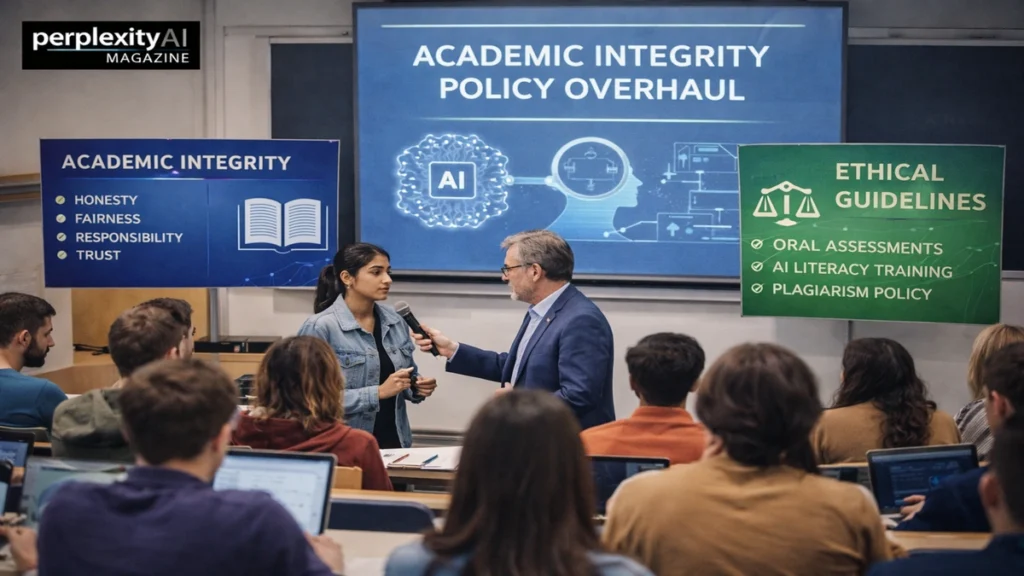
Academic integrity is being fundamentally redefined as generative artificial intelligence becomes embedded in everyday academic practice. Tools capable of producing essays, code, and analysis now exist in every student’s browser, challenging long-standing assumptions about authorship, originality, and assessment. Universities worldwide are responding by shifting away from text-only evaluation and detection-based enforcement toward holistic models that emphasize transparency, process, and critical thinking. – academic integrity ai news.
Rather than asking whether AI should be allowed, institutions are asking how it should be used responsibly. New integrity frameworks distinguish between ethical AI-assisted learning and deceptive substitution of student work. Disclosure requirements, discipline-specific AI guidelines, and redesigned assessments now form the core of institutional responses. These changes are driven not only by concern about cheating but also by recognition that AI will be part of students’ professional environments and must therefore be integrated into education ethically.
This transition marks a cultural shift from surveillance to trust, from output evaluation to learning verification, and from static rules to evolving policy ecosystems. Academic integrity is no longer about catching misconduct after it happens but about designing environments where authentic learning is visible, accountable, and meaningful.
Read: manufacturing ai news: Robots, Agents, and Digital Twins
Policy Shifts in Response to Generative AI
Universities have begun revising academic integrity policies to explicitly address generative AI. Mandatory disclosure of AI usage has become standard in many institutions, requiring students to explain when and how AI contributed to their work. This reframes AI from a hidden tool into a transparent component of learning. – academic integrity ai news.
Some institutions have restricted unauthorized AI tools on institutional devices or during high-stakes assessments, treating undisclosed use as academic misconduct. Others allow AI for brainstorming, revision, or feedback, provided students reflect on its influence and retain responsibility for final outputs.
Policies are increasingly discipline-specific, recognizing that acceptable AI use differs between fields such as programming, writing, engineering, and medicine. This granularity allows ethical use without flattening academic standards into one-size-fits-all rules.
Table: Policy Approaches to AI in Universities
| Policy Model | Purpose | Outcome |
|---|---|---|
| Disclosure-based | Transparency | Ethical AI integration |
| Restrictive | Protect assessment integrity | Reduced misuse |
| Educational | Build AI literacy | Responsible professional preparation |
The Shift Toward Process-Based Assessment
Traditional written assessments have become vulnerable to AI misuse because they evaluate polished outputs rather than learning processes. Universities are therefore shifting toward process-based assessments that emphasize reasoning, explanation, and application.
Oral exams, interactive discussions, and scenario-based assessments require students to articulate their thinking in real time. These formats make it difficult to rely on AI-generated content and instead foreground understanding, critical reasoning, and adaptability.
Interactive oral assessments use structured questioning to probe conceptual depth, often in small groups or one-on-one settings. They assess not only what students know but how they think, communicate, and respond to uncertainty. – academic integrity ai news.
This shift also improves alignment between education and professional practice, where individuals must explain decisions, collaborate, and justify actions rather than submit static documents.
Research Trends on Integrity and AI
Academic research highlights both the risks and benefits of generative AI. Risks include undetected plagiarism, erosion of writing skills, and unequal access advantages. Benefits include personalized learning support, faster feedback, and enhanced creativity when used ethically.
Researchers advocate redesigning assessment to emphasize synthesis, critique, and application rather than reproduction of information. Integrity is reframed as alignment between learning goals and evaluation methods rather than simply adherence to rules. – academic integrity ai news.
AI literacy is emerging as a core academic competency. Students must learn not only how to use AI tools but how to evaluate their outputs, recognize limitations, and understand ethical implications.
Table: Risks and Benefits of AI in Academia
| Dimension | Risk | Benefit |
|---|---|---|
| Learning | Overreliance | Personalized support |
| Assessment | Plagiarism | New evaluation models |
| Equity | Access gaps | Accessibility enhancements |
Institutional Implementations Worldwide
Universities across multiple countries have implemented oral assessments, AI disclosure policies, and literacy programs. These initiatives share a common goal: preserving authentic learning in an AI-saturated environment.
Irish institutions mandate oral verification discussions that override written submissions when discrepancies arise. Universities in New Zealand and Australia deploy interactive oral assessments across business, marketing, and engineering programs. Institutions in the United States and the United Kingdom are reviving viva voce exams for high-stakes evaluation.
These implementations demonstrate that integrity is increasingly maintained through human judgment rather than algorithmic detection.
Expert Perspectives
“Academic integrity in the age of AI is no longer about catching students but about designing systems that reveal learning,” notes an educational assessment researcher.
“Disclosure policies shift the conversation from fear to responsibility,” observes a higher-education policy analyst.
“Oral and interactive assessments restore the human element of education,” adds a university teaching fellow.
Takeaways
- Academic integrity policies now explicitly address generative AI
- Disclosure has replaced detection as the dominant ethical framework
- Oral and interactive assessments reduce AI misuse while enhancing learning
- AI literacy is becoming a core academic skill
- Integrity is shifting from enforcement to design
Conclusion
The rise of generative AI has forced universities to confront foundational questions about what education is meant to measure. Rather than defending outdated models through surveillance, institutions are redesigning systems around transparency, reasoning, and human judgment.
Academic integrity is evolving from a rulebook into a culture — one that values ethical engagement with technology, visible learning processes, and accountability grounded in explanation rather than artifacts. In doing so, universities are not merely protecting standards; they are preparing students for a world where intelligent systems are unavoidable, and integrity depends on how humans choose to use them.
FAQs
What is academic integrity in an AI context
It is the ethical, transparent, and responsible use of AI that preserves authentic learning and accountability.
Why are oral exams increasing
They verify understanding in real time and reduce reliance on AI-generated content.
Is AI completely banned in universities
No, most institutions allow AI with disclosure and ethical guidelines.
What is AI literacy
The ability to use, evaluate, and reflect on AI tools responsibly.
Does AI threaten education
AI challenges traditional models but also enables improved learning when integrated thoughtfully.
