
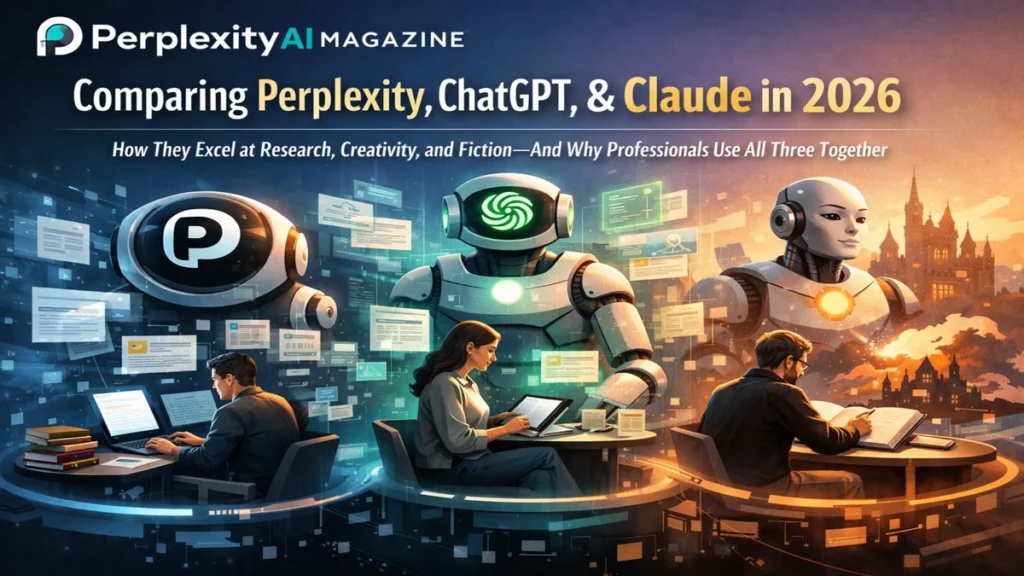
I have been watching the competition between Perplexity, ChatGPT, and Claude evolve not as a race for dominance, but as a gradual separation of cognitive labor. Each system is becoming good at a different kind of thinking, and that specialization is quietly reshaping how analysts, writers, programmers, journalists, and researchers actually work. – perplexity vs chatgpt.
I see Perplexity functioning as a research engine. It retrieves live information, cross-checks sources, and presents answers with citations, reducing uncertainty and minimizing hallucination. I experience ChatGPT as a synthesis engine. It combines ideas, generates language, writes code, and reshapes concepts through long conversational iteration. I use Claude as a narrative engine. It produces emotionally coherent prose, distinct character voices, and stylistically consistent long-form writing.
These are not overlapping strengths. They are complementary ones. That is why I no longer choose a single AI. I build workflows across all three — researching with Perplexity, developing with ChatGPT, and writing with Claude.
For me, understanding these differences is no longer theoretical. It determines whether my reporting is accurate, whether my systems function correctly, whether my stories feel authentic, and whether my decisions are grounded in reality or assumption. In 2026, selecting the wrong model for the wrong task is not inefficient — it is risky.
In this article, I trace how these tools differ, why those differences emerged, and how the division of intelligence is reshaping digital work.
Structural Differences Between the Models
Perplexity is built around retrieval. It searches, verifies, and cites. It is optimized for correctness and transparency. ChatGPT is built around synthesis. It reasons, generates, explains, and iterates. It is optimized for usefulness and flexibility. Claude is built around coherence. It preserves voice, emotional continuity, and narrative structure over long spans of text. – perplexity vs chatgpt.
This architectural distinction produces behavioral differences. Perplexity answers are compact and cautious. ChatGPT answers are expansive and adaptive. Claude answers are restrained, textured, and emotionally grounded.
Each model reflects a philosophy of intelligence. Perplexity treats intelligence as verification. ChatGPT treats intelligence as construction. Claude treats intelligence as simulation of human inner life.
“Perplexity represents a shift from generative confidence to epistemic humility,” notes a senior AI product strategist, describing how retrieval-first systems change trust dynamics.
“ChatGPT is less a tool and more a cognitive environment where ideas can be reshaped continuously,” says a digital creativity researcher studying human–AI collaboration.
“Claude’s strength is not brilliance but believability,” observes a fiction editor who has tested multiple AI writing systems.
Research, Synthesis, and Narrative Compared
| Function | Perplexity | ChatGPT | Claude |
|---|---|---|---|
| Primary Role | Live research and verification | Idea generation and synthesis | Narrative and emotional coherence |
| Web Access | Automatic and native | Optional and manual | Limited |
| Citation Behavior | Inline and consistent | Inconsistent | Rare |
| Risk of Hallucination | Low | Medium | Low–medium |
| Creative Output | Minimal | High | Medium–high |
| Long Context Handling | Medium | High | Very high |
Why Perplexity Dominates Research
Perplexity treats the internet as a live sensor. It does not assume knowledge; it checks it. This makes it essential for time-sensitive work such as policy analysis, financial research, legal monitoring, and scientific updates.
Its design minimizes epistemic risk — the risk of believing something that is wrong simply because it sounds plausible. It trades creativity for certainty, and that trade aligns with professional research needs. – perplexity vs chatgpt.
ChatGPT cannot replace this function without active browsing and careful prompting. Claude is not designed for it at all. This makes Perplexity irreplaceable in domains where facts change daily and accuracy is mandatory.
Read: perplexed definition, Meaning, and Usage Explained
Why ChatGPT Remains the Dominant Generalist
ChatGPT is the most flexible and collaborative system. It handles brainstorming, planning, coding, explanation, rewriting, and iteration better than any other model.
Its strength lies in plasticity. Users can reshape outputs, redirect tone, expand ideas, and refine logic across long conversational arcs. This makes it invaluable in creative development, education, product design, and technical problem-solving. – perplexity vs chatgpt.
ChatGPT is not optimized for being current. It is optimized for being cognitively useful.
Why Claude Excels in Narrative and Fiction
Claude produces prose that feels quieter, more natural, and less mechanical. It preserves character voice across long scenes and maintains emotional continuity. – perplexity vs chatgpt.
This makes Claude particularly effective for novels, screenplays, literary fiction, horror, and narrative nonfiction. Its restraint creates realism. Its consistency creates immersion.
Claude does not chase cleverness. It pursues coherence. That makes it less flashy but more human.
| Narrative Aspect | Claude | ChatGPT |
|---|---|---|
| Character Voice | Distinct and stable | Flexible but blends |
| Emotional Subtlety | High | Medium |
| Dialogue Naturalness | High | Medium–high |
| Scene Continuity | Strong | Moderate |
| Stylistic Restraint | High | Medium |
The Rise of Hybrid Intelligence
Advanced users no longer choose between models. They pipeline them.
They research with Perplexity, build with ChatGPT, and write with Claude. This mirrors human collaboration: researcher, architect, writer. AI is not replacing cognition; it is modularizing it.
This shift marks a structural change in digital labor. Intelligence is no longer singular. It is distributed across specialized systems performing complementary roles. – perplexity vs chatgpt.
Takeaways
- Perplexity is optimized for live research and verification
- ChatGPT is optimized for synthesis, iteration, and construction
- Claude is optimized for narrative, voice, and emotional realism
- Each system specializes rather than competes
- Hybrid workflows outperform single-model workflows
- The future of AI is cognitive division of labor
Conclusion
The AI landscape in 2026 is not converging toward one super-intelligence. It is fragmenting into specialized intelligences.
Perplexity watches the world. ChatGPT reshapes ideas. Claude imagines people.
Together they form a distributed cognition system that reflects how human societies work: some observe, some design, some narrate.
The most powerful users are not those who pick the best model, but those who know when to switch.
FAQs
Is Perplexity better than ChatGPT?
It is better for research and fact-checking, not for creative or iterative work.
Is Claude better for fiction?
Yes, especially for long-form, character-driven, or literary writing.
Can ChatGPT replace Perplexity for research?
Not reliably without browsing and verification.
Do professionals really use multiple AIs?
Increasingly yes, especially in publishing, consulting, and analysis.
Which model is best for students?
Perplexity for sources, ChatGPT for explanations, Claude for writing.
