
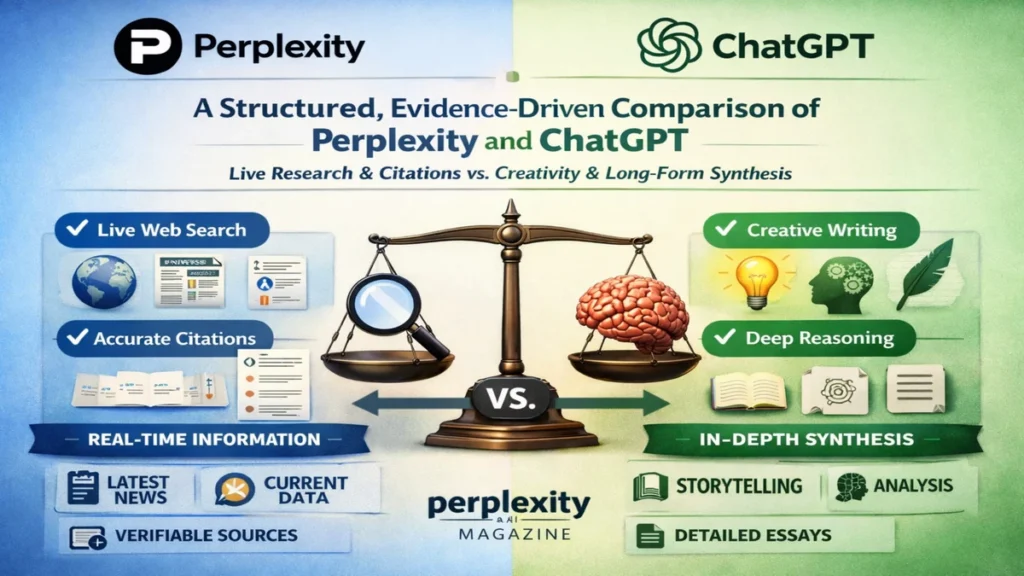
I often get asked whether Perplexity is better than ChatGPT, and the answer is less about which system is “smarter” and more about what each one is built to do. In my experience, Perplexity behaves like a research engine: it searches the live web, pulls in current sources, and attaches citations so I can verify claims instantly. That makes it extremely useful when I need up-to-date information, policy changes, financial data, or factual validation. ChatGPT, by contrast, feels more like a thinking and writing partner. It helps me reason through complex ideas, develop arguments, write long-form content, and explore creative or technical problems with depth and continuity. This difference in design shapes how I use each tool and why I don’t see them as direct competitors. Instead, I see Perplexity as the place I go to confirm what is true right now, and ChatGPT as the place I go to understand what that truth means, how it connects to other ideas, and how to turn it into something useful for readers. – is perplexity better than chatgpt.
Perplexity is built as a research-first system. It automatically searches the web, pulls in current sources, and attaches citations to its answers. Its value lies in transparency and timeliness. When users ask about recent policy changes, financial results, academic research, or news events, Perplexity is designed to reduce guesswork and hallucination by grounding responses in visible sources. – is perplexity better than chatgpt.
ChatGPT, on the other hand, is built as a general-purpose language model optimized for conversation, synthesis, creativity, and reasoning. It is not inherently tied to live web data and does not require sources for every statement. That makes it less reliable for up-to-the-minute facts, but much stronger for tasks that involve long-form writing, storytelling, brainstorming, coding, and step-by-step analysis.
This article does not argue that one tool is objectively better than the other. Instead, it shows that they are optimized for different goals. Perplexity is better when truth, timeliness, and traceability matter most. ChatGPT is better when depth, creativity, and cognitive support matter more. Understanding this distinction is the key to choosing the right tool — or combining both.
Core Design Differences
The most fundamental difference between Perplexity and ChatGPT is how they treat information.
Perplexity treats the web as its primary knowledge source. It assumes that answers should be based on current documents and that those documents should be visible to the user. Its system automatically performs live searches and then synthesizes results into a concise answer with inline citations. This design emphasizes verification and accountability.
ChatGPT treats language modeling as its core function. It draws on patterns learned during training to generate responses and uses external tools, such as browsing or file analysis, only when explicitly needed. This allows it to operate fluidly in creative, abstract, or hypothetical domains where there may be no single correct source.
This difference leads to very different user experiences. Perplexity feels like a research assistant attached to a search engine. ChatGPT feels like a thinking partner attached to a writing desk. – is perplexity better than chatgpt.
Read: Perplexity Careers: Roles, NYC Jobs, and How to Apply
Research Accuracy and Timeliness
For factual and time-sensitive questions, Perplexity usually performs better because it always checks current sources before responding. This reduces the risk of outdated information and makes it easier to verify claims. The user can click through citations, read original documents, and judge credibility for themselves.
ChatGPT can provide factual information, but unless browsing is used or the user already provides sources, it relies on pre-existing knowledge and probabilistic reasoning. This can be sufficient for historical facts, general explanations, or conceptual understanding, but it is less reliable for anything that changes quickly, such as market data, regulations, or breaking news.
As a result, Perplexity is better suited for research, journalism, policy analysis, finance, and academic work where accuracy and traceability are essential.
Creativity, Reasoning, and Narrative Ability
Where ChatGPT clearly outperforms Perplexity is in creative and analytical work.
ChatGPT can generate long-form essays, stories, scripts, technical explanations, and brainstorming sessions with coherence across many paragraphs. It can remember what has been discussed earlier in the conversation, build on it, refine it, and reshape it. This makes it powerful for writing, teaching, coding, strategic thinking, and exploration.
Perplexity is intentionally concise and factual. It is designed to answer questions, not to co-create narratives or engage in extended dialogue. It can explain concepts, but it is not optimized for stylistic richness, emotional tone, or long multi-step reasoning.
If Perplexity answers the question “what is true?”, ChatGPT answers the question “what can we make of this?”.
Feature Comparison
| Aspect | Perplexity Advantage | ChatGPT Advantage |
|---|---|---|
| Real-time information | Automatic live web search | Optional browsing |
| Citations | Inline per factual claim | Optional, aggregated |
| Fact-checking | Strong and transparent | Weaker without browsing |
| Creativity | Limited | Strong |
| Long-form writing | Basic | Excellent |
| Coding and reasoning | Moderate | Strong |
| Conversation depth | Shallow | Deep |
| Ideation and brainstorming | Limited | Strong |
Use Case Fit
Perplexity is best used when the task is about finding, checking, or validating information. Typical examples include policy research, market analysis, academic literature exploration, technical documentation lookup, and news verification. In these contexts, speed, accuracy, and sources matter more than style or depth.
ChatGPT is best used when the task is about producing, shaping, or thinking through content. This includes writing articles, crafting marketing copy, building code, designing prompts, outlining strategies, explaining complex ideas, or exploring hypothetical scenarios. – is perplexity better than chatgpt.
Many professionals naturally adopt a hybrid workflow. They use Perplexity first to gather reliable facts and sources, then use ChatGPT to synthesize that material into reports, narratives, presentations, or analyses.
Practical Examples
A researcher studying AI regulation might use Perplexity to pull the latest legal texts, policy updates, and expert commentary, then use ChatGPT to write a structured report interpreting those materials.
A journalist might use Perplexity to verify claims and gather citations, then use ChatGPT to draft the story.
A developer might use ChatGPT to design and debug code, and Perplexity to look up specific APIs, documentation changes, or version updates.
The tools are not rivals in practice. They are complementary instruments in a single workflow.
Takeaways
- Perplexity is optimized for factual accuracy, timeliness, and source transparency.
- ChatGPT is optimized for creativity, reasoning, and extended conversation.
- Neither tool is universally better; each excels at different cognitive tasks.
- Research-heavy work benefits from Perplexity’s design.
- Creative, analytical, and strategic work benefits from ChatGPT’s design.
- The most effective approach often combines both.
Conclusion
Asking whether Perplexity is better than ChatGPT is like asking whether a calculator is better than a notebook. The answer depends entirely on what you are trying to do.
Perplexity excels at finding and verifying information in the world as it currently exists. ChatGPT excels at thinking, writing, and reasoning about that world. One is an engine for truth retrieval, the other an engine for meaning creation.
In a world where information is abundant but understanding is scarce, both tools matter. Used together, they offer something more powerful than either alone: the ability not only to know what is happening, but to make sense of it.
FAQs
Is Perplexity more accurate than ChatGPT?
It is usually more accurate for current facts because it uses live sources and shows citations.
Is ChatGPT bad for research?
No, but it requires more user guidance and verification, especially for time-sensitive information.
Can ChatGPT cite sources like Perplexity?
Yes, but it does not do so automatically or per claim by default.
Which is better for writing and creativity?
ChatGPT is significantly better for long-form writing, storytelling, and ideation.
Should I choose one or both?
Most users benefit from using both together.
