

Key Takeaways
- Log-based CDC allows data lakes to receive database changes without repeatedly querying entire source tables.
- Streaming changes into a lakehouse requires more than capturing events; pipelines must also handle updates, deletions, ordering, schema evolution, and recovery.
- Apache Iceberg and other transactional table formats help make continuously updated data accessible to multiple analytical engines.
- The operational differences between CDC tools often emerge during backfills, source schema changes, traffic spikes, and destination interruptions.
- Artie provides managed, low-latency CDC with automated schema evolution, backfills, and direct Iceberg support, reducing the engineering work involved in maintaining continuously updated lakehouse tables.
A data lake can store years of operational data, but its usefulness depends on how quickly that data arrives and whether it accurately reflects changes in the source systems. Traditional batch ingestion introduces delays, repeatedly extracts information that has not changed, and can struggle to represent updates and deletions correctly.
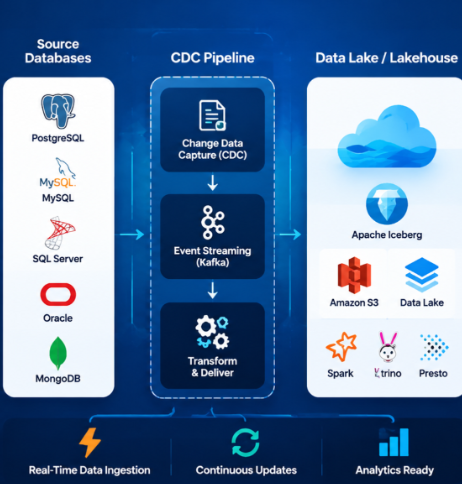
Change data capture (CDC) addresses these problems by identifying inserts, updates, and deletes in operational databases and delivering them to downstream systems. For modern data lakes, however, capturing changes is only part of the challenge. Those events must also be applied correctly to lakehouse tables, remain consistent during schema changes, and recover from interruptions without losing data.
The Best 7 CDC Tools for Real-Time Data Lake Ingestion
1. Artie
Artie is a managed, CDC-first data replication platform designed to move operational database changes into analytical destinations without requiring data teams to build and maintain their own streaming infrastructure.
For data lake architectures, Artie’s direct support for Apache Iceberg is particularly relevant. Instead of treating the lake as a collection of files that downstream jobs must continuously reconcile, Artie can deliver database changes into transactional lakehouse tables that analytical systems can query.
The platform uses log-based CDC to capture source changes and a Kafka-backed architecture to buffer and deliver them. This separates source capture from destination processing, allowing the pipeline to accommodate fluctuations in workload and temporary destination slowdowns.
Artie also manages several tasks that otherwise become ongoing engineering responsibilities. It handles initial backfills, applies inserts and updates, propagates deletions, and detects source schema changes. Its automated schema evolution supports changes such as added columns and modified data types without requiring teams to rebuild their pipelines manually.
The platform supports both current-state replication and history mode. Current-state replication maintains a representation of the latest source records, while history mode preserves successive versions of records for workloads that require historical analysis.
2. Estuary Flow
Estuary Flow is a managed data integration platform built around continuous data movement. Its architecture separates capturing data from materializing it into downstream destinations, allowing one captured stream to serve different analytical systems.
For data lakes, its Apache Iceberg destination is especially relevant. Estuary can capture changes from operational databases and materialize the resulting data into Iceberg tables, reducing the need to build a separate ingestion process for every downstream consumer.
The platform uses collections as an intermediate representation of captured data. This allows organizations to define how source data is collected, transformed, and delivered without tightly coupling each source to one destination.
That architecture is useful when a data lake forms part of a broader analytical environment. The same operational data may need to support real-time reporting, data science, and other downstream applications.
Estuary also supports transformations and managed connectors, helping teams configure continuous ingestion without assembling every component of a custom streaming stack.
3. Fivetran
Fivetran provides managed data integration across operational databases, SaaS applications, and analytical destinations. Its database replication capabilities include log-based CDC, while its broader connector ecosystem allows enterprises to combine operational and application data within the same integration environment.
For data lake use cases, Fivetran supports destinations such as Amazon S3 and Apache Iceberg, alongside conventional cloud data warehouses.
This makes it relevant to organizations that want to consolidate different categories of business data without operating separate ingestion platforms for every source.
Fivetran manages much of the connector lifecycle, including initial synchronization, incremental updates, and supported schema changes. Its enterprise database replication capabilities also draw on technology from HVR, which is designed for high-volume and heterogeneous database environments.
Fivetran’s broad integration capabilities make it relevant when database CDC is one part of a larger enterprise ingestion strategy involving both transactional systems and SaaS data.
4. Debezium
Debezium is an open-source CDC platform that captures database changes and publishes them as event streams. It is commonly deployed with Apache Kafka and Kafka Connect, making it a foundational component in many custom streaming data architectures.
Debezium reads supported database change logs and emits structured events representing inserts, updates, deletes, and other relevant changes.
For a data lake deployment, those events can be delivered through Kafka and downstream sink connectors into object storage or lakehouse systems.
The important architectural distinction is that Debezium primarily handles change capture. Teams remain responsible for designing the downstream delivery and application layers.
A typical implementation may require Kafka infrastructure, source connectors, sink connectors, schema management, error handling, monitoring, and logic for applying updates and deletions correctly to the destination.
This creates considerable flexibility. Organizations can control how events are routed, transformed, retained, and consumed. They can also support multiple downstream applications from the same change streams.
5. Striim
Striim combines CDC with streaming data integration and in-flight processing. It captures changes from operational databases and allows organizations to filter, transform, and route them before delivering the results to downstream analytical systems.
That processing layer is useful when source database records cannot simply be copied into a data lake unchanged.
For example, an enterprise may need to standardize fields, combine data from several sources, apply business rules, or enrich events before they become available to analytical consumers.
Striim supports a range of enterprise database sources and cloud analytical destinations. Its streaming architecture allows data processing to take place continuously rather than relying exclusively on scheduled transformation jobs after ingestion.
The platform also supports monitoring and operational management for enterprise streaming pipelines.
For data lake architectures, Striim can serve as the integration layer between heterogeneous operational systems and downstream storage or analytics services.
6. AWS Database Migration Service
AWS Database Migration Service (AWS DMS) supports ongoing replication of database changes into AWS destinations, including Amazon S3.
Although it is widely used for database migrations, DMS also supports continuous replication through CDC tasks. This allows organizations to capture changes after an initial load and deliver them to a data lake without repeatedly extracting complete source tables.
For AWS-based architectures, the service integrates naturally with S3 and other AWS infrastructure.
A common implementation captures changes from operational databases and writes them into S3, where additional AWS services can catalog, transform, or process the data for analytical use.
Teams also need to plan for schema changes, replication task monitoring, source log retention, and recovery when ingestion falls behind.
AWS DMS is relevant to organizations that want to use AWS-native infrastructure and retain control over how captured changes are processed after landing in their data lake.
7. Qlik Replicate
Qlik Replicate is an enterprise data replication platform that supports log-based CDC across a broad range of operational database environments.
Its source coverage is especially relevant to organizations with heterogeneous infrastructure, including legacy systems that may not be supported by newer cloud-focused ingestion tools.
For data lake architectures, Qlik Replicate can capture operational changes and deliver them to supported cloud storage and analytical destinations. Its enterprise replication capabilities are designed to reduce the need for repeated full-table extraction while keeping downstream environments synchronized with source databases.
The platform supports initial loading followed by ongoing change replication, allowing organizations to establish a destination dataset and then maintain it incrementally.
This approach is useful when a data lake must consolidate information from several generations of enterprise infrastructure. A modern cloud application database may need to coexist with long-running transactional systems that use different database engines and operational conventions.
The Difference Between Landing CDC Events and Maintaining Lakehouse Tables
Capturing database changes is not the same as maintaining an accurate copy of a database inside a data lake.
Consider an orders table containing three records. An initial load copies all three records into the lake. Shortly afterward, one order is updated, another is deleted, and a fourth is created.
A CDC system captures those operations, but the destination can represent them in two fundamentally different ways.
Where Streaming CDC Pipelines Become Difficult to Operate
A pipeline that successfully captures and delivers changes during a demonstration has not necessarily proved that it can operate continuously in production.
Several situations expose the difference.
Schema changes during active replication
Operational databases evolve. Developers introduce columns, change data types, rename fields, and occasionally remove attributes that downstream systems still expect.
A CDC pipeline must identify those changes and determine how they affect the destination.
Adding a column may be straightforward. Changing a data type can be more complicated, particularly when the destination already contains substantial historical data.
If the pipeline cannot accommodate a supported schema change automatically, engineering teams may need to pause replication, modify the destination, and restart processing.
For data lakes serving production analytics, those interruptions can affect several downstream workloads simultaneously.
Initial loads and historical backfills
CDC typically captures new changes, but most organizations also need the historical records that existed before replication began.
An initial load establishes that baseline.
The challenge is coordinating the initial load with ongoing changes. If records are updated while historical data is being copied, the pipeline must preserve the correct final state.
Backfills introduce a related problem. An enterprise may add an existing table to its lakehouse or need to reload historical information after correcting an ingestion issue.
A production CDC architecture should allow these operations without unnecessarily disrupting the streams that are already running.
Destination interruptions and replication lag
A source database does not stop receiving transactions simply because the data lake becomes temporarily unavailable.
When the destination slows down, the CDC architecture needs somewhere to retain changes until processing can resume.
Durable buffering helps separate source capture from destination availability. Recovery mechanisms then need to replay the retained changes without losing records or incorrectly applying the same operation more than once.
Monitoring is equally important. A pipeline can remain technically active while falling progressively further behind its source.
For time-sensitive analytical workloads, a growing backlog may be almost as disruptive as a complete failure.
These operational requirements explain why CDC tools that appear similar during initial configuration can create very different maintenance responsibilities over time.
Designing a CDC Pipeline Around the Destination
The destination should influence CDC architecture from the beginning.
A data lake used primarily for archival storage has different requirements from an Iceberg-based lakehouse serving operational dashboards, AI applications, and continuously updated analytical models.
For an append-only archive, landing structured change events may be sufficient. The system can preserve the history of database operations without immediately constructing a current-state representation.
For analytical tables, the pipeline must also account for updates, deletes, schema changes, and the table format’s transaction model.
For AI and machine learning workloads, freshness may become another architectural constraint. Models and applications consuming operational data need to know not only that records are available, but also how far the destination may lag behind the source.
The distinction between ingestion latency and usable-data latency is especially important. A change may reach object storage quickly but remain unavailable to analytical queries until another process applies it to the destination table.
Three questions that define the pipeline
- What should the destination represent?
An immutable history of events, the latest source table state, or both? - When must changes become queryable?
Immediately after capture, within a defined freshness window, or after scheduled downstream processing? - Who owns the operational work?
A managed CDC provider, an internal streaming team, or separate teams responsible for capture, storage, and lakehouse table maintenance?
These questions help distinguish a straightforward database-to-object-storage pipeline from a continuously maintained lakehouse.
They also reveal why the initial cost of a CDC tool is only one part of the decision. Engineering time spent maintaining connectors, handling schema changes, recovering failed pipelines, and reconciling destination records can become a significant part of the long-term cost of ingestion.
