
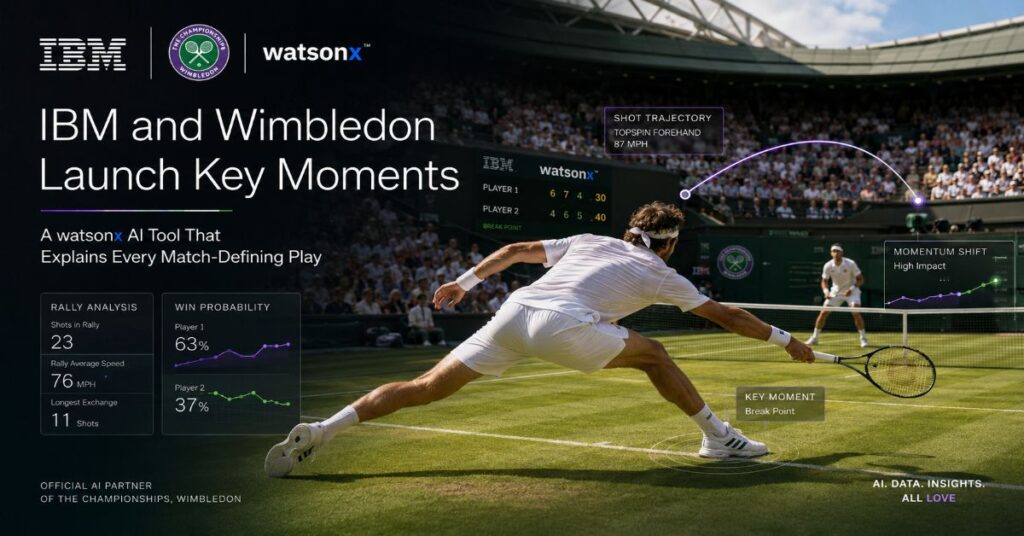
Every tennis fan watching Wimbledon has had the same experience: the on-screen win-probability bar shifts dramatically, and there is nothing telling you why. IBM just built the tool that answers that question before you can ask it.
The All England Lawn Tennis Club and IBM announced on June 22 a new suite of generative AI fan features, built on IBM watsonx, for The Championships, Wimbledon 2026. The headlining addition is Key Moments, a new tool that goes beyond the existing Likelihood to Win probability model to tell fans not just which player is ahead, but which specific shots, breaks, and rallies actually changed the match — and why. Both tools will be available on the fully redesigned Wimbledon app and wimbledon.com when the tournament opens on June 29.
The announcement also captures a second story running alongside the fan features: IBM’s own AI-powered development tool, IBM Bob, condensed what would typically be a months-long, multi-engineer digital migration project into four weeks of work for a single engineer, extracting 15,000 Wimbledon digital assets to the new platform in 47 minutes. The fan experience headline and the behind-the-scenes efficiency story are happening at the same time, on the same platform, under the same 36-year partnership.
Key Developments
- IBM and the All England Lawn Tennis Club announced Key Moments on June 22, 2026 — a new watsonx AI tool that explains which plays define each match and why, available on the Wimbledon app and wimbledon.com from June 29.
- Key Moments complements the existing Likelihood to Win probability model by providing plain-language explanations of momentum swings, not just win-percentage numbers.
- Match Chat, the AI match companion, also returns with an upgrade: answers now include relevant photos and video, delivered by a system of AI agents trained on Wimbledon’s editorial style.
- Behind the scenes, IBM Bob reduced a months-long, multi-engineer content migration to 4 weeks for one engineer and migrated 15,000 digital assets in 47 minutes.
What Happened
According to the joint announcement published on PRNewswire, Key Moments is designed to work alongside the Likelihood to Win feature rather than replace it. Likelihood to Win, the existing tool that has updated dynamically throughout each point since its introduction, shows fans a continuously recalculated win probability; Key Moments adds a layer of narrative explanation above it, identifying the plays that caused the probability line to move — the service that was broken, the return that shifted momentum, the game in the second set that changed the match’s complexion. The new tool covers each gentlemen’s and ladies’ singles match during The Championships.
The upgraded Match Chat feature continues offering a conversational AI companion fans can query in natural language — “What has happened in this match so far?”, “Who has converted more break points?” — but this year adds photos and video to some responses, expanding the system from a text-only answer engine into something more closely resembling a multimedia match guide. Match Chat is built on watsonx Orchestrate, using multiple AI agents and models that have been trained specifically on Wimbledon’s editorial style and tennis terminology to ensure answers use the same language — “gentlemen’s singles” not “men’s singles” — that the tournament itself uses.
The Mechanism: From Probability to Plain-Language Explanation
The distinction Key Moments draws between its function and Likelihood to Win’s is the core of what makes it technically interesting rather than just incrementally better. A win-probability model tells you the current state of the match as a number — Player A has a 73 percent chance of winning — but the number is opaque by design: the model weighs dozens of variables simultaneously, and the weight any single variable carries is not exposed to the fan watching the screen. Key Moments is built specifically to expose that reasoning in accessible language, identifying the plays that moved the probability enough to constitute a meaningful momentum shift.
That is a different technical challenge than simply updating a probability score. Selecting which moments are genuinely significant — distinguishing a routine service game from a break that changed the match’s psychological landscape — requires the model to synthesize current statistics, expert-opinion signals, and match context simultaneously rather than treating each point in isolation. IBM is doing that synthesis on live match data as The Championships unfolds, producing explanations in real time rather than post-match, which sets a much tighter latency requirement than a highlights summary generated after a match ends.
The Backstory
IBM and the All England Lawn Tennis Club renewed their technology partnership in January 2026, with IBM announcing the multi-year extension, committing to a digital foundation intended to deepen global fan engagement well beyond 2026. The partnership is now 36 years old — IBM launched the Wimbledon website in 1995, the mobile app in 2009, and first integrated enhanced AI-powered solutions in 2017, progressively layering more capability each year rather than renegotiating the fundamental relationship.
The consistency of the IBM-Wimbledon partnership over 36 years is itself part of the story of how large sporting institutions have started building durable AI relationships rather than one-off pilot programmes. AELTC reports that its 2025 digital efforts contributed to a 16 percent year-on-year increase in engagement across all platforms, with a 39 percent growth in users registered to myWimbledon — evidence, IBM argues, that the compounding effect of annual AI feature development is showing up in behavior data, not just product announcements. IBM itself has invested heavily this year in articulating the enterprise governance layer underneath these deployments: separate IBM Institute for Business Value research this year found 91 percent of enterprises don’t fully understand their AI vendor dependencies, a finding that makes the transparency design of Key Moments — which is explicitly intended to show why the model believes what it believes — look less like a fan feature and more like a proof of concept for the kind of explainable AI IBM is actively selling to enterprise clients.
IBM Bob, the AI-powered development accelerator behind the platform redesign, is a separate strand of IBM’s watsonx product suite deployed for engineering workflows rather than fan-facing content. Its role in this year’s Wimbledon project — reducing a content-mapping exercise that would typically involve multiple engineers over several months to a four-week solo task — is the clearest on-the-record demonstration IBM has provided of how the tool performs in a real project environment rather than a controlled demonstration.
Reactions
Jonathan Adashek, IBM’s Senior Vice President of Marketing and Communications, framed the 2026 additions as a proof of concept as much as a fan feature: “The new fan experiences, combined with the modernization of Wimbledon’s platforms using IBM watsonx and IBM Bob, are an example of how organizations can use AI not only to deepen engagement, but also to accelerate innovation and unlock new levels of operational efficiency.” The framing positions Wimbledon as a live case study for what IBM sells to enterprise clients, not just a sports partnership.
Usama Al-Qassab, Marketing and Commercial Director at the All England Club, emphasized the audience breadth the features are meant to serve: “It’s our priority every year to remain at the pinnacle of sport and deliver the best possible guest experience.” That language — “guest” rather than “fan” — is Wimbledon’s consistent framing, extending the tournament’s formal hospitality ethos into its digital products rather than treating the app as a distinct, more casual product category.
The Dispute: Explainability Has an Accuracy Problem
Key Moments is being positioned as a tool that makes AI’s match analysis more interpretable, but interpretability and accuracy are not the same thing, and this distinction has an illustrative track record at Wimbledon specifically. In 2025, with the Likelihood to Win feature running on the Wimbledon app, the AI system predicted Emma Raducanu would lose to ninth-seeded Maria Sakkari — a match Raducanu won in straight sets. The tool generated useful conversation and fan engagement, but the confidence with which the probability model presented its prediction was not matched by the outcome.
Key Moments adds a new layer of exposure: instead of simply showing a number that turned out to be wrong, it will now also explain why the model believed what it believed at each point in the match, attributing specific plays as the causes of momentum shifts. When the system gets a match right, that explanatory layer is compelling and informative. When it gets the match wrong — when it identifies a certain break in the third set as the match’s decisive turn, and then the predicted winner loses anyway — the plain-language explanation doesn’t just reveal a wrong number; it reveals a wrong narrative. Whether that increased transparency makes the tool more trustworthy or more noticeably fallible when it misreads a match is the open empirical question that The Championships 2026 will start to answer in practice.
What Happens Next
Both Key Moments and the enhanced Match Chat will go live when The Championships opens on June 29 and run through the July 12 final. The 2026 tournament will be the first real-world performance test of the Key Moments feature at scale, with millions of concurrent users. IBM and AELTC have signaled they plan to explore additional data sources in future years, including racket speed, ball spin, and ball-strike force — sensors that would expand what Key Moments can cite as the cause of a momentum shift beyond the statistics currently available courtside, deepening the explanation layer if and when that data becomes part of the live feed.
Why It Matters
The broader significance of IBM’s Wimbledon rollout this year is not that AI is now present at a tennis tournament — it has been for nearly a decade — but that the type of AI being deployed has shifted from prediction to explanation. The industry has spent several years building models that can accurately calculate what will probably happen; the harder and more consequential challenge is building systems that can explain, in plain language accessible to a non-expert, why the model believes what it believes. This mirrors a wider pattern visible across enterprise AI adoption this year, where research tracking how quickly AI diffuses into real-world workflows consistently shows that transparency and explainability — not raw capability — are the primary barriers to adoption in high-stakes environments. Wimbledon’s global audience and IBM’s public commitment to deploying Key Moments in a live, high-stakes environment make this one of the more watched real-world tests of that explanatory capability in consumer AI this year.
Sources
IBM / PRNewswire joint press release; IBM Newsroom; StockTitan; Computer Weekly; TechFinitive.
