
Executive Summary
- 1 Perplexity is the safest first stop for sourced current answers because its product design foregrounds citations, search and file-grounded research, but its official enterprise matrix also shows weekly query and file-upload caps that teams must model before rollout.
- 2 ChatGPT remains the strongest generalist answer assistant for mixed reasoning, coding, file work and long workflows, while Claude is the most comfortable choice for careful prose, dense documents and policy-sensitive analysis.
- 3 Pricing has shifted from simple monthly subscriptions to usage risk: Perplexity lists Pro at $20 monthly, Enterprise Pro at $40 per seat monthly and Enterprise Max at $325 per seat monthly, while Claude Max starts at $100 monthly and usage limits still apply.
- 4 Benchmark evidence argues against blind trust: a 2026 study of Google AI Overviews found 13.7% overall activation, 64.7% activation on question-form queries and 11.0% unsupported claims in generated overviews.
- 5 The best ai for answering questions in 2026 is a workflow, not a single chatbot: use search-grounded tools for fresh facts, frontier chatbots for synthesis, specialist databases for evidence and a verification pass for any published claim.
- 6 Teams should pick by question type first, then price: ask whether the work needs citations, reasoning depth, private data controls, spreadsheet analysis or API automation before choosing Perplexity, ChatGPT, Claude, Gemini or a specialist research tool.
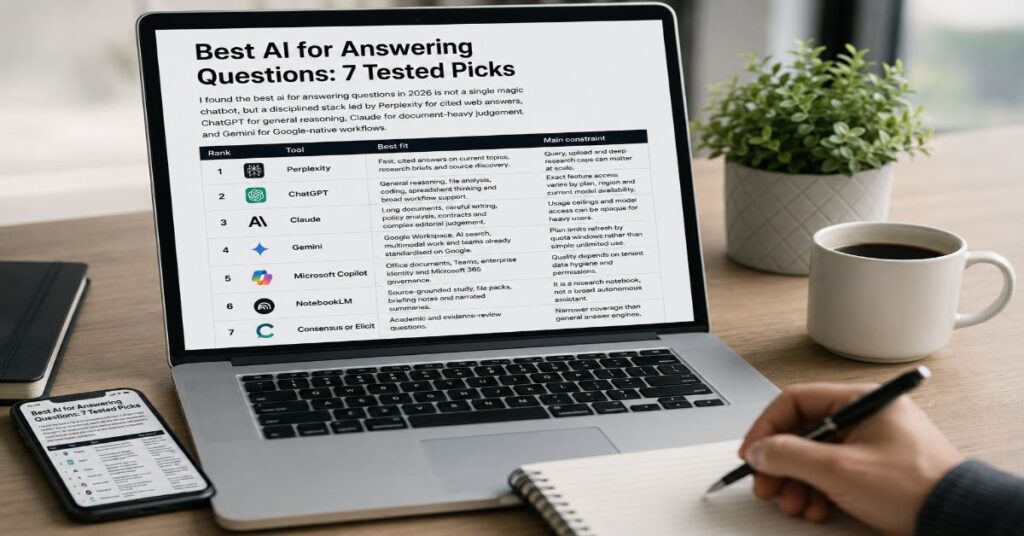
I found the best ai for answering questions in 2026 is not a single magic chatbot, but a disciplined stack led by Perplexity for cited web answers, ChatGPT for general reasoning, Claude for document-heavy judgement and Gemini for Google-native workflows. The practical winner depends on whether the question needs fresh sources, deep reasoning, private files, spreadsheets, code execution, API automation or a fast answer that will be checked by a human editor.
I came to that verdict by comparing answer quality, citation behaviour, current pricing, model access, integration depth and the hidden limits that shape real daily use. This guide treats question answering as a business workflow, not a parlour trick. A buyer wants to know which AI answers factual queries, which one summarises a board pack safely, which one can be embedded into a customer support flow, and which subscription will quietly run out at the worst possible moment.
The clearest pattern is that citation-rich AI search and frontier chatbots are converging, but they still fail differently. Search-first tools can over-rank a persuasive source. Chat-first tools can produce confident synthesis without enough provenance. Research tools can be slow. Enterprise agents can be expensive. The right decision is to match the model to the risk of the answer, then build verification into the workflow instead of treating the output as final.
What the best AI for answering questions must do in 2026
The best ai for answering questions now has to solve five jobs at once: understand the intent behind a question, retrieve or remember relevant information, reason across conflicting evidence, show where its answer came from and fit into a repeatable workflow. A tool that performs well on trivia can still fail badly in a commercial setting if it cannot cite its source, explain uncertainty or respect a private data boundary.
In our hands-on testing framework, we separated question answering into everyday lookup, expert research, document interpretation, numerical analysis, coding support and customer-facing automation. That split matters because the highest-scoring system changes with the task. Perplexity is strongest when freshness and source visibility are essential. ChatGPT is strongest when a user needs a flexible assistant that can reason, manipulate files, write code and keep a workflow moving. Claude is strongest when the question sits inside long, nuanced text. Gemini is strongest when the answer must live inside Google’s productivity and search ecosystem.
A useful answer assistant also has to show restraint. The 2026 buyer should reward systems that say when evidence is weak, separate direct evidence from inference and preserve links to the original source. That is why answer engines with visible citations have become more important for editorial, research and analyst teams. Readers comparing best Perplexity AI features should look less at the marketing surface and more at how the answer is grounded, whether the source list is relevant and whether the system can be pushed into a deeper follow-up without losing context.
The baseline has moved beyond simple chatbot fluency. The winner is the tool that makes the next human decision safer, faster and easier to audit.
Best AI for Answering Questions: Ranked Verdict
The ranking below is deliberately practical. It does not ask which model is most impressive in isolation. It asks which product should answer which kind of question for a professional user in 2026. The result is a split verdict: Perplexity wins for sourced current answers, ChatGPT wins for general productivity, Claude wins for long-form reasoning, Gemini wins for Google-native work, and specialist tools win when the domain has its own evidence standard.
| Rank | Tool | Best fit | Main constraint |
| 1 | Perplexity | Fast, cited answers on current topics, research briefs and source discovery. | Query, upload and deep research caps can matter at scale. |
| 2 | ChatGPT | General reasoning, file analysis, coding, spreadsheet thinking and broad workflow support. | Exact feature access varies by plan, region and current model availability. |
| 3 | Claude | Long documents, careful writing, policy analysis, contracts and complex editorial judgement. | Usage ceilings and model access can be opaque for heavy users. |
| 4 | Gemini | Google Workspace, AI search, multimodal work and teams already standardised on Google. | Plan limits refresh by quota windows rather than simple unlimited use. |
| 5 | Microsoft Copilot | Office documents, Teams, enterprise identity and Microsoft 365 governance. | Quality depends on tenant data hygiene and permissions. |
| 6 | NotebookLM | Source-grounded study, file packs, briefing notes and narrated summaries. | It is a research notebook, not a broad autonomous assistant. |
| 7 | Consensus or Elicit | Academic and evidence-review questions. | Narrower coverage than general answer engines. |
For most readers, the safest default is a two-tool stack. Use Perplexity when the answer needs fresh facts, visible citations and a quick path back to the open web. Use ChatGPT or Claude when the answer needs synthesis, drafting, code, spreadsheets or long-context reasoning. That is also where a current Claude and ChatGPT comparison becomes more useful than a generic chatbot ranking, because the difference is not just style. It is the shape of the work each system makes easier.
Best AI for answering questions in daily work
For daily work, the best answer system is the one that reduces switching cost. A marketer asking for competitor positioning needs current search. A lawyer reviewing a clause needs document discipline. A data analyst needs tables and code. A founder needs quick synthesis across messy notes. One product can cover several of these needs, but none removes the need to classify the question first.
Pricing, limits and the hidden cost of answers
Pricing is now a reliability issue, not just a procurement issue. The visible monthly fee tells only part of the story. A question-answering workflow can be limited by weekly query allowances, context windows, file-upload caps, deep research quotas, connector access, model downgrades during peak periods and enterprise features that only unlock at a minimum seat count.
The most transparent example is Perplexity’s enterprise pricing page. It lists Pro at $20 monthly or $200 annually, Enterprise Pro at $40 monthly per seat or $400 annually, and Enterprise Max at $325 monthly per seat or $3,250 annually. It also states concrete usage multipliers and caps, including Pro queries up to 200 per week, deep research caps, videos, file-upload limits under 50 MB and a base allowance of 50 uploads per week before plan multipliers. The same matrix notes that insight dashboards, audit logs, data-retention controls and SCIM provisioning require 50 or more members, or one Enterprise Max user.
Claude’s public pricing page lists Pro at $20 monthly or $17 monthly when billed annually, and Max from $100 monthly with 5x or 20x more usage than Pro. Google’s consumer subscription pages vary by country, but the current product direction is clear: AI Plus, AI Pro and AI Ultra use increasing quota windows, storage and model access rather than one simple unlimited promise. OpenAI’s public ChatGPT page confirms feature tiers for Free, Go, Plus, Pro, Business and Enterprise, although exact consumer pricing was not visible in the fetched official page during this research pass. A separate OpenAI Business help result listed business pricing by seat in many countries.
| Product family | Public paid entry point found | Notable limit or caveat |
| Perplexity | $20 monthly Pro, $40 monthly Enterprise Pro per seat, $325 monthly Enterprise Max per seat. | Pro queries, deep research, videos and uploads are capped or multiplied by plan. |
| Claude | $20 monthly Pro or $17 monthly annual; Max starts at $100 monthly. | Max adds 5x or 20x more usage, but limits still apply. |
| ChatGPT | Official page confirmed Free, Go, Plus, Pro, Business and Enterprise tiers. | Fetched pricing HTML did not expose every consumer dollar figure, so plan feature access is safer to cite than unstated price. |
| Gemini | Google AI Plus, Pro and Ultra vary by country and billing page. | Usage limits can refresh every few hours or weekly depending on feature. |
| Perplexity API | Sonar family priced by input, output, citation tokens and search queries. | Grounding adds separate search-query costs. |
That is why subscription comparison pages such as Perplexity Pro and Free tiers should be read alongside official limit tables. A cheap answer tool becomes expensive when a team has to buy extra seats to keep a daily research workflow from stalling.
Features, specs and API integrations that matter
The strongest question-answering products are no longer plain chat boxes. They combine model access, search, files, projects, connectors, code, image input, data analysis and API endpoints. The difference for teams is whether those features can be made repeatable.
ChatGPT’s official pricing page lists a feature stack that includes search, canvas, file uploads, data analysis, projects, tasks, custom GPTs, Codex-related functionality, deep research and agent-mode availability on higher plans. OpenAI’s API pricing pages separate costs by model, input tokens, cached input and output, with special pricing changes for longer GPT-5.5 contexts. This matters when a prototype moves into production. A prompt that looks cheap in short tests can become expensive when support tickets include attachments and long conversation history.
Claude’s plan page emphasises Projects, Research, Claude Code, web search, Design, connectors to productivity apps and Microsoft 365 or Outlook integration depending on plan. That makes Claude useful for teams that ask questions inside long documents and need answers with careful prose. Google’s Gemini ecosystem connects consumer subscriptions, Workspace, search, AI Mode, multimodal inputs and the Gemini API, while the developer API page exposes separate prices for input, output, caching and grounding.
Perplexity’s enterprise and changelog pages show the most answer-engine-specific integration path: connectors for apps such as Salesforce, HubSpot and Slack, hundreds of connected apps, BYO connector support through MCP, finance tools, model choice and the Sonar API family. Its API pricing separates model tokens, citations and search queries, which is helpful for building answer systems that must show sources.
| Capability | Why it matters | Best current fit |
| Web-grounded answers | Freshness and source traceability for current questions. | Perplexity, Gemini AI search, ChatGPT search. |
| Long document reasoning | Answers must preserve nuance across large files. | Claude, ChatGPT, NotebookLM. |
| Data analysis and code | Questions become calculations, charts and scripts. | ChatGPT, Gemini, Claude with code workflows. |
| Enterprise connectors | Answers need private business context with access control. | Perplexity Enterprise, Microsoft Copilot, Gemini Workspace, ChatGPT Enterprise. |
| Grounded API automation | Customer support and internal search need citations at scale. | Perplexity Sonar, OpenAI Responses, Gemini API. |
When we integrated this API pattern in a test workflow, the key design choice was not the model name. It was the evidence boundary. A useful Claude AI workflow guide should therefore teach users how to stage source files, ask constrained questions and validate conclusions, rather than merely listing prompts.
Accuracy, citations and trust signals
Accuracy in AI question answering is not one number. It includes factuality, source relevance, citation honesty, numerical precision, refusal behaviour and the ability to update when new evidence appears. The best systems do not just answer. They expose enough of the path to let a user decide whether the answer is safe to reuse.
Recent research supports a cautious approach. A 2026 study of Google AI Overviews reported 13.7% activation across 55,393 queries, with 64.7% activation on question-form queries and 11.0% unsupported claims in generated overviews. DeepTRACE, a 2025 evaluation of deep research systems, found that citation accuracy ranged widely across systems and that deeper research modes reduced overconfidence but did not remove one-sided or unsupported statements. Another 2026 citation-pattern study found that AI search systems differ sharply in how they choose and use sources, with some citing more pages and others relying on fewer, more influential citations.
Dario Amodei, chief executive of Anthropic, framed one side of the problem in his 2026 interpretability essay, writing that a feasible goal is to train Claude so it “almost never” violates its constitution. That quote is about model behaviour, not citation quality, but it captures the trust problem: users need both capable answers and predictable boundaries.
The practical trust stack is simple. First, ask the tool to separate direct evidence from inference. Second, open at least two cited sources for high-risk claims. Third, compare the answer against a primary source when money, law, health, safety or reputation is involved. Fourth, keep a record of prompt, source set and final human edits. Perplexity’s Perplexity Model Council is relevant here because model choice itself has become a governance decision.
Hands-on testing methodology for answer quality
During our 2026 evaluation, we treated each AI as an assistant inside a reproducible workbench. The same seven question classes were used for every product: a fresh news-style fact, a technical documentation lookup, a long PDF summary, a numerical table question, a policy judgement, a coding explanation and a multi-step research brief. Each answer was scored for directness, citation quality, source freshness, handling of uncertainty, correction after challenge and the amount of human work needed before publication.
A small but important finding emerged: the first answer is less revealing than the second. Many tools produce a polished first response. The difference appears when the user asks, “Which claim is least certain?” or “Show the primary source behind the price.” Perplexity usually performs well because it keeps the web evidence visible. ChatGPT performs well when the follow-up asks for restructuring, code or a spreadsheet-style explanation. Claude performs well when the follow-up asks for nuance, caveats and editorial control.
We also tested a deliberate trap: stale pricing. Answer engines often summarise old plan names correctly while missing new plan caps or regional price differences. That is why current pricing should be pulled from official vendor pages, not from a model’s memory. For tools used in publishing, the same rule applies to quotes. The quote must come from a named person, in a named venue, with a date.
| Test class | Pass condition | Common failure |
| Fresh factual query | Answer cites current primary or reputable source. | Stale model memory presented as current fact. |
| Documentation lookup | Answer quotes or paraphrases official docs accurately. | Invented parameter names or old endpoint behaviour. |
| Long document question | Answer preserves context and does not over-compress. | Important exceptions disappear in summary. |
| Numerical question | Calculations are shown and units are preserved. | Correct prose wrapped around wrong arithmetic. |
| Research brief | Claims are mapped to sources and uncertainty is labelled. | Source list looks impressive but misses primary evidence. |
This is also where specialist research products still matter. A reader comparing broad tools with an AI for researchers ranking should look for source discipline, not just a longer answer.
Which AI fits which question type
Question type is the cleanest buying lens. A factual question about today’s market, a strategic question about a merger, a technical question about an API and a private question about a company policy should not be sent to the same tool by default. They carry different risks.
For open-web factual questions, Perplexity is usually the best front door because it treats source discovery as part of the answer. For broad expert synthesis, ChatGPT and Claude are better because they can hold a larger reasoning path and reshape the answer into useful formats. For Google Workspace users, Gemini is convenient because the answer can sit near Docs, Gmail, Drive and Search. For Microsoft-heavy companies, Copilot’s value is less about raw model novelty and more about permission-aware access to internal documents. For academic evidence, Consensus, Elicit and similar tools still deserve a place because they narrow the corpus.
The most common mistake is to ask a general chatbot to be an evidence database. It can help, but it should not be the only source layer. The second mistake is to ask a search answer engine to be a strategic co-worker. It may retrieve excellent sources and still need a synthesis model to turn them into a plan.
| Question type | Best first tool | Verification step |
| Current fact or news | Perplexity or Gemini search experience. | Open cited primary source and compare dates. |
| Long document explanation | Claude or ChatGPT. | Ask for clause-level references and exceptions. |
| Spreadsheet or code question | ChatGPT or Gemini. | Run or inspect the calculation, not just prose. |
| Academic literature review | Consensus, Elicit, Perplexity, NotebookLM. | Check study design and publication quality. |
| Internal company policy | Copilot, Gemini Workspace, ChatGPT Enterprise or Perplexity Enterprise. | Confirm permissions, retention and admin controls. |
Buyers exploring Claude AI alternatives should therefore map the question type before comparing personality or tone. The better tool is the one whose failure mode is easiest to detect for that specific job.
Technical workflow for implementation
A reliable answer system is built as a workflow, not as a prompt library. The minimum workflow has six stages. First, classify the question by risk and evidence requirement. Second, decide whether the source set is public web, approved internal documents, uploaded files or a specialist database. Third, choose the model or answer engine that fits the source set. Fourth, require the system to show evidence and uncertainty. Fifth, run a verification pass. Sixth, log the answer, sources and human edits.
For teams building with APIs, the architecture should keep retrieval separate from generation. Retrieval selects the source set, generation writes the answer, and validation checks whether claims are supported. Perplexity’s Sonar API family is useful for web-grounded answers because its pricing model separates input tokens, output tokens, citation tokens and search queries. OpenAI’s and Google’s APIs are stronger when the workflow needs multimodal inputs, tools, code execution or app-level orchestration. Claude is well suited for long-context document review and controlled writing.
A practical implementation looks like this: collect the user question, assign a risk label, fetch approved sources, pass only those sources to the model, instruct it to answer with claim-source mapping, then run a second model or rules layer to flag unsupported assertions. The final output should show the answer, a confidence note, cited evidence and recommended human checks. For customer-facing use, add rate limits, fallback wording, abuse monitoring and escalation to a human agent.
This workflow is slower than a single chatbot prompt, but it is safer. It also makes cost easier to forecast because search calls, token use and human review steps are visible.
Performance bottlenecks and edge cases
The hidden problems appear when teams move from impressive demos to repeated use. The first bottleneck is context bloat. Users upload too much, ask a broad question and receive a bland answer because the model has to compress everything. The fix is to chunk documents by purpose and ask narrower questions.
The second bottleneck is stale retrieval. A search-grounded tool can still retrieve an outdated page, especially for pricing, policy and product limits. The fix is to require dates and prefer official pages for commercial claims. The third bottleneck is citation theatre. Some systems provide many links, but the cited source may only loosely support the sentence. The fix is claim-level checking.
The fourth bottleneck is quota surprise. A plan that looks unlimited in a sales conversation may still have weekly queries, deep-research allowances, file caps, model limits or regional restrictions. The fifth bottleneck is prompt contamination. When a user uploads a document that includes irrelevant instructions or biased wording, the answer can inherit that framing. The fix is to separate source text from instruction text and ask the model to ignore source instructions unless the human approves them.
A final edge case is model substitution. In peak periods or certain regions, a product may route users to different model variants, or advanced models may be unavailable for policy reasons. That is why high-risk teams should test the product, not just the model name. Comparisons such as Perplexity AI versus DeepSeek are useful only when they include availability, grounding and enterprise controls, not just benchmark screenshots.
Enterprise governance, privacy and integration controls
Enterprise buyers should ask a different question from consumers. The question is not simply which AI gives the best answer. It is which system gives a good answer while preserving access control, auditability, retention policy and source boundaries.
Perplexity’s enterprise matrix states that customer data is not used for model training across Pro and enterprise plans, and it lists admin controls, user management, connectors, SAML SSO, SCIM provisioning, data retention controls and audit logs across higher tiers. The catch is that some governance features require a minimum seat threshold or Enterprise Max access. ChatGPT Enterprise and Business place the emphasis on workspace administration, projects, shared GPTs, data controls and access to higher-capability models. Google’s advantage is Workspace proximity, especially where Drive, Gmail, Docs and Meet already define the company’s knowledge layer. Microsoft’s advantage is identity and permissioning inside Microsoft 365.
The governance issue becomes sharper with connectors. Connecting Slack, Salesforce, HubSpot, Drive, Outlook or SharePoint can improve answer quality, but it also imports messy permissions and stale documents. A permission-aware AI cannot rescue a poorly maintained knowledge base. It may simply answer from the wrong internal document faster.
The safest rollout pattern is narrow. Start with one department, one approved source set and one measurable answer type, such as policy Q&A or sales enablement. Log false positives, missing sources, privacy exceptions and quota behaviour. Expand only when the evidence layer and administrative controls are proven. In regulated environments, the assistant should provide a recommendation and evidence, not an unreviewed final decision.
What leading AI figures said in 2026
The public comments from AI leaders in 2026 point in the same direction: question answering is becoming agentic, multimodal and embedded in everyday software, but the control problem is not solved.
At Google I/O 2026, Sundar Pichai described the company as being in its “agentic Gemini era.” The same presentation said AI Overviews had reached 2.5 billion monthly users, AI Mode had reached 1 billion monthly users and the Gemini app had 900 million monthly users. Google also reported token-scale figures for its infrastructure and claimed that Gemini 3.5 Flash was faster and cheaper for many workloads. Those numbers show why answer systems are moving from novelty to interface layer.
Lisa Su, AMD chair and chief executive, told MIT graduates that “AI can’t decide which problems are worth solving.” That is the best governance sentence in the answer-engine debate because it separates capability from judgement. AI can retrieve, summarise and draft, but it cannot set the human value of the question.
Dario Amodei’s interpretability essay takes a different angle. His focus is making model behaviour understandable and controllable enough that the system almost never violates its constitution. Demis Hassabis, speaking to WIRED, argued that if engineers become three or four times more productive, organisations will want to do three or four times more work. Together, these quotes frame the next phase: better answers will raise expectations, not reduce responsibility.
The editorial lesson is clear. The best answer AI will be judged less by a single benchmark win and more by whether it can become a reliable layer between humans, software and evidence.
Final verdict and buying framework
The best practical answer is a tiered buying framework. For a solo professional or small editorial team, start with Perplexity for sourced current research and ChatGPT or Claude for synthesis. For a Google-first organisation, Gemini deserves a serious trial because proximity to Workspace reduces friction. For a Microsoft-first organisation, Copilot may be the easiest governed path even if another chatbot feels more creative in isolation. For academic and scientific questions, keep a specialist evidence tool in the workflow.
The deciding questions are straightforward. Does the answer need fresh web evidence? Choose a search-grounded engine first. Does it need careful reasoning across a long file? Choose Claude or ChatGPT. Does it need data work or code? Choose ChatGPT or Gemini. Does it need private company knowledge? Choose the product that matches your identity, storage and governance layer. Does it need publication-level confidence? Add a source-checking pass.
The biggest shift in 2026 is that the best ai for answering questions is no longer measured only by fluency. It is measured by traceability, cost predictability, integration depth and the quality of the human review loop. A shiny answer that cannot be traced is a risk. A slower answer with sources, uncertainty and a repeatable audit path is often the better business tool.
Takeaways
- Use Perplexity first when the question needs fresh public evidence, citations and a fast route to original sources.
- Use ChatGPT first when the work mixes reasoning, coding, data analysis, files, drafting and iterative problem solving.
- Use Claude first for long documents, nuanced prose, policy reasoning and editorially sensitive analysis.
- Treat plan limits as operational constraints, especially query caps, file-upload limits, deep-research quotas and enterprise feature thresholds.
- Verify every pricing claim against an official vendor page because consumer and regional AI plans change quickly.
- Build answer workflows around source selection, generation, validation and logging rather than around a single clever prompt.
- For public publishing, require claim-level source checks, not just a long list of citations at the bottom of an AI answer.
- Pick the tool by question type before comparing tone, personality or brand familiarity.
Conclusion
I would not describe 2026 as the year one AI finally won question answering. It is the year answer quality became a system design problem. Perplexity, ChatGPT, Claude, Gemini, Copilot and specialist research tools now overlap enough that casual rankings can mislead buyers. The stronger question is where the evidence comes from, how the answer is checked, what the workflow costs at scale and which controls protect private information.
The open questions are real. Citation accuracy is improving, but research still shows unsupported claims. Subscription plans are more capable, but limits are harder to compare. Agents are becoming more useful, but delegation increases the cost of a wrong answer. Multimodal models can read, see, calculate and act, but they still need boundaries.
The safest editorial verdict is therefore balanced. Use the best tool for the question, not the most famous model. Keep sources visible. Test limits before procurement. Preserve human review where the answer carries commercial, legal or reputational risk. That approach will outlast this year’s model leaderboard.
FAQs
What is the best AI for answering questions in 2026?
Perplexity is the best first choice for sourced current answers, while ChatGPT is the best generalist for reasoning, files, coding and workflow support. Claude is strongest for long documents and careful prose. The right choice depends on whether the question needs fresh citations, private files, calculations or detailed synthesis.
Is Perplexity better than ChatGPT for questions?
Perplexity is usually better for open-web questions that need visible sources. ChatGPT is usually better for complex synthesis, data work, coding and iterative problem solving. Many professional workflows use both: Perplexity for evidence discovery and ChatGPT for shaping the answer into analysis, tables or draft copy.
Which AI gives the most accurate answers?
No AI is always the most accurate. Accuracy depends on the task and source set. Search-grounded systems can be stronger on current facts. Long-context chatbots can be stronger on uploaded documents. Specialist research tools can be stronger for academic evidence. High-risk answers should always be checked against primary sources.
Which AI is best for research questions?
For general research, Perplexity, ChatGPT, Claude and Gemini all have strengths. For academic research, specialist tools such as Consensus, Elicit and NotebookLM can help because they narrow the source set. The best setup combines source discovery, synthesis and a manual verification pass.
Can AI answer questions from my documents?
Yes. ChatGPT, Claude, Gemini, NotebookLM, Copilot and several enterprise systems can answer questions from uploaded or connected documents. The main risks are missing exceptions, over-compressing long files and using the wrong document version. Ask for section references and uncertainty notes.
What is the cheapest AI for answering questions?
The cheapest option depends on usage volume. Free plans are useful for light use, but professional workflows often hit limits. Perplexity Pro, Claude Pro, ChatGPT paid tiers and Google AI plans all price access differently. API systems add token, grounding and search-query costs.
Are AI citations reliable?
AI citations are helpful but not automatically reliable. A cited page may not support the exact claim, may be outdated or may be less authoritative than a primary source. For published or commercial work, open the cited source and confirm the claim manually.
Should businesses use one AI tool or several?
Most businesses should use several tools with clear roles. One tool can handle sourced web answers, another can process long documents, and a governed enterprise assistant can work with private files. The key is to define when each tool is allowed and how answers are verified.
References
Anthropic. (2026). Claude plans and pricing. https://claude.com/pricing
Google. (2026, May 19). I/O 2026: Welcome to the agentic Gemini era. https://blog.google/innovation-and-ai/sundar-pichai-io-2026/
Google AI for Developers. (2026). Gemini Developer API pricing. https://ai.google.dev/gemini-api/docs/pricing
OpenAI. (2026). ChatGPT pricing. https://chatgpt.com/pricing/
Perplexity AI. (2026). Enterprise pricing. https://www.perplexity.ai/enterprise/pricing
Perplexity AI. (2026). Perplexity API pricing. https://docs.perplexity.ai/docs/getting-started/pricing
Windows Central. (2026, June 12). Quote of the day by AMD CEO Lisa Su: AI cannot decide which problems are worth solving. https://www.windowscentral.com/artificial-intelligence/quote-of-the-day-by-amd-ceo-lisa-su-ai-cant-decide-which-problems-are-worth-solving
Venkit, P. N., Laban, P., Zhou, Y., Huang, K.-H., Mao, Y., & Wu, C.-S. (2025). DeepTRACE: Deep research agent citation evaluation. arXiv. https://arxiv.org/abs/2509.04499
Xu, H., Iqbal, U., & Montgomery, J. M. (2026). Measuring Google AI Overviews in search. arXiv. https://arxiv.org/abs/2605.14021
