
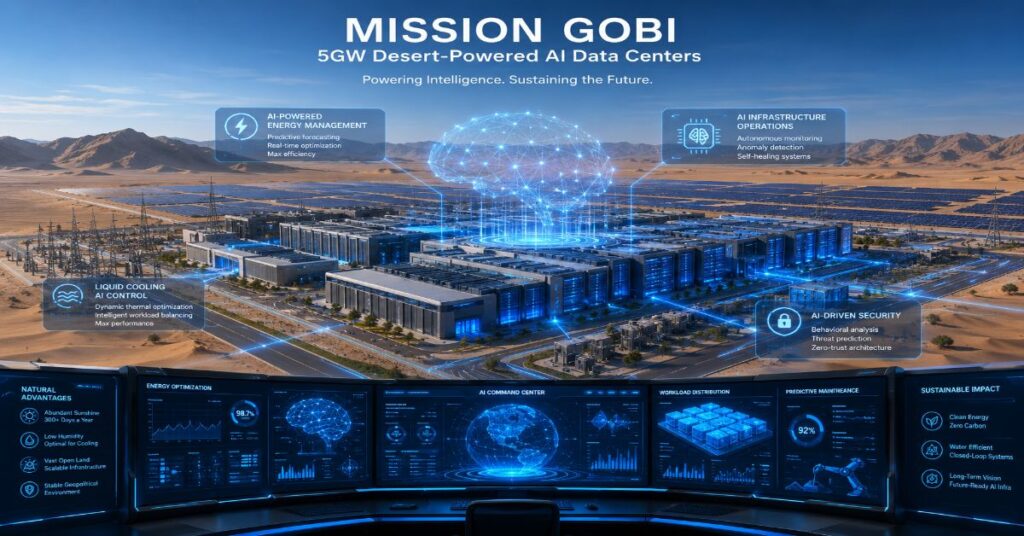
Every gigawatt of new AI computing capacity now comes with an uncomfortable follow-up question: where is the power going to come from, and what is it going to cost the grid, the climate, or the water table to get it there? Envision’s answer, unveiled this week in Paris, is to stop asking the grid at all.
At VivaTech 2026, the Shanghai-based green technology company announced Mission Gobi, a global initiative to build 5 gigawatts of green AI data center capacity in desert and arid regions by 2030. Rather than connecting new AI computing clusters to already-strained national grids, the plan is to build renewable generation, storage, and computing together as a single off-grid system, sited deliberately in places most power planners have spent decades avoiding: deserts.
Founder and chief executive Lei Zhang framed the announcement as a structural fix rather than an incremental one, arguing that the traditional power system was never designed for AI-era scale and speed. The pitch is bold even by AI-infrastructure standards: Envision says developing even 1 percent of the world’s desert and Gobi-region land could support terawatt-scale computing capacity at competitive cost — a claim that, if it holds up, would reshape where the next decade of AI infrastructure gets built.
Key Developments
- Envision announced Mission Gobi on June 18, 2026 at VivaTech in Paris — a global plan to build 5GW of green AI data center capacity in deserts and arid regions by 2030.
- The model pairs off-grid renewable generation, storage, and computing on-site, avoiding new connections to already-strained national power grids.
- It builds on Envision’s existing Inner Mongolia projects — the Chifeng facility, billed as the first AI data center running entirely on direct green power, and the Ulanqab Galaxy Campus, a gigawatt-scale build using the same model.
- The press release does not address cooling-water requirements — a separate and growing flashpoint for AI data centers sited in deserts.
What Happened
According to Envision’s announcement, Mission Gobi is structured as an open, replicable blueprint rather than a single flagship project: the company says it will work with governments, utilities, technology companies, infrastructure investors, and local partners worldwide to deploy clean, flexible power systems integrated directly with computing infrastructure. No specific first sites, government partners, or capital commitments were named in the launch materials, and Envision did not disclose a financing structure or construction timeline beyond the 2030 target for 5 gigawatts of cumulative capacity.
The announcement leans heavily on two existing Envision projects as proof points. In Chifeng, in China’s Inner Mongolia region, the company already operates what it describes as the world’s first AI data center running entirely on directly connected green power. In nearby Ulanqab, the Envision Galaxy Campus is under construction as what the company calls the world’s only gigawatt-scale AI data center powered by direct renewable connection rather than grid draw. Mission Gobi is explicitly framed as an attempt to take that template global.
The Mechanism: Why Deserts, and Why Off-Grid
The logic behind siting AI data centers in deserts is more than a marketing flourish; it has an established basis in energy research. A peer-reviewed analysis published in the journal Energy Conversion and Management earlier this year modeled exactly this approach — off-grid, hybrid wind-solar-storage systems co-located with data centers in desert regions — and found the strategy economically and technically viable at scale. The researchers behind that work noted that prior proposals to export desert solar power over long distances, such as Sahara-to-Europe transmission schemes, foundered on the cost of moving electricity across continents. Data centers sidestep that problem entirely: instead of transporting power, they transport the output of power — computation — over fiberoptic and satellite links that are dramatically cheaper to build and operate than high-voltage transmission corridors.
Remoteness carries a second, less obvious advantage. The same desert siting that gives access to abundant land and sunlight also keeps the noise and waste heat of hyperscale computing away from population centers, a recurring source of local friction for data center projects sited closer to cities. The tradeoff is that off-grid, desert-based systems must solve their own reliability problem without help from a backup grid — pairing solar and wind generation with enough battery storage to smooth out intermittency, and that storage layer is precisely where Envision’s pitch concentrates its technical claims, built on the AI Power System architecture the company has spent recent years developing to forecast weather and dispatch energy at the system level rather than the device level.
The Backstory
Envision is not a newcomer making an opportunistic AI announcement; it is the world’s second-largest wind turbine manufacturer pivoting a two-decade-old energy business toward AI-native infrastructure. Lei Zhang has spent the past several years arguing that falling renewable costs and AI-driven grid optimization have crossed a historic threshold in China, where it is now cheaper to build new wind and solar capacity than to keep aging coal plants running. Zhang has described an AI “brain” — a system that can forecast two weeks of weather patterns in roughly a minute and dispatch energy at the millisecond level — as the missing ingredient that finally makes intermittent renewables reliable enough to run hyperscale computing directly, without grid backup.
That pitch has already traveled well beyond China. Envision signed a 30-year service agreement with Casa dos Ventos, Brazil’s largest renewable energy developer, in January 2026, explicitly flagging future AI data center cooperation as part of the relationship. Zhang has also pursued the model in Canada, pitching Inner Mongolia-style off-grid AI-managed energy systems to Canadian officials as a way to solve the country’s own power-constrained AI ambitions. Mission Gobi formalizes that pattern of opportunistic, country-by-country pitches into a single named global initiative with a public capacity target attached to it.
Reactions
Zhang’s own framing of Mission Gobi emphasizes scale and inevitability rather than caution, describing the initiative as a system-level approach that integrates renewable energy, storage, grid infrastructure, and computing to deliver clean power at a cost competitive with conventional grid connections. He has cast the broader shift toward AI-managed renewables in sweeping historical terms, at one point comparing the spread of cheap Chinese clean-energy technology to the historical diffusion of papermaking — a comparison that signals how Envision wants Mission Gobi understood: not as a single data center project, but as exportable infrastructure technology.
Not every reaction to Envision’s broader model has been as enthusiastic. Environmental group Greenpeace has previously pushed back on the remote, mega-scale energy center approach Envision favors, arguing that distributed generation closer to where people actually live — such as China’s rooftop solar program, which has turned millions of farmers into small-scale power producers — is a more efficient and equitable use of renewable capacity than concentrating gigawatts of generation in remote deserts to feed AI computing demand located somewhere else entirely.
The Dispute: Clean on Carbon, Untested on Water and Geopolitics
Mission Gobi’s entire framing is built around solving AI’s carbon and grid-strain problem, and on that narrow measure the desert-renewable model has real technical merit. But a growing body of research argues that carbon is no longer the only — or even the most pressing — environmental constraint on AI infrastructure. A United Nations University study published this month found that AI data centers could consume enough water by 2030 to meet the basic annual domestic needs of 1.3 billion people, and the report’s lead author was explicit that the dynamic cuts in more than one direction: switching to renewable energy sources can reduce a data center’s carbon footprint while simultaneously increasing its water and land footprint, depending on which renewable technology and cooling architecture is used. “Low-carbon is not automatically low-water or low-land,” the report states.
Envision’s announcement makes no mention of cooling-water sourcing for Mission Gobi’s planned facilities, which matters because water, not energy, has become the sharper flashpoint for data centers specifically sited in deserts. Oracle’s Project Jupiter facility in the New Mexico desert became a local controversy this year over an 11-million-gallon one-time fill for its closed-loop cooling system, in a county where underground water levels are already falling. A Guardian analysis cited separately found that roughly two-thirds of new US data centers planned for construction are slated for land that has experienced drought within the past year. Whether Mission Gobi’s facilities will rely on water-intensive evaporative cooling, more expensive closed-loop systems, or fully waterless approaches — the kind already in commercial deployment at MIT spinout Ferveret’s nuclear-reactor-cooled AI data centers — is left entirely unaddressed in the launch materials.
There is also a geopolitical dimension that Envision’s pitch does not engage with directly. Because the company’s signature off-grid model depends on an AI dispatch system Zhang himself describes as the indispensable ingredient, adopting Envision’s architecture means adopting a Chinese-engineered control layer at the heart of a country’s energy infrastructure — not just buying turbines. That tension surfaced explicitly in Canada earlier this year, where Ontario Premier Doug Ford invoked the need to guard against Chinese state influence over critical infrastructure in response to Zhang’s pitch, even as Envision continued courting federal-level interest in the same country. For governments outside China weighing Mission Gobi participation, the calculus is not only about megawatts and water tables but about who, ultimately, controls the software dispatching the power.
What Happens Next
Mission Gobi is, for now, a named initiative with a global capacity target rather than a portfolio of contracted sites. The clearest test of whether the 5-gigawatt-by-2030 figure is realistic will be how quickly Envision converts the partnership conversations it says are already underway — with governments, utilities, and infrastructure investors — into named projects with disclosed locations and financing, following the template already running at Chifeng and Ulanqab. Given the pace of AI infrastructure announcements generally in 2026, expect the first concrete Mission Gobi site to be named within the next two to three quarters, and expect water-sourcing and cooling architecture to be a question journalists and regulators press on once it is.
Why It Matters
Mission Gobi arrives at a moment when the industry’s energy story has split in two. One half of the AI infrastructure conversation, dominated by hyperscalers in the US and Europe, is increasingly about nuclear power purchase agreements, on-site gas generation, and fights with utilities and residents over grid connections and water rights. Envision’s pitch is a structural alternative to all of that: skip the grid fight entirely by building somewhere nobody else wants the land. If it works at the scale Envision is promising, it offers a genuine path to decoupling AI’s computational growth from both fossil-fuel dependence and grid congestion in exactly the way the company claims. If it doesn’t — if water, financing, or geopolitical trust turn out to be harder constraints than energy ever was — Mission Gobi becomes a case study in how even a technically sound climate fix for AI can run into the same resource and sovereignty questions it was designed to avoid.
Sources
Envision Energy / PRNewswire; Bloomberg; United Nations University Institute for Water, Environment and Health; CBC News; Data Centre Magazine; Tom’s Hardware.
