
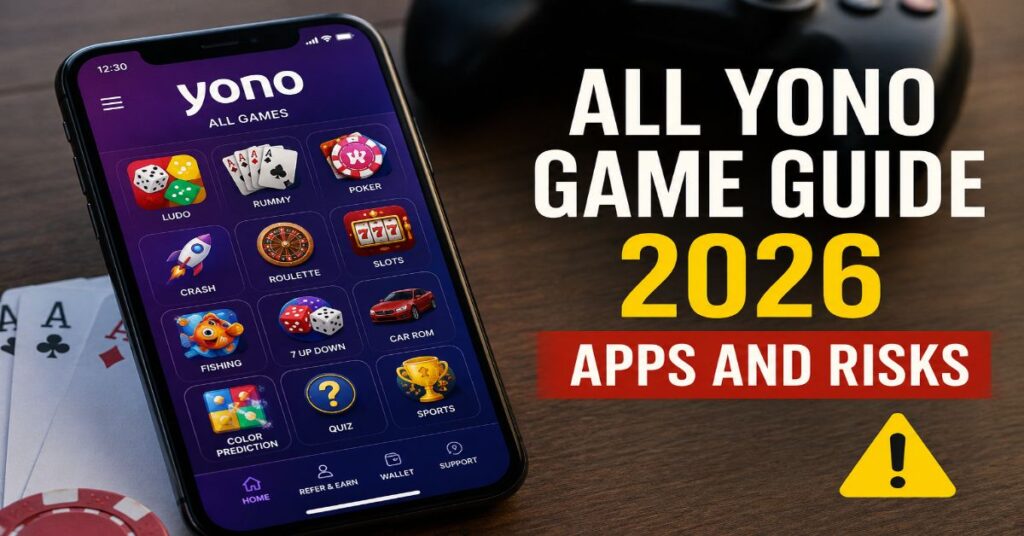
When i evaluate all yono game as a search topic, the user intent is clear: readers want a complete list of Yono-branded gaming apps, a plain explanation of what these apps do, and a safety-first view before they install an APK or deposit money. The term usually points to Indian-facing real-money gaming and earning apps across rummy, slots, spin games, arcade games, bingo, Teen Patti and related bonus-driven products. It does not point to one official publisher with one verified product line.
That distinction matters for all yono game searches. A familiar brand pattern can make separate apps feel connected, even when ownership, licensing, payment handling and privacy practices are not equally visible. The supplied app list includes names such as Yono Rummy, Yono Slots, Yono 777, Jaiho Spin, Bingo 101, Teenpatti Master, Yono Vip and Yono All Games. These names sit inside a wider mobile gaming market where referral bonuses, sign-up rewards and low withdrawal claims compete for attention.
For readers who compare risky digital tools, Perplexity AI Magazine has also covered online platform safety and legal risk patterns, which is relevant because the first question should be trust, not convenience.
What the Yono App Ecosystem Means in 2026
The Yono app ecosystem is a search phrase used for a cluster of Yono-branded or Yono-adjacent gaming applications. The group commonly includes card games, chance-based reel games, spin games, bingo-style experiences, arcade apps and promotional earning platforms. Some pages describe sign-up bonuses from roughly Rs. 500 to Rs. 1,500, minimum withdrawals near Rs. 100 and smaller bonus amounts around Rs. 91 to Rs. 100, but these figures should be treated as promotional claims until verified inside the app’s current terms.
The important editorial finding is fragmentation. A user may see similar app names and assume there is a single parent company, a shared withdrawal system or a common support desk. That assumption is risky. Similar naming can be a marketing pattern rather than a legal or technical relationship. Each app should be checked separately for developer identity, privacy policy, payment rails, user agreement, grievance process and local compliance.
Our desk-level review of the supplied app taxonomy found five practical buckets: rummy, slots, spin, arcade or bingo and Teen Patti. The categories overlap in some lists, which is another trust signal to examine. Clear product ecosystems usually keep names, ownership and category labels consistent. Low-friction earning app ecosystems often blur those details because the acquisition funnel matters more than long-term brand clarity.
| Category | Examples from supplied list | User intent | Primary risk signal |
| Rummy games | Yono Rummy, Rummy 91, Rummy 365, Boss Rummy, Jaiho Rummy | Card play, contests and withdrawals | Skill claims may not remove real-money risk or legal complexity |
| Slots games | Yono Slots, 567 Slots, Super Slots, Jaiho Slots, Good Slots | Fast casual play and bonus discovery | Chance mechanics, high volatility and loss-chasing risk |
| Spin games | Yono 777, Jaiho Spin, Spin Winner, Spin Gold, SVIP 777 | Short sessions and reward loops | Frequent micro-decisions can increase overspending |
| Arcade and bingo | Yono Arcade, Bingo 101, IND Bingo, 789 Jackpots | Simple mobile games and jackpot framing | Unclear odds, bonus terms and app provenance |
| Teen Patti and other | Teenpatti Master, Teenpatti Gold, Yono Vip, Jaiho Win | Traditional card entertainment and earning claims | Regulatory status and withdrawal transparency |
System Analysis: How the Yono App Funnel Usually Works
The Yono-style app funnel is built around low entry friction. A user discovers a name through search, a messaging group, a short video, a referral post or a download page. The landing material usually highlights bonuses, minimum withdrawal amounts and quick registration. The next step is often an Android install, sometimes outside mainstream app-store discovery. That is where the risk profile changes from entertainment to device security and financial exposure.
A typical flow has four layers. First is acquisition, where a bonus or referral promise pulls the user in. Second is identity and wallet setup, where phone numbers, UPI details or KYC documents may be requested. Third is gameplay, where small wins and promotional credit can create confidence. Fourth is withdrawal, where rules around wagering, account review, minimum balances and bonus eligibility determine whether the user can actually cash out.
This is why the Yono app cluster should be judged as a system, not just a list. The visible game is only one part of the product. The more important parts are account controls, payment processing, anti-fraud checks, customer support and dispute resolution. Google Play’s official gambling policy says real-money gambling apps are allowed only in select countries and only when developers meet requirements such as licensing or authorization in the relevant jurisdiction (Google, 2026). That policy lens is useful even when an app is distributed outside Google Play because it shows what a regulated app ecosystem expects from operators.
The hidden limitation is that APK availability can create a false sense of access. An install file may work technically while still failing basic trust checks. The user should not treat a working login screen as proof of legitimacy, legal permission or payout reliability.
The same risk pattern appears across other unofficial app and platform topics. Our guide to APK risks and gambling claims in regional markets explains why installation convenience can hide ownership and payment risk.
Features, Bonuses and Withdrawals: What to Check Before Playing
The most searched features are sign-up bonuses, referral rewards, low minimum withdrawals and fast cash-outs. These are acquisition tools. They are not proof that an app is safe or financially favorable. A Rs. 500 sign-up bonus can be attractive, but the key question is whether it is withdrawable, locked behind wagering rules, limited to specific games or cancelled if the account triggers a review.
Users should read bonus terms in three places: the promotion page, the wallet screen and the withdrawal policy. If those three areas use different wording, that is a friction point. The safest practical workaround is to take screenshots of the offer terms before depositing and again before claiming. It will not guarantee a dispute outcome, but it creates a record if support later interprets the promotion differently.
A second overlooked threshold is the true cost of withdrawal. A Rs. 100 minimum withdrawal sounds simple, but the user may still face KYC checks, bank verification, cooldown windows, rejected bonus funds, transaction fees or account review. The right comparison is not advertised minimum withdrawal versus zero. It is advertised minimum withdrawal versus the total conditions needed to receive money in a bank or wallet account.
| Claim to verify | Why it matters | Practical check |
| Sign-up bonus | May be promotional credit rather than cash | Read wagering and withdrawal rules before playing |
| Minimum withdrawal | Low threshold can still require KYC and review | Check wallet page, terms page and user complaints |
| Fast payout | Speed depends on verification and payment rails | Test support response before large deposits |
| Referral income | Can encourage risky promotion to friends | Confirm whether referrals require deposits or play volume |
| APK download | Can bypass app-store policy checks | Install only after verifying developer identity and permissions |
Indian Regulatory Context: Why 2025 Changed the Risk Calculation
India’s online gaming policy environment changed sharply in 2025. Government material for the Promotion and Regulation of Online Gaming Bill, 2025 described a complete ban on online money games, including games of chance, games of skill and games combining both elements. It also stated that advertising and promotion would be prohibited and that financial transactions related to these platforms could not be processed by banks or payment systems (Ministry of Electronics and Information Technology, 2025).
That context affects Yono-branded searches directly. Even when a game presents itself as rummy, spin, arcade or entertainment, the presence of deposits, winnings, cash withdrawals or betting-like mechanics can move the user into a more sensitive category. Users should avoid relying on old forum posts, old APK pages or copied promotional claims because legal and payment conditions may have shifted after publication.
The World Health Organization’s 2024 gambling fact sheet also frames gambling as a public health issue, warning that gambling can threaten health and divert household spending from essentials (World Health Organization, 2024). That matters for mobile-first apps because the phone compresses discovery, deposit, gameplay and repeat engagement into one device. The shorter the path from impulse to payment, the more important spending limits become.
There is a counterargument from industry operators: overly broad restrictions may push users toward offshore or unregulated platforms with fewer consumer protections. That concern is plausible. Reuters reported in August 2025 that major Indian gaming apps suspended real-money features after the legislative shift, while companies weighed legal challenges and warned about market disruption (Reuters, 2025). The user-level lesson remains the same: uncertain regulation increases the need for caution, not experimentation.
Risks and Trade-Offs Users Should Not Ignore
The first risk is financial loss. Rummy, Teen Patti, slots and spin games may feel different, but any model involving stake, uncertain outcome and reward can create loss-chasing behavior. Slots and spin games deserve particular caution because quick rounds, bright feedback and small near-miss experiences can encourage repeated play.
The second risk is identity exposure. Real-money apps may ask for phone numbers, bank details, UPI information or identity documents. If the operator is unclear, the user is not only risking a deposit. The user may be sharing reusable personal data with a party that is hard to locate later.
The third risk is payment irreversibility. UPI and wallet transactions are fast by design. Speed helps legitimate commerce, but it also reduces the time users have to stop and evaluate a suspicious request. A promotional app that pushes urgent deposits, extra verification payments or account-unlock fees should be treated as high risk.
The fourth risk is support asymmetry. A platform can automate deposits in seconds but handle withdrawals manually. That mismatch is a practical warning sign. Users should test customer support with a non-sensitive question before depositing. Slow, scripted or evasive answers are not proof of fraud, but they reduce confidence.
For a broader comparison of suspicious service patterns, our coverage of mirror-domain safety and malware exposure shows how confusing domains, redirects and unclear ownership can increase user risk.
Market, Cultural and Real-World Impact
Yono-style apps sit at the intersection of entertainment, aspiration and financial pressure. Their marketing often speaks the language of quick rewards rather than long-term play. That makes them culturally powerful in mobile-first communities where low deposit amounts and peer referrals can spread faster than formal reviews.
The real-world impact is visible in how users search after the first encounter. They do not only ask what the game is. They ask whether it is safe, whether withdrawals work, whether the APK is harmful and how to recover money. Those follow-up searches reveal a trust gap. A mature gaming product should reduce uncertainty before the user deposits, not after a dispute begins.
There is also a platform mismatch. Mainstream app stores and payment providers increasingly emphasize verified developers, policy compliance and user protection. Low-trust APK ecosystems often grow through the opposite path: direct links, referral groups and promotional urgency. That mismatch is likely to widen as regulators, banks and app stores demand clearer accountability.
This trust gap is not limited to gaming. Our review of consumer-facing digital tools for Indian readers found that simple content can help users, but sensitive topics need stronger trust signals.
Three Original Insights for Safer Evaluation
- Brand similarity is not ownership proof. Treat every Yono-branded app as separate until the developer, legal entity, support channel and payment processor are verified.
- The withdrawal page is more important than the bonus page. A large promotional offer has little value if the terms, KYC process or payout route are unclear.
- Compliance is becoming a user feature. In 2026, visible licensing, age controls, responsible gaming tools and dispute channels may matter more than a slightly higher bonus.
The Future of All Yono Game in 2027
The future of the Yono gaming cluster in 2027 will likely be shaped by enforcement, app distribution and payment controls. If Indian policy continues to restrict online money games, compliant operators may shift toward esports, social games, educational games or non-cash entertainment formats. Less transparent operators may move toward mirror domains, private APK channels and offshore payment routes. That would increase risk for users because support and accountability become harder to verify.
App stores may also play a larger gatekeeping role. Google’s real-money gambling policy already emphasizes licensing, jurisdictional eligibility and developer compliance (Google, 2026). A more verified app environment would help users identify compliant operators, but it may also leave non-compliant brands circulating through informal downloads. The practical result is a two-tier discovery market: verified apps with more friction and unofficial apps with more risk.
By 2027, the strongest legitimate gaming platforms will probably compete on trust infrastructure: clear ownership, age checks, spending controls, transparent odds where relevant, faster grievance handling and responsible gaming features. The weakest platforms will keep competing on bonus size. Users should recognize that difference. A bigger welcome reward is not a substitute for a safer system.
Key Takeaways
- These searches describe a broad app cluster, not one verified official product.
- Rummy, slots, spin, arcade, bingo and Teen Patti apps carry different gameplay patterns but similar payment and trust concerns.
- APK installation risk should be evaluated before the user shares phone, UPI or identity details.
- India’s 2025 online gaming policy shift makes real-money features and financial transactions more sensitive.
- Withdrawal rules matter more than advertised bonuses because payout friction is where many disputes begin.
- Users should treat unclear ownership, mirror links, urgent deposit prompts and vague support as warning signs.
- The safest 2027 direction for the category is transparent compliance, not louder promotions.
Conclusion
The Yono games ecosystem is best approached as a risk-review topic, not simply a download list. The app names may look familiar, and the bonuses may seem generous, but the core decision is whether a platform is identifiable, compliant, secure and fair in its withdrawal process. A user who checks only the reward amount is evaluating the least reliable part of the offer.
The balanced view for all yono game readers is that mobile games can be entertainment when rules are clear, spending is controlled and the operator is accountable. The problem begins when real-money mechanics, APK distribution, unclear ownership and promotional urgency combine. In that environment, users should slow down, verify details and avoid depositing money they cannot afford to lose. The most useful question is not which Yono app pays the highest bonus. It is which platform can prove it deserves trust before the first deposit.
Readers comparing practical app choices outside gaming may also find our guide to productivity apps and account security tools useful for building safer mobile habits.
FAQ
What does the Yono games list mean?
It means a broad collection of Yono-branded or Yono-adjacent gaming apps, often including rummy, slots, spin games, arcade games, bingo, Teen Patti and bonus-based earning apps. It should not be assumed to mean one official game from one verified developer.
Is all yono game safe to download on Android?
Safety depends on the specific app, source and permissions. Users should verify the developer, avoid unknown APK links, read the privacy policy, check payment identity and look for independent complaints before installing or depositing money.
Which apps are included in the all yono games list?
Commonly cited names include Yono Rummy, Rummy 365, Yono Slots, Yono 777, Jaiho Spin, Bingo 101, Teenpatti Master, Yono Vip and Yono All Games. Lists vary, so each app should be checked individually.
Can users withdraw money from Yono Rummy or similar apps?
Some apps advertise low withdrawal thresholds, but withdrawals may depend on KYC, wagering rules, payment verification, bonus eligibility and account reviews. Users should read the withdrawal policy before depositing.
Are Yono rummy and Yono slots the same type of game?
No. Rummy is usually framed as a card game with skill elements, while slots and spin games are chance-driven formats. Both can involve financial risk when deposits and withdrawals are present.
What are the biggest risks of Yono earning apps?
The biggest risks are financial loss, unclear ownership, APK security, identity exposure, delayed withdrawals, misleading bonuses and changing legal rules around real-money gaming.
How should a user review a Yono app before playing?
Start with developer identity, app source, permissions, privacy policy, payment route, withdrawal terms, support responsiveness and user complaints. If any of these are unclear, avoid depositing money.
Methodology
This article was prepared from the production brief supplied for Perplexity AI Magazine and checked against current public sources. The supplied brief provided the core keyword, app taxonomy, promotional claims and required editorial structure. Our desk then validated the wider context through official policy pages, public health guidance and current reporting on India’s online gaming sector.
Primary validation sources included Government of India material on the Promotion and Regulation of Online Gaming Bill, Google Play’s real-money gambling app policy, World Health Organization gambling guidance and Reuters reporting on the 2025 India real-money gaming market response. Internal links were selected from live Perplexity AI Magazine pages that relate to app safety, digital tool risk, APK concerns, platform trust and mobile security habits.
References
Google. (2026). Real-money gambling, games, and contests. Google Play Console Help. https://support.google.com/googleplay/android-developer/answer/9877032
Ministry of Electronics and Information Technology. (2025). Promotion and Regulation of Online Gaming Bill, 2025. Government of India. https://static.pib.gov.in/WriteReadData/specificdocs/documents/2025/aug/doc2025821618101.pdf
Reuters. (2025, August 22). India’s Dream11, top gaming apps halt money-based games after ban. Reuters.
Reuters. (2025, August 25). Flutter shuts down money-based online games in India following law change. Reuters.
World Health Organization. (2024, December 2). Gambling. https://www.who.int/news-room/fact-sheets/detail/gambling
Perplexity AI Magazine. (2026). Y2mate: Safety, legality and better ways to download video in 2026. https://perplexityaimagazine.com/blog/y2mate-safety-legality-guide/
Perplexity AI Magazine. (2026). Nagatoto168.com -cuan explained: Security risks, APK safety concerns and Indonesia’s online gambling regulations. https://perplexityaimagazine.com/blog/nagatoto168-com-cuan-apk-risks-safety/
Perplexity AI Magazine. (2026). Xbatcat: Safety, legality and the real cost of free manhwa sites. https://perplexityaimagazine.com/blog/xbatcat-safety-legality-guide/
Perplexity AI Magazine. (2026). Best productivity apps for work, focus, time management and personal organization in 2026. https://perplexityaimagazine.com/blog/best-productivity-apps/
