
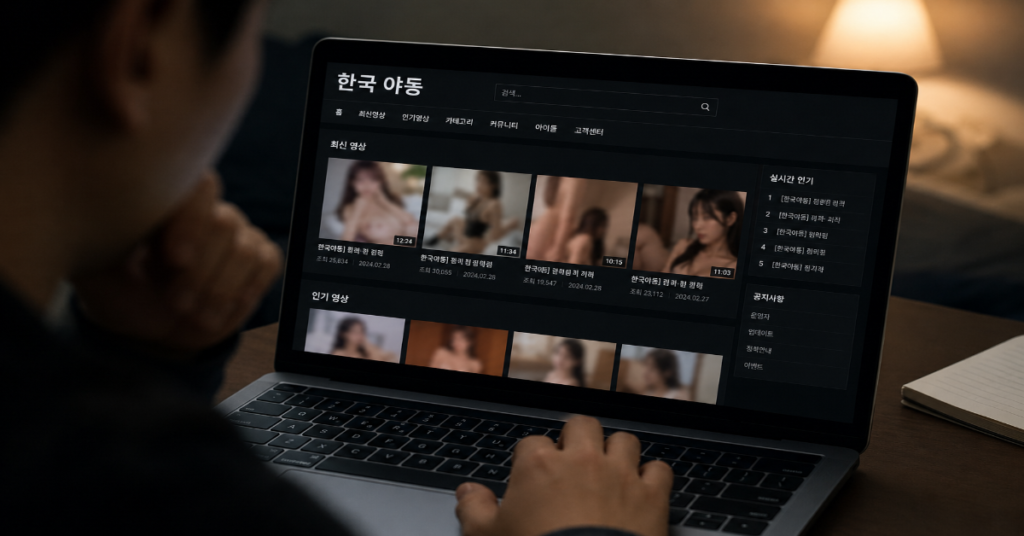
한국 야동 is a Korean search term generally associated with Korean adult video content. In English, it is often translated broadly as “Korean adult videos” or “Korean porn.” The phrase may sound like a simple entertainment keyword, but it sits inside a complicated digital environment shaped by consent, age verification, copyright, illegal filming, deepfakes, privacy exposure and platform safety.
This article does not recommend adult sites or provide access routes to explicit material. Instead, it explains the topic from a legal, ethical and safety perspective. That distinction matters. Adult content involving consenting adults may be lawful in some contexts, depending on jurisdiction and platform rules. Content created, uploaded or shared without consent is different. Hidden-camera footage, leaked private videos, sexually explicit deepfakes and any content involving minors are harmful and can trigger serious criminal consequences.
The article follows the supplied editorial brief, which identifies 한국 야동 as the required core keyword and frames the topic around Korean adult content, legality, privacy and safety concerns.
South Korea has treated digital sexual crime as a major public issue for years. Government and municipal programs now focus on takedowns, victim support, AI-assisted monitoring and cross-agency enforcement. In 2026, South Korea also launched a pan-government organization to improve the national response to digital sex crimes.
What Does 한국 야동 Mean?
한국 야동 combines “한국,” meaning Korea or Korean, with “야동,” a shortened Korean slang term for adult video. In ordinary search behavior, users may use it to look for Korean-language adult content, Korean performers, Korean subtitles or videos categorized as Korean on international platforms.
The term is broad. That is part of the problem. It can refer to professionally produced adult content, but it can also be used by piracy sites, aggregator pages, spam networks and unlawful uploaders. Search results may mix legitimate adult material with stolen videos, private leaks, hidden-camera recordings, manipulated images or misleading thumbnails.
A responsible article about 한국 야동 therefore has to separate three different categories:
| Category | What it means | Main concern |
| Consensual adult content | Content involving verified adults who consented to production and distribution | Age verification, platform legality, copyright |
| Unauthorized adult content | Reuploaded, leaked or pirated content | Consent violations, copyright infringement, privacy harm |
| Criminal sexual content | Hidden-camera footage, minor-related material, coercive content or explicit deepfakes | Criminal liability and severe victim harm |
The key issue is not only whether content is sexual. It is whether everyone involved is an adult, whether consent was real and ongoing, whether the upload was authorized and whether the viewer is accessing it through a lawful channel.
Why This Search Term Carries Higher Risk
Search terms linked to adult entertainment often attract unsafe websites. Pages may be filled with pop-ups, fake video players, malware traps, aggressive tracking scripts and misleading download buttons. In the case of 한국 야동, there is another layer of concern: South Korea has faced repeated public scandals involving illegal filming, private image abuse and non-consensual distribution.
The Ministry of Gender Equality and Family has described digital sex crime as especially harmful because illegal photos and videos can keep spreading after upload, making the harm persistent and difficult to contain. It also directs victims to support channels for counseling, deletion assistance and legal help.
That means a viewer may not always know whether a video was uploaded legally. A clip presented as “Korean amateur,” “leaked,” “hidden cam” or “private” should be treated as a major warning sign, not as a genre label. Those words often indicate possible non-consensual material.
Legal and Ethical Issues
The safest rule is simple: do not watch, save, share or search for anything that appears to involve coercion, hidden recording, minors, deepfakes, leaked private material or unauthorized uploads.
South Korea has moved aggressively against digital sexual crimes. Reuters reported that lawmakers passed a bill to criminalize possession or viewing of sexually explicit deepfake images and videos, with penalties of up to three years in prison or fines up to 30 million won. Producing or distributing explicit deepfakes can carry heavier penalties.
AP also reported that South Korea expanded penalties and platform responsibilities after a surge in deepfake pornography, including punishment for possession or viewing and stronger penalties for production or distribution.
Copyright is another issue. South Korea’s Copyright Act protects authors’ rights and neighboring rights while also addressing fair use. Unauthorized reuploading of commercial adult videos can still be copyright infringement, even when the viewer ignores the legal status of the upload.
Structured Legal Risk Table
| Risk area | Example warning sign | Why it matters |
| Non-consensual filming | “Hidden cam,” “spy cam,” “secret recording” | May involve image-based sexual abuse |
| Deepfake abuse | Celebrity, classmate or influencer face swaps | May be criminal even to possess or view in South Korea |
| Minor-related content | School references, teen framing, age ambiguity | Avoid immediately and report where possible |
| Piracy | Full premium videos reposted on free aggregators | May violate copyright and platform terms |
| Privacy exposure | Names, social profiles or personal details shown | May intensify victim harm |
The Role of Consent
Consent is the central line between lawful adult production and abuse. Consent must cover more than participation. It also includes recording, editing, distribution, monetization and continued availability.
A person may consent to private intimacy but not to recording. A person may consent to being recorded but not to public upload. A performer may consent to release on one licensed platform but not to pirated distribution elsewhere. A former partner may possess a video privately but has no right to share it.
This is why viewers should be skeptical of content marketed as “real,” “leaked,” “private,” “revenge,” “secret” or “unreleased.” Those terms are often used to create curiosity, but they can also signal abuse.
Digital Sex Crime Response in South Korea
South Korea’s response has become more coordinated. In May 2026, the country launched a pan-government organization to tackle digital sex crimes. Reports said the organization would monitor illegal sexually exploitative content and work on legislative responses.
Seoul has also developed local response infrastructure. In February 2026, the Seoul Metropolitan Government announced an integrated center to combat online sexual exploitation, including AI detection, emergency rescue channels and victim support.
The Seoul model has drawn international recognition. A United Nations public service award profile described Seoul’s Digital Sex Crime Comprehensive Response Policy as including prevention, one-stop victim support and deletion assistance.
These programs show that Korean adult-content searches cannot be treated as ordinary entertainment queries only. They exist in a wider social context shaped by illegal filming, online exploitation and victim protection.
Practical Safety Guidance for Readers
A reader searching for 한국 야동 should apply a strict safety filter.
Do not open pages that advertise hidden-camera material, leaked private videos or “real amateur” content with unclear consent. Avoid sites that push downloads, browser extensions, mirror links or fake age-verification prompts. Do not upload documents, payment details or personal identification to unknown adult websites.
Use privacy basics. Keep browsers updated. Avoid downloading files from adult aggregators. Do not reuse passwords. Do not assume incognito mode makes activity anonymous. It mainly hides local browsing history from other people using the same device, not from websites, internet providers or malicious scripts.
Most importantly, leave immediately if content appears non-consensual or age-ambiguous. Do not save it. Do not share it. Do not comment on it. Report it through the relevant platform or local authority channel.
Market, Cultural and Real-World Impact
The global demand for Korean media has grown through K-pop, K-dramas, Korean fashion, beauty culture and streaming platforms. That cultural visibility also affects adult-content search trends. Keywords connected to Korean identity can be exploited by spam sites, piracy networks and unlawful uploaders because they know global users are searching for Korean-language or Korea-adjacent content.
This creates a cultural harm. Korean women, celebrities, influencers, students and private individuals can be targeted by deepfake creators or illegal uploaders because Korean identity itself becomes a searchable label. The Guardian reported that South Korea faced a surge in digital sex crimes involving deepfake pornography, with victims including students, teachers and military personnel.
The market effect is also practical. As enforcement grows, platforms face pressure to detect unlawful sexual content faster. AI monitoring systems, hash-matching tools, takedown workflows and victim-support portals are becoming part of the digital safety infrastructure.
Comparison: Unsafe Search Behavior vs Safer Behavior
| Unsafe behavior | Safer alternative |
| Searching for leaked or hidden-camera videos | Avoid and report suspected abuse |
| Downloading files from unknown adult sites | Do not download from untrusted sources |
| Assuming all “free” uploads are legal | Check platform legitimacy and rights signals |
| Viewing deepfake sexual content casually | Treat it as potential abuse and legal risk |
| Sharing suspicious links with friends | Do not amplify harmful material |
The Future of 한국 야동 in 2027
By 2027, the discussion around 한국 야동 will likely be shaped less by ordinary adult-content categorization and more by enforcement, platform accountability and AI-generated abuse.
Three trends are already visible.
First, deepfake regulation is tightening. South Korea’s legal changes and enforcement campaigns show that AI-generated sexual abuse is being treated as a serious criminal and social problem, not as harmless online manipulation.
Second, detection technology is becoming more central. Seoul’s AI-assisted monitoring approach shows how governments may use automated tools to identify unlawful sexual images, request removal and reduce reuploading.
Third, adult-content platforms will face more pressure to prove consent, age verification and upload authorization. This will not eliminate illegal content, but it may make anonymous reposting and abuse-based traffic harder to sustain.
The uncertainty is enforcement quality. Strong laws do not automatically guarantee quick takedowns, victim safety or cross-border cooperation. Many adult-content sites operate outside Korea. That means 2027 will likely bring more regulation, but also continuing friction between national law, foreign hosting and fast-moving AI tools.
Key Takeaways for Publishers and Readers
- The keyword 한국 야동 should be handled carefully because it can overlap with illegal filming, piracy and non-consensual image abuse.
- Ethical coverage should explain risks without linking to adult sites or guiding users toward explicit material.
- Deepfake sexual content is becoming a major legal issue in South Korea.
- Viewers have responsibility too. Watching or sharing suspicious content can worsen victim harm.
- Legitimate adult content requires verified adult participation, consent and authorized distribution.
- Safer search habits include avoiding leaked, hidden-camera, age-ambiguous or coercive material.
- The 2027 landscape will likely involve stricter monitoring, stronger takedown systems and more platform accountability.
Conclusion
한국 야동 is more than a search phrase. It is a doorway into a sensitive area where adult entertainment, privacy, consent, copyright and digital sexual crime can collide. A responsible reader should not treat every search result as harmless or legitimate. The safest approach is to avoid suspicious material, reject non-consensual content and understand that deepfakes, hidden-camera recordings and leaked private videos can cause lasting harm.
South Korea’s recent policy direction shows how seriously the issue is being treated. Government agencies, city programs and victim-support centers are building stronger systems for monitoring, removal and legal response. For publishers, the right editorial approach is clear: explain the topic, protect readers, avoid explicit facilitation and center consent. For viewers, the rule is even simpler. When consent, age or legality is unclear, do not engage.
FAQ
What does 한국 야동 mean?
한국 야동 is a Korean phrase commonly used to refer to Korean adult video content. The term can appear in legal, pirated or harmful contexts, so it should be approached carefully.
Is 한국 야동 legal to watch?
Legality depends on the viewer’s jurisdiction, the platform, the age and consent of participants and whether the upload is authorized. Non-consensual, minor-related, hidden-camera, deepfake or leaked material should be avoided and may be criminal.
Why are hidden-camera videos dangerous?
Hidden-camera videos usually imply a person was recorded without consent. This can be a form of digital sexual abuse and may cause long-term harm because files can be copied and redistributed.
Are sexually explicit deepfakes illegal in South Korea?
South Korea has strengthened laws against sexually explicit deepfakes. Reuters reported that lawmakers passed a bill criminalizing possession or viewing of such material, with penalties including prison time or fines.
How can someone report digital sexual crime in Korea?
Victims can seek help through official support systems. South Korea’s Ministry of Gender Equality and Family lists reporting and support options for digital sexual crime victims, including counseling and deletion support.
Is it safe to use free adult-content websites?
Many free adult sites carry privacy, malware, piracy and consent risks. Users should avoid suspicious pages, downloads, fake verification prompts and any content that appears leaked, coerced, hidden-camera based or age-ambiguous.
Methodology
This article was prepared as an informational safety guide, not as adult-content promotion. The editorial structure follows the uploaded production brief, including the required keyword, category, metadata, FAQ, visual strategy and methodology requirements.
The legal and policy context was checked against recent reporting and official or institutional sources, including South Korean government-related resources, Seoul Metropolitan Government materials, Reuters, AP and Korea-focused news reports. The analysis avoids explicit descriptions, adult-site recommendations and instructions that could help locate unlawful material. Limitations remain: laws vary by country, enforcement changes over time and readers should consult qualified legal counsel for jurisdiction-specific advice.
References
Associated Press. (2024). South Korea fights deepfake porn with tougher punishment and regulation. AP News.
Korea JoongAng Daily. (2026). Korea launches pan-gov’t organization to tackle digital sex crimes.
Korea Legislation Research Institute. (n.d.). Copyright Act.
Ministry of Gender Equality and Family. (n.d.). Digital sexual crime victim support information.
Reuters. (2024). South Korea to criminalise watching or possessing sexually explicit deepfakes.
Seoul Metropolitan Government. (2026). Seoul launches Korea’s first integrated center to combat online sexual exploitation.
The Guardian. (2024). South Korea battles surge of deepfake pornography after thousands found to be spreading images.
