
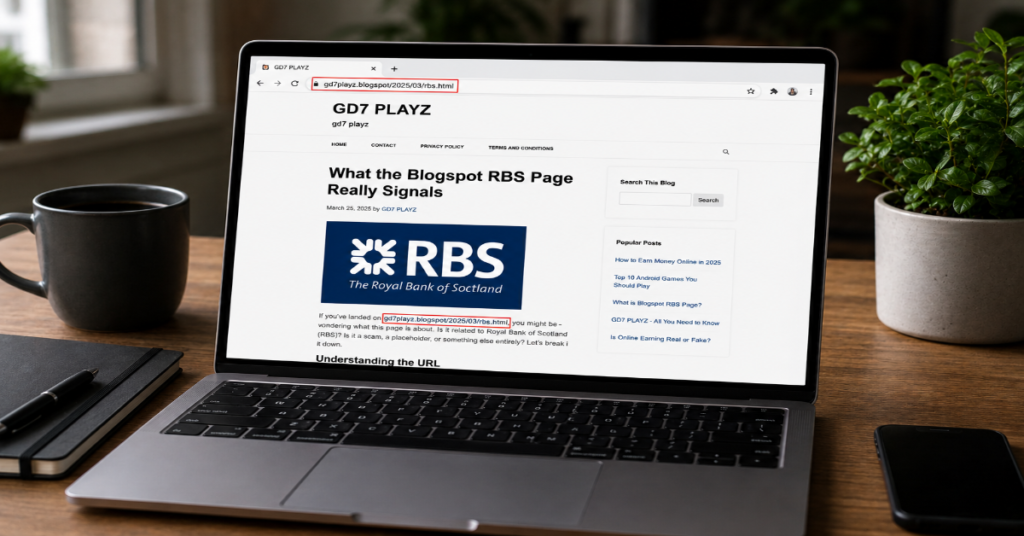
gd7 playz.blogspot/2025/03/rbs.html is a search phrase built around what looks like a Blogger post URL. The likely intended format is closer to a standard Blogspot address with a blog name, a year and month folder and a final article slug. That structure often appears on Blogger sites, where individual posts can use date-based paths and custom permalinks.
The problem is not the format itself. Blogspot is a legitimate Google-owned publishing platform. The problem is verification. A free blogging platform can host useful guides, personal notes, gaming posts, spam pages or misleading redirect content. Without direct confirmation of the live page and its owner, readers should avoid treating the URL as authoritative.
Search results around the phrase suggest that other sites have described it as a mysterious or gaming-related Blogspot page, but those secondary articles do not prove what the original post contains. One search result describes it as connected to “gaming-focused” content, while another frames it more generally as a Blogspot URL with a March 2025 post path. Those descriptions are not enough to confirm legitimacy.
This article explains what the URL structure means, why the page may be appearing in searches, what risks matter most and how to evaluate a page like this without exposing your device or personal accounts.
What gd7 playz.blogspot/2025/03/rbs.html Appears to Be
The phrase gd7 playz.blogspot/2025/03/rbs.html appears to combine a blog identity, a Blogspot host pattern, a March 2025 archive path and a final slug named “rbs.html.”
A normal Blogger post URL can include a date path and a post slug. Google’s Blogger documentation notes that post publication dates are part of the post metadata and can be set through the Blogger interface. Blogger also supports individual post retrieval through its API, which reflects the platform’s structured post model.
That gives the URL a plausible shape. It does not prove the page is safe, current or useful.
| URL Element | Likely Meaning | Trust Signal |
| gd7 playz | Possible blog or brand name | Unverified |
| blogspot | Blogger-hosted publishing platform | Legitimate platform, variable content |
| 2025/03 | Likely March 2025 post archive path | Plausible Blogger structure |
| rbs.html | Post slug | Meaning unclear |
| Search snippets | Secondary descriptions from other sites | Weak evidence |
The phrase may also be slightly malformed. A real Blogspot URL usually includes the full domain format, such as a subdomain plus “blogspot.com.” Missing dots or spacing in user searches can cause confusion, especially when people copy URLs from social posts, messaging apps or low-quality repost pages.
Why People Are Searching for It
People usually search a strange URL for one of four reasons: curiosity, safety checking, lost access or rumor tracking. gd7 playz.blogspot/2025/03/rbs.html fits that pattern because it looks specific but not self-explanatory.
The “RBS” slug may be the main trigger. It could stand for a guide title, a game mode, a file name, a player strategy or something unrelated. There is not enough verified public evidence to define it confidently.
Secondary pages have framed the URL as gaming-related, but those pages appear to be explainers rather than primary sources. One result describes “GD7 Playz” in connection with player strategies, while another calls the URL a gaming-focused blog reference. That supports the possibility of a gaming angle, not certainty.
The bigger point is intent. Searchers are probably not asking “what is Blogspot?” They are asking whether this exact page is worth opening, what it contains and whether it is safe.
Safety Analysis: Platform Trust vs Page Trust
A key distinction matters here: platform trust is not the same as page trust.
Blogger is a legitimate service. Google’s Blogger content policy prohibits phishing, including attempts to collect passwords, financial data and other sensitive information. It also prohibits spam and certain regulated goods or services.
But Blogger is also a user-generated publishing platform. Anyone can create a blog. That means the host platform may be legitimate while an individual page can still be low quality, misleading, abandoned or risky.
Google Safe Browsing exists to detect unsafe pages and warn users about dangerous sites or downloads. Google says Safe Browsing examines billions of URLs per day and protects users across Google products and the wider web.
That protection is helpful, but it is not a reason to click blindly. Safe Browsing systems can miss new pages, temporary redirects or newly compromised links. Google’s own Safe Browsing FAQ explains that malware detection involves scanning sections of the web index and testing suspicious sites in virtual environments. Phishing detection also uses statistical models.
Practical Risk Checklist
Before opening gd7 playz.blogspot/2025/03/rbs.html or any similar page, check the risk signals first.
| Risk Signal | What It Means | Safer Action |
| The URL is shared without context | Could be curiosity bait or spam | Search the domain first |
| Page asks for login details | Potential phishing | Do not enter credentials |
| Page offers downloads | Malware or unwanted software risk | Avoid unless source is verified |
| URL redirects quickly | Destination may differ from visible link | Stop and inspect |
| Too-good-to-be-true claims | Common scam pattern | Verify through independent sources |
| No author or contact details | Weak accountability | Treat as low-trust |
| Copied articles across many sites | Possible SEO spam | Do not rely on claims |
CISA warns that phishing often tries to make people open harmful links or attachments that can steal personal information or infect devices. Its guidance emphasizes recognizing suspicious links and reporting phishing attempts.
Unknown Blogspot Page vs Verified Gaming Resource
If the URL is gaming-related, readers should compare it with more accountable sources.
| Factor | Unknown Blogspot Post | Verified Gaming Resource |
| Author identity | Often unclear | Usually named or community-verified |
| Update history | Hard to confirm | Usually visible |
| Downloads | Higher caution needed | Often scanned or moderated |
| Comments | May be unmoderated | Often community-reviewed |
| Strategy quality | Unknown | More likely tested by players |
| Safety checks | Reader must perform them | Platform may add moderation |
| Trust level | Low until verified | Medium to high depending on source |
This does not mean all Blogspot pages are bad. Many older niche communities still use free blog platforms. But for unknown links, the burden of proof sits with the page, not the reader.
What “RBS” Could Mean
The slug “rbs” is too short to interpret safely. It may refer to:
- a gaming strategy
- a private abbreviation
- a title shortened for the URL
- a file or resource name
- a redirect landing page
- a random slug used for search manipulation
The safest editorial position is simple: do not define “RBS” unless the page content confirms it. Guessing the meaning would create false authority.
A better method is to inspect surrounding evidence. Search for the blog homepage, other posts from the same month, archived copies, visible author names and whether the same page appears in spam-like repost networks. If the same claims appear across low-quality sites with no primary source, confidence should remain low.
Real-World Impact: Why Small URLs Become Search Trends
Specific URLs can become search trends even when the page itself is ordinary. A link may spread in a gaming chat, Telegram group, Discord server, Facebook post or YouTube description. Once people are unsure whether it is safe, they search the full address.
That creates a second wave: SEO pages begin writing explainers about the URL, sometimes without adding verification. This can make the page seem more important than it is.
The effect is common with obscure domains, short slugs and free-hosted pages. Search demand grows because of uncertainty, not because the original content is necessarily authoritative.
For gd7 playz.blogspot/2025/03/rbs.html, the safest conclusion is that search visibility appears to come from curiosity and secondary coverage, not confirmed institutional importance.
Original Insight: The Real Risk Is Not Blogspot, It Is Context Collapse
The hidden risk with a URL like gd7 playz.blogspot/2025/03/rbs.html is context collapse. A page can move from a small gaming audience into public search results without the surrounding explanation that made it meaningful.
Inside a community, “RBS” may be obvious. Outside that community, it becomes a mystery. Mystery attracts clicks. Clicks attract copycat articles. Copycat articles reduce clarity because they repeat assumptions.
That is why users should verify the original source first. A URL without context is not automatically dangerous, but it is not trustworthy either.
The Future of gd7 playz.blogspot/2025/03/rbs.html in 2027
By 2027, pages like gd7 playz.blogspot/2025/03/rbs.html will likely face more aggressive trust filtering from browsers, search engines and security tools. Google’s Safe Browsing already operates at massive scale, and Google says it helps protect more than five billion devices by warning users before dangerous sites or downloads.
The trend is toward stronger reputation systems. Search engines increasingly evaluate source quality, authorship signals, page behavior and user safety. Free-hosted blogs will still exist, but thin posts with unclear ownership may struggle to earn trust unless they show transparent authorship, useful content and safe outbound linking.
For small gaming blogs, that means the future is not hopeless. A Blogspot page can still be useful if it is clear, updated, honest and safe. But pages that rely on vague titles, unexplained downloads or recycled claims will become harder to defend.
Takeaways
- gd7 playz.blogspot/2025/03/rbs.html looks like a Blogspot-style post path, but the exact content remains insufficiently verified.
- Blogspot is legitimate, but individual pages require separate trust checks.
- The “RBS” slug should not be interpreted without primary page evidence.
- Secondary articles can show search interest, but they do not prove legitimacy.
- Do not enter passwords, install files or follow redirects from unknown pages.
- Google Safe Browsing is useful, but it does not replace manual caution.
- The best safety move is to inspect the source, author, links and page behavior before engaging.
Conclusion
gd7 playz.blogspot/2025/03/rbs.html is best understood as an unverified Blogspot-style URL that may be connected to gaming content, but cannot be treated as authoritative without direct evidence. The structure is plausible. The surrounding search interest is real. The trust level, however, remains uncertain.
Readers should avoid the two common mistakes: assuming every Blogspot page is unsafe or assuming every Google-hosted page is safe. Both are too simple. The better approach is source evaluation. Check the domain, confirm the author, avoid downloads, inspect redirects and use security tools before clicking.
If the page is only a basic gaming post, these steps may feel excessive. But they are exactly the habits that protect users when a harmless-looking URL turns into a phishing page, redirect trap or low-quality content farm. Treat the link as unknown until it proves otherwise.
FAQ
What is gd7 playz.blogspot/2025/03/rbs.html?
It appears to be a search phrase based on a Blogspot-style post URL. The likely structure points to a blog name, a March 2025 archive path and a slug called “rbs.html.” The exact content is not clearly verified through mainstream sources.
Is gd7 playz.blogspot/2025/03/rbs.html safe?
There is not enough verified evidence to call it safe or unsafe. Treat it as unknown. Do not enter login details, download files or follow redirects unless you can verify the page owner and destination.
What does RBS mean in this URL?
The meaning of “RBS” is unclear. It could be a gaming abbreviation, title slug, private shorthand or unrelated label. It should not be defined confidently without the original page content.
Is Blogspot a trusted platform?
Blogger is a legitimate Google-owned publishing platform, and its policies prohibit phishing and spam. However, individual blogs are created by users, so every page still needs separate trust evaluation.
Why are people searching for this URL?
People may be checking whether the page is safe, trying to understand a gaming reference or following up after seeing the link shared elsewhere. Obscure URLs often gain search interest because users want context before clicking.
Should I open the page directly?
Only after basic checks. Search the domain, inspect snippets, use a safe browsing checker and avoid downloads. If the page asks for credentials or redirects to unrelated sites, close it.
Can this URL be used as a reliable source?
Not without verification. A reliable source should show clear authorship, original content, updated information, safe linking behavior and evidence for its claims.
Methodology
This article was drafted from the provided production brief, using the supplied keyword and topic framing. Public search checks were used to identify whether the exact URL had verified mainstream coverage. The review found secondary pages discussing the phrase, but no strong primary confirmation of the original page content.
Safety guidance was grounded in Google Blogger policy, Google Safe Browsing documentation and CISA phishing guidance. The analysis avoids claiming that the page is malicious because that was not proven. It also avoids claiming that the page is legitimate because the original content could not be independently validated.
Known limitation: this article does not include direct firsthand testing of the live page in a sandbox environment. A human editor should verify the current URL status, inspect any redirects, confirm whether the page is live and check all citations before publication.
References
Cybersecurity and Infrastructure Security Agency. (2021). Avoiding social engineering and phishing attacks. CISA.
Cybersecurity and Infrastructure Security Agency. (n.d.). Recognize and report phishing. CISA.
Google. (n.d.). Blogger content policy. Blogger.
Google. (n.d.). Google Safe Browsing. Google Safe Browsing.
Google. (n.d.). Safe Browsing site status. Google Transparency Report.
Google Developers. (2025). Blogger API reference. Google for Developers.
