
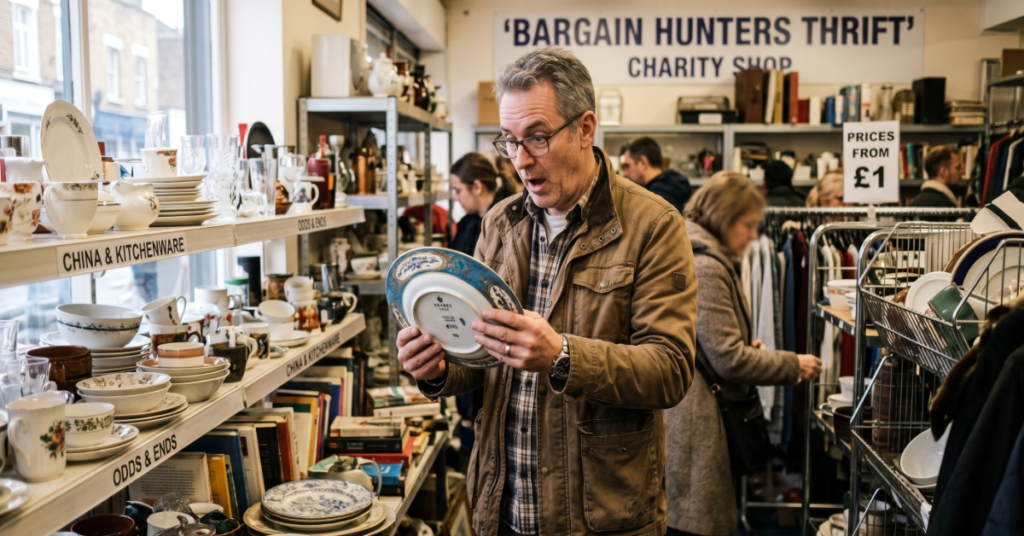
The scenario sounds like something from a television show: a man walks into a Goodwill, digs through a cart, almost walks away, catches something in the corner of his eye, picks it up, and holds what turns out to be a rare 18th-century antique worth thousands of dollars. It happened in October 2024, in Evanston, Illinois, and the man who experienced it is John Carcerano — a one-man carpet cleaning operation who has spent 35 years buying and selling antiques as a side business. Man Discovers Valuable Plate Thrift Store did not come from luck alone. It came from knowledge, attention, and a tool that anyone with a smartphone can access.
The story spread across Newsweek, The Mirror, and Yahoo Lifestyle in February 2025, generating widespread attention because it is both genuinely extraordinary and — in the way it unfolded — surprisingly instructive.
The Full Story: What Happened and How
Carcerano had been frequenting the Goodwill in Evanston more than usual during a period of recovery from illness in 2023. He chose that location deliberately — it sits near a wealthier northern Chicago suburb, meaning donations cycle through higher-quality items.
On the day of the find, he was working through a cart alongside three other shoppers. Everyone moved on. Carcerano started to as well, then caught something out of the corner of his eye: a plate tucked beneath a modern one. He picked it up.
‘The plate was underneath a modern plate and three other people were digging on the cart with me,’ he told Newsweek. ‘When everybody walked away from the cart, including me after we went through it, in the corner of my eye I noticed the plate was underneath a modern one.’
Within five minutes, using Google Lens on his phone, he found a comparable piece that had previously sold at auction for approximately $4,400. He sent detailed photographs to three major auction houses. Sotheby’s identified it as a Chinese export armorial chamfered rectangular platter from the Qianlong period (circa 1755), decorated with the arms of Mendes Da Costa, estimated between $4,000 and $6,000. Bonhams and Leslie Hindman Auctioneers confirmed the assessment independently.
Why This Plate Was Valuable: Understanding Chinese Export Porcelain
During the Qianlong period of the Qing dynasty (1735-1796), Chinese artisans produced vast quantities of fine porcelain specifically for export to European markets. These pieces were often personalized with the heraldic arms of European families who commissioned them, making each piece unique. The Mendes Da Costa arms designate a prominent Sephardic Jewish family with ties to Amsterdam and London during the 18th century.
| Factor | Detail | Impact on Value |
| Period | Qianlong period (around 1755) | Significant — prime Qing dynasty era |
| Type | Chinese export armorial porcelain | High collector demand |
| Heraldry | Arms of Mendes Da Costa | Rare Jewish European provenance |
| Condition | Pristine — never used, no scratches | Premium condition adds value |
| Auction context | First example in a Judaica sale | No comparable recent sales |
What Carcerano Did Right — and What Anyone Can Learn
He targeted the right location.
Goodwill stores in proximity to wealthier neighborhoods tend to receive higher-quality donations. Families clearing estates in affluent areas donate items that would command serious prices at auction — often without recognizing their value.
He stayed after others left.
The three other shoppers who were working the same cart walked away. Carcerano almost did too. The one moment of attention he paid after starting to move on made the difference.
He used Google Lens immediately.
Google Lens, a free image recognition tool available on any smartphone, allows users to photograph an object and search for visually similar items across the web. For antiques and collectibles, it surfaces comparable auction results within seconds.
He verified through experts.
Rather than relying on Google Lens alone, Carcerano contacted three major auction houses for independent verification. This established credibility for a Sotheby’s sale.
The Broader Thrift Store Antique Opportunity
| Category | What to Look For | Why It Has Value |
| Chinese export porcelain | Armorial decoration, blue-white design, 18th century | Export trade pieces command strong collector demand |
| Mid-century modern furniture | Eames-era design, specific maker marks | Designer attribution drives significant premiums |
| Vintage Pyrex | Specific patterns from 1950s-1970s | Collector community has created strong secondary market |
| First-edition books | Dust jackets intact, specific printing marks | Rare first editions routinely surprise at auction |
| Art Deco silver | Heavy gauge, hallmarked, pre-1940 | Intrinsic metal value plus craft premium |
The Future of Thrift Store Treasure Hunting in 2027
The tools available to thrift shoppers are improving faster than the competition for finds is increasing. Google Lens is still underused among casual shoppers. AI-powered image recognition is expected to become more precise and widely integrated into consumer apps by 2027 — meaning the gap between a knowledgeable thrift shopper and an uninformed one will narrow.
The resale market for thrifted antiques is also growing structurally. Platforms including eBay, 1stDibs, and specialized auction house discovery tools have lowered the barrier between finding a valuable object and reaching the right buyer.
Takeaways
- John Carcerano’s October 2024 find at a Goodwill in Evanston, Illinois — an 18th-century Chinese export plate bought for $4.99, valued at $4,000-$6,000 — is genuine and verified by Sotheby’s, Bonhams, and Leslie Hindman Auctioneers.
- The plate’s specific rarity comes from its Qianlong period dating, pristine condition, and the extreme rarity of Chinese export armorial porcelain bearing Jewish heraldic arms.
- Google Lens enabled Carcerano to identify the plate’s approximate value within five minutes — available to any smartphone user at no cost.
- Goodwill stores near affluent neighborhoods receive estate donations that regularly include underrecognized high-value items.
- Staying after other shoppers leave and paying attention to what is underneath other items is consistently how significant thrift finds happen.
- Category knowledge — Carcerano spent ten years specifically studying Asian antiques — is what converted a visual observation into a correct identification.
Conclusion
The story of John Carcerano’s $4.99 plate is satisfying not because it promises that anyone can walk into a Goodwill and leave with a Sotheby’s auction piece. It is satisfying because it shows what actually produces such a find: deliberate location selection, the attention to stay when others leave, the tool competence to identify what you are looking at, and the patience built from decades of accumulated knowledge. That is the honest version of the thrift store treasure story — and it is more instructive than the version that attributes everything to chance.
FAQ
What did John Carcerano find at the thrift store?
In October 2024, Carcerano purchased a plate for $4.99 at a Goodwill store in Evanston, Illinois. The plate was later identified by Sotheby’s as an 18th-century Chinese export armorial chamfered rectangular platter from the Qing dynasty’s Qianlong period, valued between $4,000 and $6,000.
How did he know the plate was valuable?
Carcerano used Google Lens on his smartphone to photograph the plate and search for comparable items. He found a similar piece that had sold at auction for approximately $4,400, then contacted three major auction houses for independent verification.
What is Chinese export armorial porcelain?
Fine porcelain produced during the Qing dynasty primarily for European markets, often personalized with the heraldic arms of the commissioning European family. Pieces from the Qianlong period (1735-1796) are particularly sought after by collectors.
What made this specific plate so rare?
Its Qianlong period dating (circa 1755), pristine condition, and the combination of Chinese craftsmanship with Jewish European heraldry — the arms of Mendes Da Costa. A Sotheby’s specialist noted it was likely the first Chinese export plate with Jewish arms ever offered at a Judaica sale.
How can I spot valuable items at thrift stores?
Use Google Lens to photograph unfamiliar items and search for comparable auction results. Target stores near affluent areas. Look beneath and behind other items. Build knowledge in a specific category over time rather than hunting broadly.
Are thrift store treasure finds common?
Genuine finds of this scale are rare but documented. Confirmed examples include Ming Dynasty porcelain purchased for $2 and valued at $250,000, and an 18th-century Wedgwood plate bought for $4.99 and sold for over $14,000.
Methodology
All factual details are sourced directly from Newsweek’s February 2025 reporting, which includes screenshots of email correspondence between Carcerano and Sotheby’s, Bonhams, and Leslie Hindman Auctioneers. Secondary finds referenced are drawn from published journalistic sources. Limitation: the final Sotheby’s auction outcome is not yet documented. AI disclosure: This article was drafted with AI assistance and reviewed by the editorial team at Perplexityaimagazine.com.
