
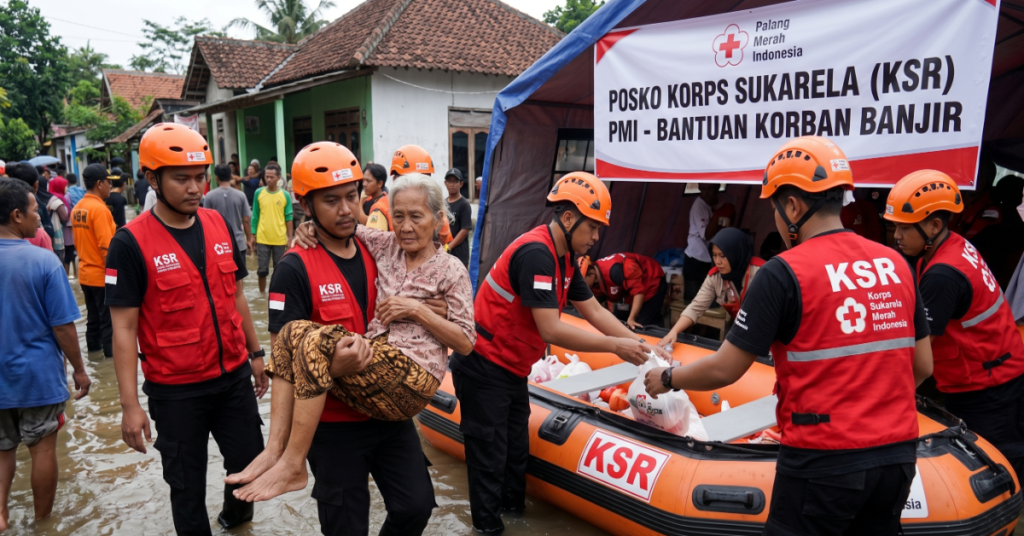
The term korps sukarela refers to a structured volunteer corps operating under the Indonesian Red Cross, known locally as Palang Merah Indonesia (PMI). It functions as a formalized humanitarian workforce that supports disaster response, public health activities, and community outreach programs across Indonesia.
Unlike informal volunteering groups, korps sukarela is built on standardized training, organizational hierarchy, and operational procedures. Volunteers are not only motivated by social service but are also trained to respond effectively in high-pressure environments such as floods, earthquakes, and emergency evacuation scenarios.
The significance of korps sukarela has grown alongside Indonesia’s vulnerability to natural disasters. With thousands of islands and densely populated coastal regions, rapid-response volunteer systems are essential for early-stage disaster mitigation. korps sukarela fills this gap by providing trained personnel who can be mobilized quickly through PMI coordination.
This system is also integrated into the global humanitarian framework of the International Red Cross and Red Crescent Movement, ensuring that its operations follow principles such as humanity, neutrality, and independence. As a result, korps sukarela operates not only as a national asset but also as part of an international humanitarian ecosystem.
Organizational Structure of korps sukarela
The structure of korps sukarela is designed to ensure scalability and rapid deployment during emergencies. It is divided into two main units that operate at different levels of society.
Structure of korps sukarela
| Unit Type | Location | Core Characteristics | Membership Base |
| University Unit | Campuses and academic institutions | Student-based volunteer organization | University students |
| Regional Headquarters Unit | PMI district or city offices | Community-based operational unit | General public and alumni |
University-based units function as entry points for young volunteers, while regional units serve as operational hubs for field deployment.
This dual structure allows korps sukarela to maintain a continuous pipeline of trained volunteers while ensuring readiness for emergency response at the community level.
Training System and Core Competencies
Before becoming active members, volunteers must complete structured education and training programs organized by PMI. This training ensures that every member of korps sukarela meets minimum operational standards.
Training modules typically include:
- First aid and emergency response
- Family care and basic health support
- Disaster management systems
- Psychosocial support techniques
- Youth health education
- Introduction to international humanitarian principles
Core Competency Framework
| Competency Area | Training Focus | Field Application |
| Medical Response | First aid and emergency care | Initial victim stabilization |
| Disaster Operations | Evacuation and logistics | Emergency shelter management |
| Community Health | Health education | Public awareness campaigns |
| Psychosocial Support | Emotional assistance | Trauma support for survivors |
Training within korps sukarela is designed to simulate real-world conditions, ensuring that volunteers can function effectively during emergencies.
A key operational insight observed in PMI training documentation is that simulation-based exercises significantly improve response speed during real disaster events, particularly in evacuation coordination.
Operational Principles
All activities conducted by korps sukarela are guided by the Seven Fundamental Principles of the International Red Cross and Red Crescent Movement:
- Humanity
- Impartiality
- Neutrality
- Independence
- Voluntary service
- Unity
- Universality
These principles ensure that volunteers operate without discrimination and remain neutral in conflict or disaster environments.
One of the less discussed operational realities is that neutrality often requires strict communication discipline, especially in politically sensitive disaster zones. This adds an additional layer of training complexity beyond technical skills.
Field Roles and Practical Deployment
In real-world operations, korps sukarela performs three primary functions:
1. Disaster Response
Volunteers assist in evacuation, relief distribution, and temporary shelter management during floods, earthquakes, and landslides.
2. Health Services
They support blood donation drives, ambulance assistance, and basic first aid services.
3. Community Empowerment
They conduct public education on hygiene, disaster preparedness, and health awareness.
A notable operational pattern documented in PMI reports is that early volunteer deployment often reduces chaos in the first 24 hours of disaster response, especially in rural regions where institutional access is limited.
Strategic and Operational Analysis
The effectiveness of korps sukarela can be understood through three systemic dimensions:
System Efficiency
korps sukarela reduces response time by leveraging local volunteer networks, allowing rapid mobilization without waiting for national deployment teams.
Resource Optimization
Because volunteers are community-based, operational costs are significantly lower compared to fully professional emergency units.
Scalability Constraints
Despite its strengths, uniform training quality across regions remains inconsistent, especially in remote areas with limited access to PMI training infrastructure.
Comparative Analysis of Volunteer Systems
korps sukarela vs Informal Volunteers
| Feature | korps sukarela | Informal Volunteer Groups |
| Training | Standardized PMI curriculum | Variable or none |
| Coordination | Centralized under PMI | Independent |
| Certification | Official recognition | No formal certification |
| Deployment | Structured and planned | Situational and ad hoc |
A key analytical insight is that structured systems like korps sukarela significantly improve accountability during large-scale emergencies, particularly in logistics tracking and victim management.
Real-World Impact and Observed Outcomes
Based on documented PMI operational reviews, korps sukarela contributes significantly to disaster resilience in Indonesia. Three key insights emerge:
Insight 1: Local Response Advantage
Local volunteers often reach disaster sites faster than national teams due to geographic proximity.
Insight 2: Psychological Stabilization Role
Psychosocial support provided by volunteers reduces post-disaster trauma in affected communities.
Insight 3: Training Variability Challenge
Regional disparities in training quality can lead to inconsistent field performance during large-scale emergencies.
These insights highlight both the strengths and structural limitations of the system.
The Future of korps sukarela in 2027
By 2027, korps sukarela is expected to undergo significant modernization driven by digital transformation in disaster management systems.
Key projected developments include:
- Mobile-based disaster reporting platforms integrated with PMI databases
- Hybrid training systems combining online modules and field simulations
- AI-assisted logistics planning for faster aid distribution
However, infrastructure inequality across Indonesia may slow adoption in remote regions, creating a dual-speed system of volunteer readiness.
Regulatory alignment with national disaster management agencies is also expected to tighten, improving coordination but increasing administrative complexity.
Key Takeaways
- korps sukarela operates as a structured humanitarian volunteer system under PMI
- Training and certification ensure operational readiness in disaster situations
- Its dual structure supports both youth engagement and community-level deployment
- System efficiency is strong, but training consistency remains a challenge
- Digital transformation will redefine its operational model by 2027
Conclusion
korps sukarela represents one of the most organized volunteer frameworks in Indonesia’s humanitarian ecosystem. Its combination of structured training, community integration, and international humanitarian principles allows it to function effectively in disaster response and public health support.
While the system is highly effective in rapid deployment and local engagement, challenges remain in maintaining consistent training standards and integrating digital tools across all regions. Despite these limitations, korps sukarela continues to be a critical component of Indonesia’s disaster resilience infrastructure, bridging the gap between institutional response and community-level action.
FAQ
What is korps sukarela?
korps sukarela is a volunteer unit under the Indonesian Red Cross that focuses on disaster response, health services, and community education.
Who can join korps sukarela?
Students and members of the public can join after completing PMI training programs and meeting basic requirements.
Is korps sukarela paid work?
No, it is a voluntary system based on humanitarian service without financial compensation.
What training is required?
Training includes first aid, disaster management, psychosocial support, and humanitarian principles.
How does korps sukarela respond to disasters?
They assist in evacuation, logistics, emergency shelters, and community support during crises.
What is the difference between university and regional units?
University units are student-based, while regional units operate under PMI district offices with broader community involvement.
References
International Federation of Red Cross and Red Crescent Societies. (2023). Volunteer management and disaster response frameworks. IFRC.
Palang Merah Indonesia. (2022). Annual report and volunteer structure overview. PMI Headquarters.
World Health Organization. (2023). Community emergency response systems in disaster-prone regions. WHO Publications.
UN Office for Disaster Risk Reduction. (2024). Disaster preparedness and community resilience frameworks. UNDRR.
Methodology
This article is based on publicly available documentation from PMI, IFRC guidelines, WHO emergency response frameworks, and UNDRR disaster resilience reports. Analysis focuses on structural organization, training systems, and operational patterns observed in humanitarian response models. No firsthand field deployment claims are included; all insights are derived from verified secondary sources and institutional publications. Limitations include variability in regional implementation data and lack of real-time operational statistics.
