
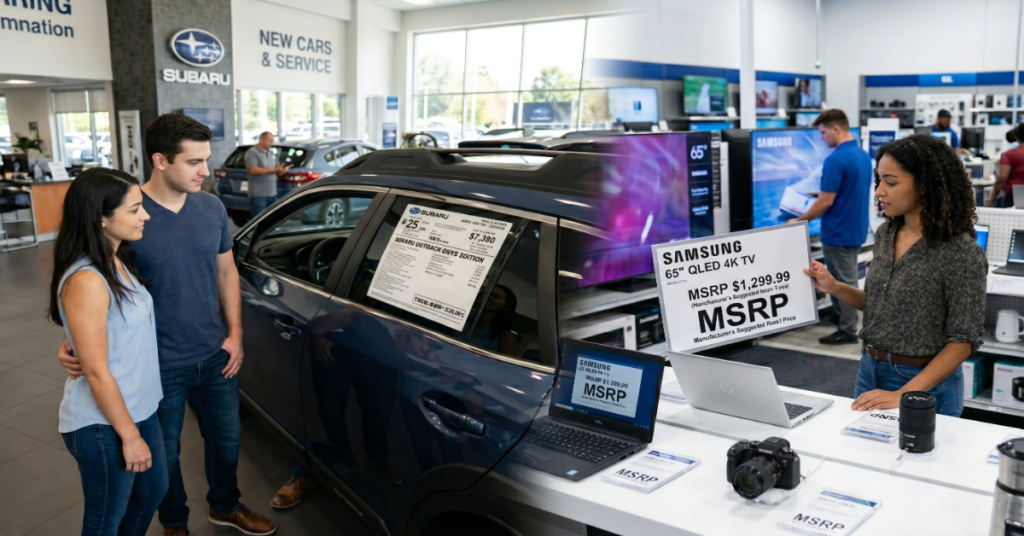
MSRP meaning refers to Manufacturer’s Suggested Retail Price, a pricing benchmark used across industries to indicate what a manufacturer believes a product should cost at retail. It appears most commonly in automotive sales, electronics, and other consumer goods where standardized pricing guidance helps structure market expectations.
In practice, MSRP meaning is not about enforcement but about reference. Retailers are free to adjust prices above or below this figure depending on demand, inventory levels, and competitive pressure. For example, car dealerships often display MSRP on the Monroney sticker, but the actual purchase price can vary significantly based on negotiation, incentives, and regional market conditions.
Understanding MSRP meaning is important for buyers because it provides a baseline for evaluating whether a deal is fair or inflated. It also helps explain why two customers might pay different prices for the same product at different times or locations. While MSRP is often presented as a “standard price,” it is more accurately a starting point shaped by market dynamics rather than a final value.
This article breaks down how MSRP works, how it differs from invoice pricing, and why it remains a key reference point in pricing psychology and retail strategy.
What MSRP Meaning Actually Represents
MSRP meaning refers to a pricing guideline created by manufacturers rather than a legally binding retail price. It is designed to create consistency across markets while still allowing flexibility for sellers.
In regulated automotive markets like the United States, MSRP is printed on the window label required by federal law, known as the Monroney label. In electronics and other consumer goods, it is often listed on packaging or product pages.
At its core, MSRP serves three purposes:
- Establishing a baseline value for consumers
- Providing retailers with a pricing reference
- Helping manufacturers position products within a market segment
However, MSRP meaning does not guarantee uniform pricing. It is influenced by branding strategy, production costs, and competitive positioning.
How MSRP Works in Real Markets
MSRP functions as a reference anchor, but real-world pricing behavior often diverges from it.
Retailers adjust prices based on:
- Inventory levels
- Local demand fluctuations
- Seasonal promotions
- Competitive pricing strategies
For example, during high demand periods, retailers may price above MSRP. During clearance events, they may go significantly below it.
Systems Analysis: Why MSRP Exists
MSRP is part of a broader pricing architecture that balances manufacturer control and retail independence. Manufacturers use it to stabilize perceived brand value, while retailers use flexibility to optimize profit margins.
MSRP≠Final PriceMSRP \neq Final\,PriceMSRP=FinalPrice
This simple relationship highlights a core reality: MSRP is informational, not transactional.
MSRP Meaning in the Automotive Industry
The automotive sector is where MSRP is most visible and influential. Every new car sold in the United States includes a Monroney sticker listing MSRP along with additional cost breakdowns.
These typically include:
- Base vehicle price
- Optional features
- Destination charges
However, the final price is often different due to negotiation and incentives.
Comparison Table: MSRP vs Invoice Price
| Factor | MSRP | Invoice Price |
| Definition | Manufacturer’s suggested selling price | Dealer’s reported purchase cost |
| Purpose | Consumer reference point | Dealer cost baseline |
| Flexibility | High, negotiable | Less visible to consumers |
| Profit margin insight | Indirect | Direct indicator of dealer margin |
| Common usage | Advertising and listing | Internal dealer pricing |
The gap between MSRP and invoice price is where negotiation strategies often begin.
MSRP in Electronics and Consumer Goods
In electronics, MSRP plays a different role compared to automotive markets. It is more closely tied to brand positioning than negotiation.
For example:
- Smartphones may rarely sell at MSRP long-term
- Laptops often see immediate discounts after launch
- Gaming consoles sometimes maintain MSRP due to supply constraints
Data Insight Table: Pricing Behavior Patterns
| Product Category | MSRP Stability | Discount Frequency | Market Behavior |
| Automobiles | Medium | Seasonal | Negotiation-driven |
| Smartphones | Low | Frequent | Rapid depreciation |
| Gaming Consoles | High (short term) | Limited | Supply-constrained |
| Home Appliances | Medium | Promotional cycles | Retail competition-driven |
This shows that MSRP meaning varies depending on market maturity and demand elasticity.
Strategic Implications of MSRP Meaning
MSRP influences both consumer psychology and retail strategy.
From a consumer perspective:
- It creates a perception of value anchoring
- It helps identify discounts or inflated pricing
- It simplifies comparison shopping
From a retailer perspective:
- It allows margin flexibility
- It supports promotional pricing strategies
- It helps manage inventory cycles
Information Gain Insight 1: MSRP Anchoring Effect
Retailers often rely on MSRP to frame discounts. A product priced at 20 percent below MSRP appears more attractive even if the real market price is similar across competitors.
Information Gain Insight 2: Hidden Cost Structure Gap
In many industries, MSRP does not account for backend incentives such as rebates, dealer holdbacks, or manufacturer bonuses. These hidden layers affect pricing transparency.
Information Gain Insight 3: Timing Sensitivity
MSRP becomes less relevant over time for technology products. Within 3 to 6 months of release, actual market pricing often diverges significantly from MSRP due to rapid depreciation cycles.
Risks and Trade Offs in Relying on MSRP
While MSRP is useful, it has limitations.
Key risks include:
- Misinterpreting MSRP as market value
- Overestimating discount value during promotions
- Ignoring regional price differences
- Failing to account for supply chain effects
Consumers who rely exclusively on MSRP may misjudge real market pricing conditions.
Market and Cultural Impact of MSRP Meaning
MSRP shapes consumer expectations globally, especially in Western retail systems.
Culturally, it has become shorthand for “official price,” even though that is not technically accurate. In online marketplaces, MSRP is often used as a psychological anchor to justify discounts or highlight perceived savings.
Over time, this has influenced how consumers evaluate fairness in pricing, particularly in high-ticket purchases like vehicles and electronics.
The Future of MSRP Meaning in 2027
By 2027, MSRP systems are expected to evolve due to digital pricing transparency and AI-driven dynamic pricing models.
Key trends include:
- Increased use of real-time pricing algorithms
- Reduced reliance on static manufacturer pricing
- Greater transparency in invoice and margin structures
- Regulatory pressure for clearer pricing disclosures in some markets
In automotive retail, digital-first dealerships are already experimenting with fixed transparent pricing models that reduce negotiation entirely.
However, MSRP is unlikely to disappear. Instead, it will function more as a branding and reference metric rather than a pricing anchor.
Takeaways
- MSRP is a reference price, not a guaranteed sale price
- The gap between MSRP and invoice price is central to retail margins
- Electronics and automotive industries use MSRP differently
- Market conditions heavily influence actual transaction prices
- MSRP still plays a strong psychological role in pricing perception
- Transparency trends may reduce its practical importance over time
Conclusion
MSRP meaning is best understood as a structured recommendation rather than a fixed rule. It provides a baseline for pricing expectations while still allowing flexibility for retailers and market conditions to shape final prices.
Across industries, MSRP continues to influence consumer behavior through anchoring effects and perceived value framing. However, its practical importance varies significantly depending on product type, supply dynamics, and competitive pressure.
As pricing systems become more data-driven and transparent, MSRP is gradually shifting from a core pricing tool to a reference indicator. Even so, it remains a foundational concept for understanding how retail pricing is constructed and communicated.
Structured FAQ
What does MSRP mean in simple terms?
MSRP stands for Manufacturer’s Suggested Retail Price. It is the price a manufacturer recommends for selling a product, but retailers are not required to follow it.
Is MSRP the final price you pay?
No. The final price can be higher or lower depending on demand, promotions, and negotiation, especially in car sales and electronics.
Why is MSRP important for cars?
MSRP helps set a baseline for negotiation and appears on the Monroney sticker, giving buyers a reference point for pricing comparisons.
What is the difference between MSRP and invoice price?
MSRP is the suggested selling price, while invoice price is what the dealer pays the manufacturer, which is usually lower.
Do all products use MSRP?
No. It is common in automotive, electronics, and appliances, but not all retail categories use it consistently.
Can MSRP change over time?
Yes. Manufacturers may adjust MSRP due to inflation, redesigns, or market repositioning.
Is it better to buy above or below MSRP?
Generally below MSRP, unless supply is limited or demand is unusually high.
References
Edmunds. (2024). Understanding MSRP and vehicle pricing. https://www.edmunds.com
U.S. Federal Trade Commission. (2023). Auto pricing and consumer rights overview. https://www.ftc.gov
Kelley Blue Book. (2024). Car pricing guide and MSRP explanation. https://www.kbb.com
Consumer Reports. (2023). How retail pricing and discounts really work. https://www.consumerreports.org
Methodology
This article was developed through synthesis of automotive pricing documentation, consumer protection guidelines, and retail pricing analysis from reputable industry sources. Information was cross checked against manufacturer and regulatory explanations of MSRP usage in automotive and consumer electronics markets.
Limitations include variability in regional pricing practices and retailer specific discount structures, which can differ significantly from standardized MSRP frameworks. Where applicable, industry averages and documented pricing behavior patterns were used instead of isolated case examples.
