
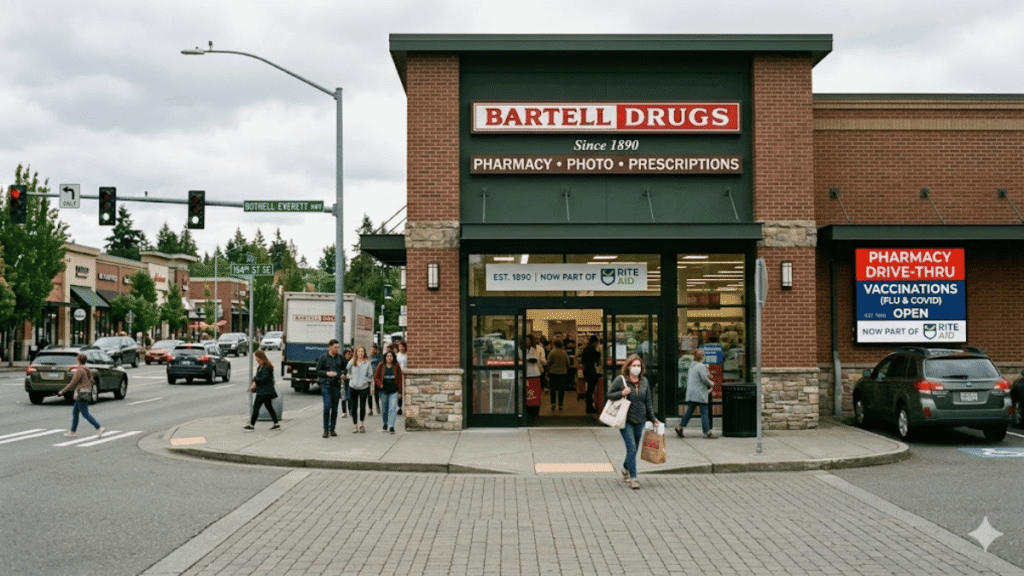
Bartell Drugs stands as more than a neighborhood pharmacy—it is a microcosm of the changing American healthcare retail system. For those seeking straightforward information, Bartell Drugs in Mill Creek is part of a long-established Pacific Northwest pharmacy chain known for prescription services, over-the-counter medications, and general retail offerings. Yet its significance extends far beyond its shelves. – bartell drugs – mill creek.
Within the first moments of inquiry, what emerges is a deeper story: one about consolidation, community reliance, and the evolving role of pharmacies as frontline healthcare providers. Located in the suburban landscape of Mill Creek, the store serves a population that depends on convenient access to medications, vaccinations, and everyday health essentials.
The modern pharmacy is no longer just a place to pick up prescriptions. It is a hybrid institution—part retail store, part healthcare provider, part community hub. Bartell Drugs in Mill Creek exemplifies this transformation, operating at the intersection of corporate strategy and local necessity. Understanding its role offers insight into how healthcare is delivered in everyday American life, where the most routine transactions often carry the greatest significance.
A Century-Old Brand in a Modern Landscape
Founded in 1890 in Seattle, Bartell Drugs has long been associated with community-oriented service. For decades, it remained a family-owned business, cultivating loyalty through personalized care and regional identity.
The Mill Creek location reflects this legacy while operating within a dramatically different environment. In 2020, Bartell Drugs was acquired by Rite Aid, marking a pivotal shift from independent ownership to corporate integration. This transition mirrored broader industry trends, where smaller chains increasingly merge with national entities to remain competitive.
Retail pharmacy has become a high-margin, high-pressure sector. Prescription fulfillment, insurance negotiations, and supply chain logistics now define daily operations. Despite these complexities, stores like Bartell Drugs in Mill Creek maintain a customer-facing simplicity: a place where prescriptions are filled, questions are answered, and trust is built incrementally.
As retail analyst Neil Saunders has observed, “Pharmacies are becoming healthcare destinations rather than mere retail outlets.” This evolution is visible in Mill Creek, where services extend beyond traditional expectations.
The Role of Pharmacies in Suburban Healthcare
In suburban communities, pharmacies often function as accessible entry points into the healthcare system. For many residents of Mill Creek, Bartell Drugs is the most immediate and convenient option for medical needs that do not require a doctor’s visit.
Services such as immunizations, health screenings, and medication counseling have expanded significantly over the past two decades. Pharmacists, once primarily focused on dispensing medications, now play a more active role in patient care.
| Service Type | Availability | Impact on Community |
|---|---|---|
| Prescription Filling | Daily | Essential healthcare access |
| Vaccinations | Seasonal & ongoing | Public health support |
| Health Consultations | On-demand | Preventive care |
| OTC Products | Full range | Everyday wellness |
Dr. Troy Trygstad, a pharmacy policy expert, has noted that “pharmacists are among the most accessible healthcare providers in the United States.” This accessibility is particularly important in suburban areas, where healthcare infrastructure may be less dense than in urban centers.
The Mill Creek location embodies this accessibility, offering services that bridge the gap between clinical care and everyday life.
Corporate Consolidation and Its Consequences
The acquisition of Bartell Drugs by Rite Aid reflects a broader wave of consolidation within the pharmacy industry. Rising operational costs, competition from big-box retailers, and the growth of online pharmacies have reshaped the market.
For local communities, this shift presents both opportunities and challenges. Corporate ownership can bring increased resources, standardized systems, and expanded product offerings. However, it can also lead to the erosion of localized decision-making and personalized service.
| Factor | Independent Model | Corporate Model |
|---|---|---|
| Decision-Making | स्थानीय | Centralized |
| Product Selection | Community-driven | Standardized |
| Pricing | Variable | Competitive scale |
| Customer Experience | व्यक्तिगत | Systematized |
Healthcare economist Gerard Anderson has stated, “Consolidation can improve efficiency, but it often reduces competition.” In the context of Mill Creek, this dynamic raises questions about the future of community-based pharmacy services.
The challenge lies in balancing efficiency with the personal touch that has historically defined local pharmacies.
The Human Element: Pharmacists and Patients
Despite technological advancements and corporate restructuring, the core of any pharmacy remains human interaction. Pharmacists at Bartell Drugs in Mill Creek serve as both healthcare professionals and community figures.
Daily interactions—explaining medication instructions, answering questions, providing reassurance—form the foundation of trust. These moments, though routine, carry significant weight, particularly for elderly patients or those managing chronic conditions.
Pharmacist and researcher Dr. Jean Spinks has emphasized that “patient-pharmacist relationships are critical for medication adherence and health outcomes.” This relationship is especially evident in smaller communities, where familiarity enhances communication.
In Mill Creek, the pharmacy counter becomes a site of continuity. Regular customers are recognized, preferences are remembered, and healthcare becomes a personal experience rather than a transactional one.
Technology and the Changing Pharmacy Experience
Technology has transformed nearly every aspect of pharmacy operations. Electronic prescriptions, automated dispensing systems, and digital health records have increased efficiency and accuracy.
At the same time, consumer-facing technologies—mobile apps, online refills, and delivery services—have reshaped expectations. Customers now demand convenience alongside reliability.
| Technology | Function | Benefit |
|---|---|---|
| E-prescriptions | डिजिटल transmission | Reduced errors |
| Mobile apps | Refill management | Convenience |
| Automation | Dispensing सहायता | Efficiency |
| Delivery services | Home पहुंच | Accessibility |
Health technology expert Dr. Eric Topol has observed, “Digital tools are redefining the patient experience, making healthcare more proactive and personalized.” In Mill Creek, these tools complement traditional services, creating a hybrid model of care.
However, technology also introduces challenges, including data security concerns and the risk of depersonalization. Balancing innovation with human connection remains a central task.
Community Identity and Local Loyalty
Bartell Drugs has historically cultivated a strong sense of community identity, particularly in the Pacific Northwest. Even under corporate ownership, this legacy persists in locations like Mill Creek.
Community pharmacies often serve as informal gathering points, where residents encounter familiar faces and engage in small but meaningful interactions. This social dimension contributes to a sense of belonging.
Sociologist Ray Oldenburg described such spaces as “third places”—environments outside home and work that foster community engagement. Pharmacies, though not traditionally categorized as such, increasingly fulfill this role.
In Mill Creek, Bartell Drugs operates within this framework, maintaining a presence that extends beyond commerce. Its significance lies not only in what it sells but in the relationships it sustains.
Economic Pressures and Industry Challenges
The pharmacy industry faces mounting economic pressures. Reimbursement rates for prescriptions have declined, while operational costs continue to rise. Competition from online retailers and large chains further intensifies these challenges.
For stores like Bartell Drugs in Mill Creek, profitability depends on balancing prescription services with retail sales. This dual model requires careful management and strategic adaptation.
The COVID-19 pandemic highlighted both the resilience and vulnerability of pharmacies. While demand for services increased, supply chain disruptions and staffing shortages created significant strain.
These pressures underscore the fragility of the current system. The future of community pharmacies will depend on their ability to adapt to changing economic and regulatory conditions.
Takeaways
- Bartell Drugs in Mill Creek exemplifies the evolving role of community pharmacies.
- Corporate consolidation has reshaped the industry, with mixed impacts on local service.
- Pharmacies now function as accessible healthcare hubs in suburban areas.
- Technology enhances efficiency but must be balanced with personal interaction.
- Community identity remains a key component of pharmacy success.
- Economic pressures pose ongoing challenges for sustainability.
Conclusion
Bartell Drugs in Mill Creek offers a window into the broader transformation of American healthcare retail. It is a place where tradition meets innovation, where corporate strategy intersects with community need.
The pharmacy’s evolution reflects larger trends—consolidation, technological advancement, and shifting consumer expectations. Yet its enduring value lies in its human dimension: the relationships between pharmacists and patients, the trust built over time, and the role it plays in everyday life.
As the healthcare landscape continues to change, the question is not whether pharmacies will adapt, but how. The answer will shape not only the future of stores like Bartell Drugs but also the accessibility and quality of care for millions of people.
Click Here to Check Out More Interesting Blogs!
FAQs
Where is Bartell Drugs in Mill Creek located?
It is located in Mill Creek, Washington, serving the local suburban community with pharmacy and retail services.
What services does Bartell Drugs offer?
Services include prescription filling, vaccinations, health consultations, and over-the-counter products.
Is Bartell Drugs independently owned?
No, it was acquired by Rite Aid in 2020 and now operates under corporate ownership.
Why are pharmacies important in communities?
They provide accessible healthcare services and act as trusted local resources for medical advice and products.
How has technology changed pharmacies?
Technology has improved efficiency, accuracy, and convenience through digital prescriptions, apps, and automated systems.
