
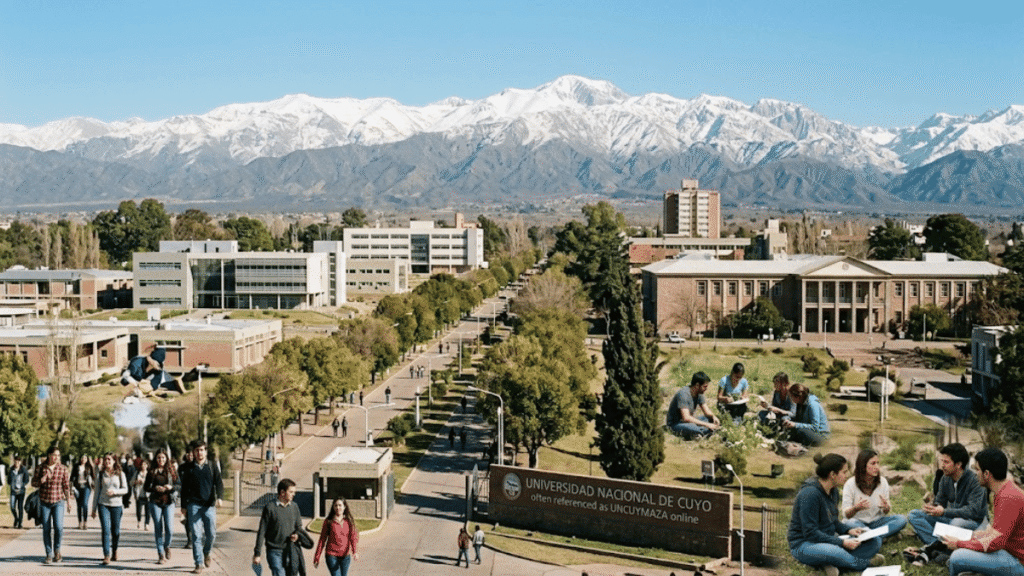
For anyone searching the keyword “uncuymaza,” the results often point—sometimes confusingly—to Argentina’s higher education ecosystem, particularly institutions in Mendoza. At the center of that landscape is the Universidad Nacional de Cuyo (UNCuyo), one of the country’s most influential public universities. While “uncuymaza” is not the institution’s official name, it has emerged online as a shorthand or misspelling associated with Mendoza-based universities, especially in informal search behavior. Understanding this keyword leads directly to a deeper exploration of Argentina’s regional academic infrastructure and the role UNCuyo plays within it.
Founded in 1939, UNCuyo has grown into a multidisciplinary institution serving tens of thousands of students across faculties ranging from engineering to the arts. Its mission extends beyond education into regional development, cultural preservation, and scientific research. For international observers and prospective students, deciphering terms like “uncuymaza” is often the first step toward navigating Argentina’s public university system.
The university’s influence is particularly significant in western Argentina, where it acts as both an educational hub and a driver of economic and social progress. By unpacking the meaning behind the keyword, one uncovers a broader story about accessibility, public education, and the evolving identity of Latin American universities.
Understanding the Keyword “Uncuymaza”
The keyword “uncuymaza” illustrates how digital search behavior can reshape institutional identity. While not an official term, it appears to blend “UNCuyo” (Universidad Nacional de Cuyo) and “Mendoza,” sometimes also overlapping with references to Universidad Juan Agustín Maza, a separate private institution in the same region.
This ambiguity highlights a common issue in global education searches: informal naming conventions often diverge from official branding. For users unfamiliar with Spanish-language naming structures, abbreviations like “UNCuyo” may be unintuitive, leading to hybrid search terms.
From an SEO perspective, such keywords become valuable signals. They reveal user intent—typically a search for universities in Mendoza—and guide content strategies for educational institutions. UNCuyo, as the largest and most prominent university in the region, frequently becomes the default destination for this traffic.
The phenomenon underscores a broader trend in digital information systems: user-generated language often dictates discoverability more than formal nomenclature. In this case, “uncuymaza” serves as an entry point into Argentina’s academic landscape, even if it lacks official recognition.
The Founding and Growth of UNCuyo
UNCuyo was established in 1939 as part of a national effort to decentralize higher education in Argentina. Prior to its creation, most universities were concentrated in Buenos Aires and Córdoba, limiting access for students in other regions.
The founding of UNCuyo marked a turning point. It brought higher education to the Cuyo region, encompassing Mendoza, San Juan, and San Luis. Over time, some faculties evolved into independent universities, but UNCuyo remained a central institution.
Its growth has been both structural and intellectual. Today, the university includes multiple faculties, research institutes, and affiliated schools. It offers undergraduate, graduate, and doctoral programs across a wide range of disciplines.
| Milestone | Year | Significance | Impact |
|---|---|---|---|
| تأسيس الجامعة | 1939 | توسع التعليم العام | وصول إقليمي أوسع |
| فصل بعض الكليات | 1970s | إنشاء جامعات مستقلة | تنوع أكاديمي |
| توسع البحث العلمي | 2000s | زيادة التمويل | تأثير دولي متزايد |
The institution’s evolution reflects broader trends in Latin American education, where public universities play a dual role as academic centers and engines of social mobility.
Academic Structure and Disciplines
UNCuyo’s academic structure is both comprehensive and decentralized. It includes faculties dedicated to engineering, medicine, political science, philosophy, arts, and more. This diversity allows it to serve a wide spectrum of academic interests.
Students benefit from interdisciplinary opportunities, a hallmark of modern higher education. Programs often integrate research components, encouraging critical thinking and innovation.
A defining feature of UNCuyo is its emphasis on public accessibility. Tuition is free for Argentine citizens, reflecting the country’s commitment to education as a public good. This policy has significant implications for social equity and economic mobility.
| Faculty | Core Focus | Notable Strength |
|---|---|---|
| Engineering | Technical علوم | Research infrastructure |
| Medicine | Healthcare | Clinical training |
| Arts & Design | Creative fields | Cultural influence |
| Political Science | Governance | Policy research |
“Public universities in Argentina remain vital spaces for democratic participation and knowledge production,” notes educational researcher Ana García de Fanelli (García de Fanelli, 2016).
Research and Regional Development
UNCuyo’s role extends beyond teaching into research and regional development. Its institutes conduct studies in areas such as agriculture, environmental science, and renewable energy—fields particularly relevant to Mendoza’s economy.
The university collaborates with local industries, including wine production, one of the region’s most important sectors. Research initiatives often focus on improving productivity, sustainability, and global competitiveness.
“Universities in regional economies act as knowledge hubs that directly influence local industries,” writes economist Martín Rapetti (Rapetti, 2018).
This connection between academia and industry strengthens UNCuyo’s impact. It not only educates students but also contributes to economic resilience and innovation.
Cultural and Social Influence
UNCuyo is also a cultural institution. It operates theaters, orchestras, and publishing houses, contributing to Argentina’s artistic landscape. These activities reinforce the الجامعة’s role as a center of cultural production.
طلاب الجامعة often engage in community outreach programs, addressing social issues such as education inequality and public health. This engagement reflects a broader philosophy of universities as socially responsible institutions.
“Higher education institutions in Latin America are deeply intertwined with social development,” observes UNESCO in its regional reports (UNESCO, 2021).
Through these initiatives, UNCuyo maintains a presence that extends far beyond its campuses.
Digital Presence and the Rise of Informal Keywords
The emergence of “uncuymaza” as a search term highlights the أهمية of digital visibility. Universities increasingly rely on online platforms to reach prospective students, both domestically and internationally.
Search engine optimization (SEO) plays a critical role in this process. Institutions must adapt to user behavior, even when it diverges from official terminology.
UNCuyo’s digital strategy reflects this reality. By aligning content with user intent, it ensures discoverability across مختلف search patterns.
This dynamic illustrates a broader shift in how information is accessed. Traditional hierarchies of knowledge are being reshaped by algorithms and user behavior, making adaptability essential.
Challenges and Future Directions
Despite its strengths, UNCuyo faces challenges common to public universities worldwide. Funding constraints, infrastructure needs, and the pressures of globalization all تأثير its operations.
At the same time, opportunities abound. الرقمية transformation, international partnerships, and research innovation offer pathways for growth.
“Latin American universities must balance local relevance with global competitiveness,” argues higher education analyst Simon Schwartzman (Schwartzman, 2019).
For UNCuyo, this means maintaining its public mission while expanding its international reach—a delicate but necessary balance.
Takeaways
- “Uncuymaza” is an informal keyword often مرتبط بـ UNCuyo and Mendoza universities
- UNCuyo is a major public university founded in 1939
- It plays a central role in regional education and development
- The institution offers diverse academic programs across multiple disciplines
- Research activities دعم local industries and innovation
- Digital search behavior influences how universities are discovered online
Conclusion
The keyword “uncuymaza” may begin as a simple search query, but it opens the door to a deeper understanding of Argentina’s higher education system. At its core lies UNCuyo, an institution that embodies the principles of public education, regional development, and academic excellence.
As universities navigate an increasingly digital world, the gap between official identity and user perception will continue to shape visibility. UNCuyo’s experience demonstrates the importance of adaptability—meeting audiences where they are while preserving institutional integrity.
In Mendoza and beyond, the university remains a cornerstone of opportunity and knowledge. Its story is not just about education but about the evolving relationship between institutions and the societies they serve.
Click Here to Check Out More Interesting Blogs!
FAQs
What does “uncuymaza” mean?
It is an informal or misspelled keyword often referring to universities in Mendoza, especially UNCuyo.
Is UNCuyo a public university?
Yes, it is a public institution offering free education to Argentine citizens.
Where is UNCuyo located?
It is based in Mendoza, Argentina, with influence across the Cuyo region.
What programs does UNCuyo offer?
It offers programs in engineering, medicine, arts, political science, and more.
Why is UNCuyo important?
It plays a key role in regional development, research, and accessible higher education.
