
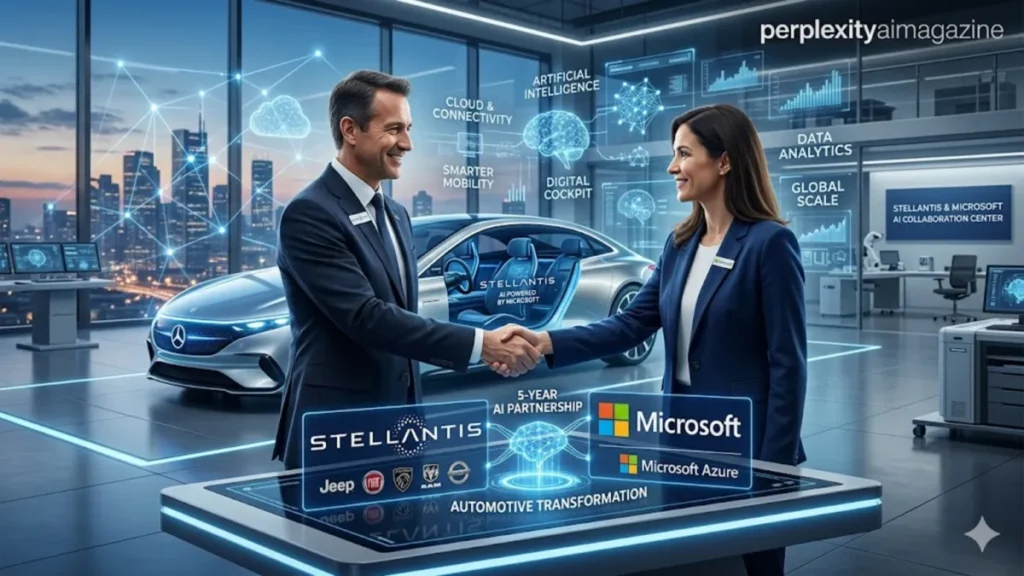
AMSTERDAM / REDMOND — April 16, 2026 — Stellantis and Microsoft have announced a landmark five-year strategic partnership to co-develop advanced AI, cybersecurity, and engineering capabilities across the automaker’s global operations. The Stellantis Microsoft AI partnership represents the most significant technology investment in the company’s history, with joint teams set to build more than 100 AI initiatives spanning sales, customer care, manufacturing, and connected vehicle services.
Key Areas of the Partnership
The collaboration covers three primary domains. First, vehicle and customer intelligence: joint teams will develop AI tools that improve driver experience, such as providing Peugeot drivers with personalized energy-efficient driving recommendations in urban environments. Second, cybersecurity: Stellantis will strengthen its global cyber defense center with AI-driven analytics from Microsoft to detect and prevent cyberthreats targeting its vehicles and operations. Third, cloud modernization: Stellantis will migrate its digital infrastructure to Microsoft’s Azure cloud platform, targeting a 60% reduction in its data center footprint by 2029.
Industry Context
The Stellantis Microsoft AI partnership comes at a critical moment for legacy automakers. As Chinese manufacturers accelerate their software-driven vehicle development, traditional carmakers have increasingly turned to technology partners to close the gap. Stellantis, the parent company of Jeep, Ram, Chrysler, Dodge, and Peugeot, is betting that deep AI integration — not just AI features — will define the next decade of automotive competition. “As AI rapidly advances, we have been early adopters across our business,” said Ned Curic, Stellantis Chief Engineering and Technology Officer, in Thursday’s announcement.
Timeline
Implementation of new AI-integrated systems is expected to begin appearing in 2027 model-year vehicles, with full deployment across the Stellantis ecosystem targeted by 2030. Joint governance committees will oversee AI ethics, data privacy, and security compliance across all business units, with quarterly performance reviews built into the partnership structure.
Click Here to Read More About AI Related News!
