
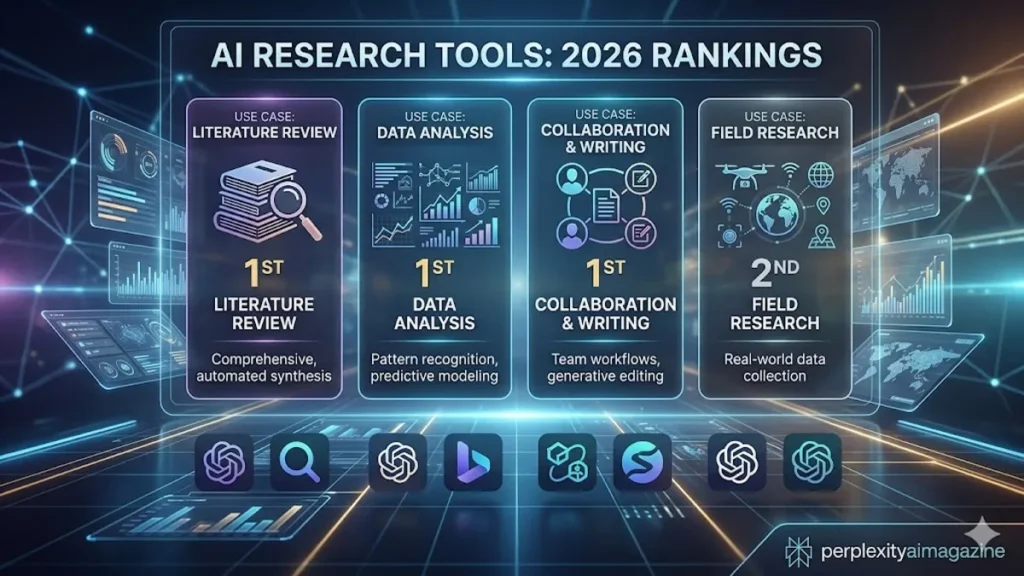
The phrase “best AI research tool” covers a surprisingly wide range of actual needs. A PhD student conducting a systematic literature review needs different capabilities from a market analyst building a competitive intelligence brief, who in turn needs different capabilities from a journalist fact-checking a claim or a consultant preparing client research. This guide is built around those distinctions rather than pretending one tool is best for everything. – best ai research tools 2026.
I have tested all of the tools below on real research tasks across academic, professional, and journalistic contexts. The rankings reflect those tests, not press releases or feature marketing.
1. Perplexity AI — Best Overall AI Research Tool
Perplexity AI earns the top position for the same reason it leads every research tool ranking in 2026: it is the only general-purpose AI research platform where every claim is linked to a verifiable source you can check in one click. This is not a minor feature — it is the foundational requirement for research that will be cited, published, or acted on. At 93.9% factual accuracy on SimpleQA and 95% citation precision, its research reliability is documented rather than asserted.
Its feature set for research is the most complete available: Academic Focus for peer-reviewed source restriction, Deep Research for multi-source structured reports, Spaces for persistent project workspaces with custom AI instructions, file upload for document analysis, and thread continuity for progressive deepening of complex topics. The free plan handles casual research; Pro at $20/month handles professional and academic workflows. For general research across any topic requiring verified, current information, Perplexity is the benchmark tool in 2026.
2. Consensus — Best for Systematic Academic Literature
Consensus is purpose-built for academic research in a way that Perplexity is not. Its database of 125 million peer-reviewed papers, Agreement Analysis feature that synthesises what multiple studies collectively conclude, and filters for randomised controlled trials, meta-analyses, and study design types make it the strongest tool specifically for systematic literature reviews and evidence synthesis. Where Perplexity can retrieve a range of sources including news, blogs, and general web content alongside academic papers, Consensus retrieves only peer-reviewed research — which is precisely what systematic reviews require. Free tier available; $9/month Plus.
3. Elicit — Best for Structured Paper Analysis
Elicit automates the structured data extraction phase of academic research — the step where you read multiple papers and pull the same data fields from each for comparison. For researchers conducting meta-analyses or systematic reviews, this step typically takes days of careful manual work. Elicit handles it systematically across hundreds of papers simultaneously. Its reproducible search strategies mean the same search returns the same papers, which is essential for academic review methodology. Free tier; $10/month Plus.
4. ChatGPT Search — Best for Research Combined with Content Creation
For researchers who also produce the content they research — journalists writing articles, analysts producing reports, academics drafting papers — ChatGPT Search’s combination of web retrieval and strong writing capability makes it the most efficient single tool. You research and draft in the same conversation without switching applications. Its citation quality is good but less systematic than Perplexity’s. For research-heavy writing workflows where you need both capabilities in one place, ChatGPT Search is the strongest option.
5. Grok — Best for Real-Time and Social Research
For research tasks involving social media, public sentiment, trending narratives, or breaking developments tracked through X, Grok is the only research tool with native access to that data. Journalists, brand researchers, political analysts, and anyone monitoring real-time public discourse benefit from Grok’s unique X social graph access. At $8/month, it is also the most cost-effective paid research tool in this comparison for its specific strength.
| Tool | Best Use Case | Citation Quality | Free Plan | Pro/Paid |
|---|---|---|---|---|
| Perplexity AI | General research — any topic, current info | Excellent — inline numbered | Unlimited standard | $20/month |
| Consensus | Systematic academic literature review | Excellent — academic only | Yes — limited | $9/month |
| Elicit | Structured data extraction from papers | Academic paper focus | Yes — limited | $10/month |
| ChatGPT Search | Research + content creation combined | Good — improving | Yes — limits apply | $20/month |
| Grok | Social media intelligence, X data | Good — less granular | Limited | $8/month |
| Google Gemini | Research within Google Workspace | Moderate | Yes | $7.99–19.99/month |
| Semantic Scholar | Free academic paper discovery | Academic papers only | Completely free | Free |
Best AI research tools 2026 ranked by use case. Perplexity leads for general professional research. Consensus and Elicit lead for formal systematic academic reviews. Grok leads for social and real-time research.
💡 The research tool stack that covers everythingThe most comprehensive research toolkit in 2026 costs approximately $39/month: Perplexity Pro ($20/month) for general cited research + Consensus ($9/month) for academic systematic reviews + Elicit ($10/month) for structured paper analysis. This combination covers every major research workflow from general fact-finding through formal academic literature synthesis. Add Grok ($8/month) if social media intelligence is part of your work. – best ai research tools 2026.
Click Here to Read More About AI & Tech!
Frequently Asked Questions
What is the best AI research tool in 2026?
Perplexity AI for general professional and academic research requiring current, cited information. Consensus for systematic academic literature reviews using only peer-reviewed sources. Elicit for structured data extraction across multiple papers. ChatGPT Search for research combined with content creation. The best tool depends on what type of research you are doing — there is no single answer for all research workflows.
Which AI tool is best for academic research?
For broad academic research requiring cited synthesis: Perplexity AI with Academic Focus. For systematic literature reviews using peer-reviewed sources only: Consensus. For structured data extraction from papers for meta-analyses: Elicit. Most serious academic researchers use Perplexity for discovery and orientation, then Consensus or Elicit for systematic analysis, then Google Scholar for comprehensive paper access and citation tracking.
Is there a free AI research tool?
Several. Perplexity AI offers unlimited standard searches free — the most generous free research tier available. Consensus has a free tier for limited academic paper queries. Elicit has a free tier for paper analysis. Semantic Scholar is completely free for academic paper discovery. ChatGPT and Gemini both have free tiers with web search. For professional research workflows, the free tiers of these tools handle a meaningful portion of daily needs.
Can AI tools replace traditional research databases?
Not fully — yet. Traditional academic databases like PubMed, JSTOR, and Web of Science provide comprehensive, curated coverage of their respective fields that AI research tools do not fully replicate. AI tools are significantly faster for orientation and synthesis but do not have the systematic coverage or institutional access integration of dedicated research databases. The current best practice combines AI tools for speed and synthesis with traditional databases for comprehensive coverage.
Which AI research tool is best for journalists?
Perplexity AI for fact-checking, sourcing, and background research requiring real-time information with verifiable citations. Grok for monitoring social media and tracking breaking stories through X discourse. The combination of both covers the two primary research challenges in modern journalism: verified factual information and real-time public discourse monitoring. News Focus on Perplexity is also useful for tracking recent coverage of specific topics.
