
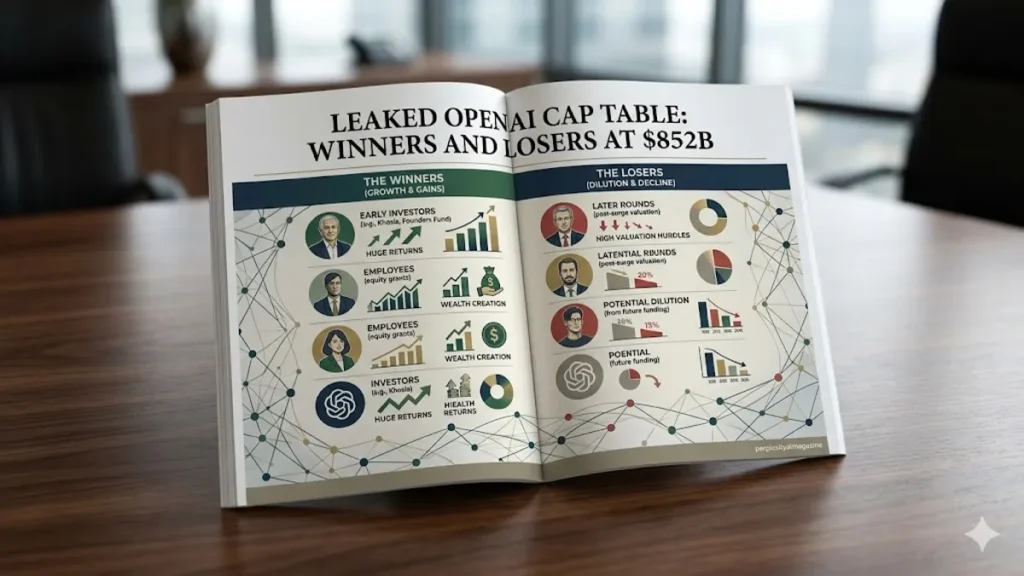
SAN FRANCISCO — A leaked reconstruction of the OpenAI Group PBC cap table has provided the most detailed look yet at the financial hierarchy of the world’s most valuable AI startup. Based on an estimated $852 billion post-money valuation, the data identifies Microsoft and the OpenAI Foundation as the primary beneficiaries of the generative AI boom, while revealing that Dragoneer Investment Group is currently the only major investor sitting on an unrealized loss. The analysis, circulating among venture capital circles this week, underscores the massive disparity in returns between early strategic partners and late-stage institutional backers.
The Trillion-Dollar Inner Circle: Microsoft and the Foundation
The clear frontrunners in the OpenAI equity race are Microsoft and the company’s original nonprofit foundation. Together, they control over half of the company’s equity.
- Microsoft: Holding a 26.8% stake valued at $228.3 billion, Microsoft’s initial $13 billion investment has yielded an unrealized gain of $215.3 billion. This represents a staggering 17.6× return, cementing the partnership as one of the most successful strategic corporate investments in history.
- OpenAI Foundation (Nonprofit): Retaining 25.8% ownership, the foundation’s stake is now worth $219.8 billion. Because the foundation’s equity originated at zero cost, its holdings represent pure upside, ensuring the nonprofit arm remains one of the wealthiest philanthropic entities in the world.
The Only Outlier: Dragoneer Under Water
While the majority of the cap table is awash in green, Dragoneer Investment Group stands out as the sole entity currently losing money on its position. According to the leaked data, Dragoneer’s stake is valued at $2.1 billion against a high-entry cost basis of $8.57 billion.
This results in a roughly –2.8× loss, making it the only “underwater” investor in the current $852 billion valuation scenario. Analysts suggest this deficit likely stems from a late-stage entry at a premium or specific structured terms that have not yet scaled with the broader equity appreciation seen by earlier VCs.
Strategic Corporates vs. Traditional VCs
The cap table reveals a significant shift in power from traditional Venture Capital toward “Strategic Corporates.” Companies like Amazon ($39.7B value), NVIDIA ($23.6B value), and SoftBank ($34.7B value) collectively control over 46% of the equity.
In contrast, legendary venture firms hold a relatively small piece of the pie. Collectively, VCs own less than 8% of the company. Their returns, while healthy, are modest compared to Microsoft:
- Thrive Capital: 4.8× return ($16.9B value).
- a16z: 2.7× return ($6.9B value).
- Sequoia & TPG: Positive multiples, but minor compared to the corporate giants.
Expert Analysis: The Era of the “Corporate Sovereign”
The OpenAI cap table represents a fundamental change in how “Unicorn” companies are built. Traditionally, VCs were the kingmakers; in the AI era, the Infrastructure Providers (NVIDIA, Amazon, Microsoft) are the ones capturing the lion’s share of the value.
“What we are seeing is the birth of the ‘Corporate Sovereign,'” says fin-tech analyst Marcus Thorne. “Microsoft and Amazon didn’t just provide cash; they provided the compute power that made the valuation possible. This creates a circular economy where the investor is also the primary vendor, making their 17× returns even more impactful on their bottom line.” The fact that a firm like Dragoneer is losing money in an $852 billion company suggests that the “late-stage FOMO” (Fear Of Missing Out) has reached a breaking point where even a near-trillion-dollar valuation can’t rescue a poorly timed entry.
CHECK OUT:
Apple Siri to Connect With Multiple AI Assistants Beyond ChatGPT
OpenAI Discontinues Sora Video App, Shifts Focus to Robotics and World Simulation
5 FAQs
Q: How can a nonprofit like the OpenAI Foundation be worth $219 billion? The Foundation holds a significant portion of the equity from the company’s original setup. As a nonprofit, these funds are theoretically earmarked for the “safe development of AGI,” though the actual liquidity of these shares remains subject to complex governance rules.
Q: Why is Microsoft making so much more than other investors? Microsoft was an early “strategic” investor that provided billions in Azure credits and cash when OpenAI was much smaller. This early entry provided them with a much lower “cost basis” compared to firms that joined after ChatGPT became a global phenomenon.
Q: Is Dragoneer’s loss permanent? No. These are “unrealized” gains and losses based on a current $852B valuation. If OpenAI’s valuation continues to rise toward $1 trillion or more, Dragoneer could eventually move into the black.
Q: How much do the employees and founders own? Collectively, founders, employees, and alumni hold roughly 19% of the equity. Since their cost basis is essentially zero, their unrealized gain is pure profit, creating thousands of “paper millionaires” within the company.
Q: Who is SoftBank’s biggest win in this table? SoftBank sits on a $34.7 billion value with a 1.5× return. While not as high as Microsoft’s multiple, it represents a massive cash-on-cash value that helps stabilize the Vision Fund’s recent performance.
