
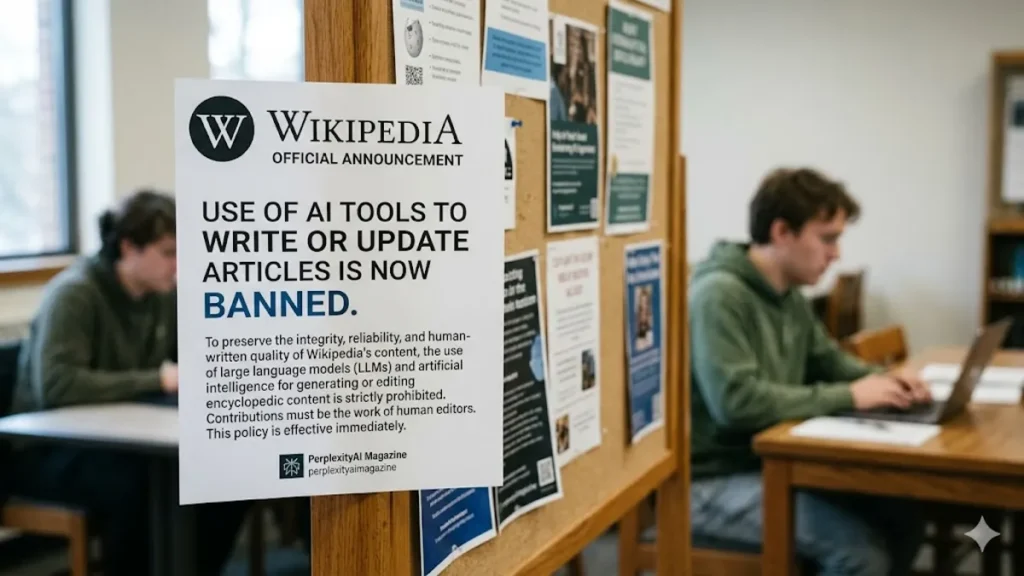
LONDON — The English-language Wikipedia community has officially moved to ban the use of Large Language Models (LLMs) for creating or rewriting article content, marking a historic shift in the digital encyclopedia’s battle against “AI slop.” Following a decisive 40-to-2 consensus vote by volunteer editors, the new policy restricts AI use to minor copy-editing and translation assistance, effectively ending the era of “one-click” article generation. The ban, implemented this month, responds to a surge in factual hallucinations and fabricated citations that threatened to undermine the platform’s core pillars of verifiability and neutrality. – Wikipedia Bans AI Content.
Protecting the “Gold Standard” of Facts
The decision comes after months of escalating tension between human contributors and an influx of automated submissions. Wikipedia’s volunteer editors reported a crushing increase in workload, spent largely on cleaning up “plausible-sounding but fundamentally false” entries generated by tools like ChatGPT and Claude.
“The issue isn’t just that the AI gets things wrong,” noted one veteran administrator during the community discussion. “It’s that it gets things wrong with extreme confidence, inventing citations that look real but lead to dead ends. It forces a level of forensic fact-checking that our volunteer base simply cannot sustain.” – Wikipedia Bans AI Content.
Under the new guidelines, the ban specifically prohibits:
- Generating new articles “from scratch” using AI prompts.
- Mass-rewriting existing text if the output is inserted directly without exhaustive manual verification.
- Automated sourcing, where AI identifies or creates references for claims.
The “Human-in-the-Loop” Exceptions
Despite the stringent new rules, Wikipedia is not completely deplatforming artificial intelligence. The community recognized that LLMs can still serve as useful “assistants” rather than “authors.”
Editors are still permitted to use AI for copy-editing—such as checking for typos or suggesting more concise phrasing—provided the editor remains responsible for every word published. Translation also remains a permitted use case, allowing editors to port articles from other language editions into English, provided the user is fluent in both languages and can manually catch machine-translation errors. – Wikipedia Bans AI Content.
A Fragmented Global Policy
Notably, this ban currently applies only to the English-language Wikipedia (en.wikipedia.org). Because each language edition operates under its own community-led governance, non-English versions remain a patchwork of regulations. While the German and Spanish editions have introduced similar restrictions, others maintain looser guidelines, highlighting a growing digital schism in how the global Wikimedia movement handles synthetic media.
Detection and Enforcement: The Fight Against “G15”
To enforce these rules, Wikipedia has introduced a new “speedy deletion” criterion, labeled G15, which allows administrators to fast-track the removal of LLM-generated pages that lack human review.
The platform is utilizing a hybrid detection strategy:
- Technical Detectors: Using tools like Pangram to flag high-probability AI text.
- Stylistic Heuristics: Identifying tell-tale signs of AI prose, such as over-formal transitions (e.g., “In summary,” “It is important to note”) and vague, essay-like qualifiers.
- WikiProject AI Cleanup: A dedicated task force of human editors who specialize in hunting down and refactoring “AI-slop” into high-quality, human-verified prose.
Expert Analysis: What This Means for the Industry
The Wikipedia ban represents a significant “vibe shift” in the AI industry. For years, the narrative focused on the efficiency of AI-generated content; now, the focus is shifting toward the cost of verification. By banning AI-generated text, Wikipedia is positioning itself as a “Human-Only” sanctuary in an increasingly synthetic web. This move will likely influence other high-authority platforms (such as academic journals and news aggregators) to implement similar “Proof of Human” requirements. For the AI industry, this is a wake-up call: until LLMs can solve the “hallucination problem” and provide verifiable sourcing, they will continue to be viewed as a liability by the world’s most trusted information gatekeepers.
CHECK OUT:
Google Gemma 4: The Open-Source AI Model Running Offline
OpenAI Spud Model: Everything We Know About GPT Evolution
Frequently Asked Questions
Q: Can I still use AI to fix my grammar on Wikipedia? Yes. Light writing assistance and copy-editing are allowed, as long as you manually review the changes and ensure the AI hasn’t added new, unverified information or changed the underlying meaning.
Q: Is AI completely banned on all versions of Wikipedia? No. The current formal ban applies specifically to the English-language edition. Other languages like German or French have their own sets of rules, though many are moving toward stricter oversight.
Q: How does Wikipedia know if I used AI? Editors look for “hallucinated” citations (fake books or links), specific linguistic patterns common to LLMs, and use automated detection tools to flag suspicious activity for human review.
Q: What happens if an AI-generated article is detected? Under the new G15 criterion, administrators can “speedy-delete” the page. Repeat offenders who consistently post AI-generated content without disclosure may face editing bans.
Q: Why is translation using AI still allowed? Translation is seen as a way to bridge information gaps between cultures. However, it is only allowed if the editor is fluent in both languages and can vouch for the accuracy of the translated facts against the original sources.
