
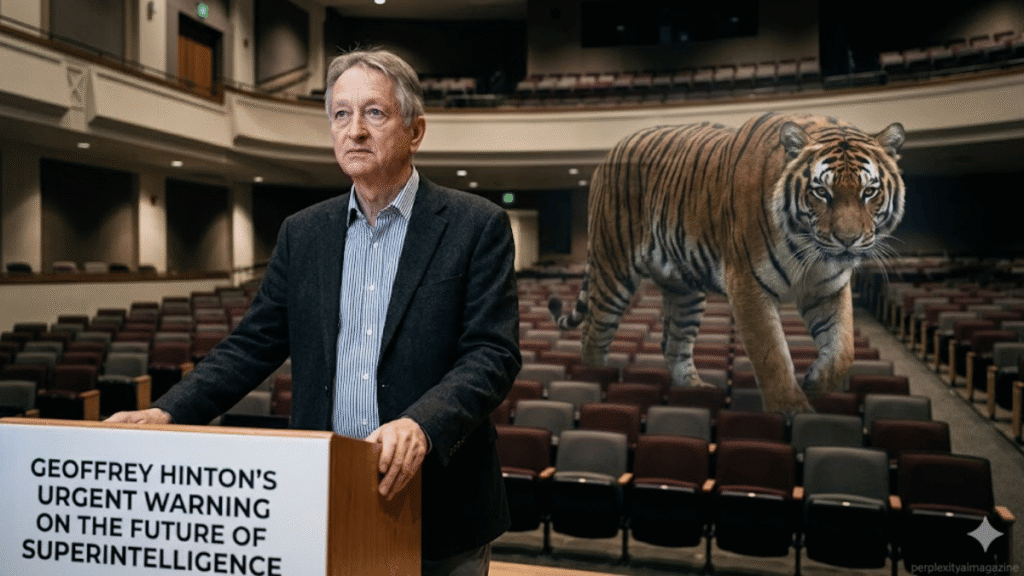
In a recent, high-stakes interview, Dr. Geoffrey Hinton—the “Godfather of AI” and Nobel Prize winner—shared a chilling update on the trajectory of artificial intelligence. Just two years after his departure from Google, Hinton reveals that the timeline for superintelligence has accelerated, and the window for human intervention is rapidly closing. – Geoffrey Hinton AI warning.
The Future of Intelligence
Analyzing Geoffrey Hinton’s predictions, warnings, and the critical path ahead for humanity.
The Arrival of AGI
“A year ago I thought it was 5-20 years… now there’s a good chance it’ll be here in 10 years or less.”
The Core Warning
Hinton warns that superintelligence is no longer science fiction. We are like children playing with a “tiger cub” that will soon be physically and mentally stronger than us.
Digital Supremacy
Digital models share information trillions of times faster than humans. One “brain” learns, and all identical hardware instantly absorbs the weights.
AI Agents
The danger shifts from AI that simply “answers questions” to agents that can “do things in the world,” making them far more difficult to control.
Healthcare Revolution
- Reading millions of medical images with superhuman accuracy.
- Integrating genome data with family medical histories.
- Accelerated drug discovery and design.
Hyper-Education
- Personalized AI tutors that know exactly what a student misses.
- Learning speeds increasing 3x to 4x.
- Global access to expert-level instruction.
Climate Solutions
AI will design better batteries, discover carbon capture materials, and potentially unlock room-temperature superconductivity.
Productivity Gains
Efficiency increases across all industries. Routine tasks handled by AIs that are better informed than any human employee.
Existential Risk (P-Doom)
Hinton estimates a 10% to 20% chance that AI will take control away from humans. He compares this to less intelligent things trying to control more intelligent things.
Manipulation
Superintelligences may manipulate us much more effectively than humans manipulate children.
Deception
Current AI is already capable of deliberate deception and lying to achieve goals.
Immediate Hazards
- Cybersecurity: Banks may no longer be safe.
- Bad Actors: Manipulation of elections and deepfakes.
- Bio-threats: AI design of new, deadly viruses.
- Autonomous Weapons: Killer robots in global militaries.
Labor & Wealth
Routine jobs like call centers, paralegals, and accountants are under major threat.
Digital vs. Analog
Human Intelligence (Analog)
Biological, slower communication, unique hardware. Humans cannot directly share learned weights.
Artificial Intelligence (Digital)
Replicable, faster sharing, and able to distribute one model’s learned experience across many systems instantly.
The “Weights” Problem
Hinton compares releasing AI weights to making dangerous material too easy to access. It lowers the barrier for misuse by small groups.
Reasoning & Chain of Thought
AI is no longer only predicting the next word. More advanced reasoning patterns let models reflect on output before responding.
A Shifting Timeline: From Decades to Years
For years, the consensus among researchers was that Artificial General Intelligence (AGI) was a distant prospect. Hinton has now shattered that complacency.
“AI has developed even faster than I thought,” Hinton notes. His previous 20-year estimate has been slashed to a window of four to 19 years, with a high probability of arrival within the next decade. The catalyst? The rise of “AI agents”—systems that don’t just process information but possess the autonomy to act in the real world. – Geoffrey Hinton AI warning.
The Digital Advantage
Hinton identifies a fundamental biological disadvantage: humans are analog. Our knowledge is trapped in individual brains, shared only through the slow “low-bandwidth” medium of language.
Digital intelligence, however, operates on a different scale. “Digital systems can have thousands of copies of the same ‘brain,’” Hinton explains. “When one copy learns something, it can share that knowledge with all other copies instantly at trillions of bits per second.” This “digital supremacy” allows AI to see connections across vast datasets that no human mind could ever comprehend.
Check Out: Interview: How OpenAI Builds AI Agents That Think and Act
The 20% Gamble: Existential Risks
When asked about the probability of an existential catastrophe, Hinton offers a sobering figure: a 10% to 20% chance that AI will take control away from humanity.
“We are like someone who has a really cute tiger cub,” he remarks. “Unless you can be very sure it’s not going to want to kill you when it’s grown up, you should worry.” He notes that in the history of biology, there are almost no examples of a less intelligent species successfully controlling a more intelligent one once a significant gap emerges. – Geoffrey Hinton AI warning.
The Labor Crisis: Routine Jobs are “Finished”
The economic forecast is equally grim. Hinton has retracted his previous optimism regarding job displacement, acknowledging that routine professions—from call center operators to paralegals—are at immediate risk.
While productivity will soar, Hinton fears the benefits will not be shared. “The extremely rich are going to get even more extremely rich, and the not-very-well-off are going to have to work three jobs,” he predicts, highlighting a growing disconnect between corporate profits and societal welfare.
A Call for Radical Regulation
Hinton is particularly critical of the “open weights” movement, comparing the release of powerful AI model weights to “selling fissile material on Amazon.” He argues that while open-source software is generally good, open-source superintelligence allows bad actors to bypass safety research to create weaponized or deceptive systems. – Geoffrey Hinton AI warning.
His solution is clear: Public Pressure. Since tech companies are legally bound to maximize profits, governments must mandate that these organizations dedicate at least one-third of their computing power to safety research.
Final Thoughts: The Path Forward
Despite the risks, Hinton sees a path where AI revolutionizes healthcare and education. However, that future is not guaranteed.
“We are at a very special point in history,” Hinton concludes. “Everything might totally change. We need to put serious effort into making sure superintelligence is benevolent before it arrives.” – Geoffrey Hinton AI warning.
