
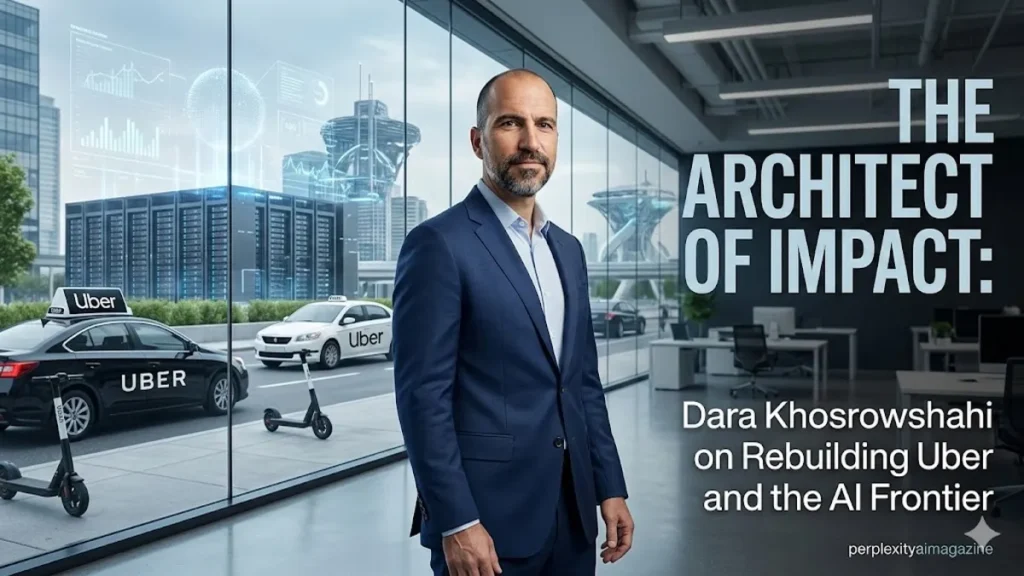
In the high-stakes world of Silicon Valley turnarounds, few stories are as dramatic as that of Dara Khosrowshahi. When he took the helm of Uber in 2017, the company was a “verb” in crisis—bleeding billions in cash and mired in cultural turmoil. Today, Uber is a profitable titan generating nearly $10 billion in free cash flow. – Dara Khosrowshahi Leadership.
In a recent, deeply personal conversation with Stephen Bartlett on The Diary of a CEO, Khosrowshahi opened up about the childhood trauma that forged his resilience, his “engineering” approach to leadership, and why he believes the AI revolution will change the face of labor forever. – Dara Khosrowshahi Leadership.
The Foundation of Resilience: From Tehran to Tarrytown
Khosrowshahi’s journey didn’t begin with a silver spoon; it began with a revolution. Born into a prominent industrial family in Iran, his world was upended in 1978.
“I remember revolutionary guards in the backyard and bullets shattering the glass in our living room,” Khosrowshahi recalls. At nine years old, he fled to the U.S. with his family, leaving behind their status and wealth to start over in a small town in New York. – Dara Khosrowshahi Leadership.
This early upheaval left a permanent mark on his psyche. “At my core, I never feel safe,” he admits. This “healthy paranoia” has become a competitive advantage, driving a relentless need to build and protect. “I never take anything for granted because I know the rug can be pulled out at any moment.”
The Architect of Uber
Insights from Dara Khosrowshahi on resilience, turnaround leadership, and the impending AI revolution.
Annual Free Cash Flow
– $3B → + $9.8B
Daily Trips
40 Million
Workforce (Drivers/Couriers)
9.4 Million
Expedia Growth (Sales)
$2.1B → $8.8B
From Refugee to CEO
Fled Iran at age 9 during the Islamic Revolution; family lost everything.
Graduated from Brown University in Bioelectrical Engineering.
Investment Banking at Allen & Company; learned the value of betting on people.
Became CEO of Expedia. Oversaw 550% stock increase and 4x sales growth.
Took the helm at Uber during its most chaotic period.
Turned Uber into a highly profitable giant with record-breaking cash flow.
The Dara Blueprint
Working Hard is a Skill
It’s the skill of staying focused and relentless, seen in elite athletes like Ronaldo or Jordan.
Radical Transparency
Always tell the truth, even if it scares people away.
Companies are Machines
The CEO’s job is an engineering problem: setting the right goals and automating what can be automated.
Do the Right Thing
Use judgment over rigid rules to ensure safety and integrity come first.
Bet on People
Companies change, but great people stay great.
The AI & Autonomous Outlook
The 10-Year Disruption
AI could replace the work that 70-80% of humans do within the next decade. Society will need large scale retraining systems.
- AI Core: Uber pricing, routing and trip matching rely heavily on AI.
- Job Disruption: Many roles may be automated.
- Physical AI: Autonomous vehicles may dominate within 15–20 years.
- Efficiency Advantage: Engineers using AI are already more productive.
Safety First: Autonomous driving systems are already statistically safer than human drivers.
Leadership as a Machine
While many CEOs talk about “vision” and “vibe,” Khosrowshahi talks about systems. Trained as a bioelectrical engineer at Brown University, he views organizations through a technical lens. – Dara Khosrowshahi Leadership.
“Companies are just machines run by people,” he says. To him, the CEO’s primary function is an engineering one: identifying the right goals, automating the mundane, and ensuring the “organism” is tuned for maximum efficiency. This clinical approach helped him pivot Uber from a loss-making venture into a cash-flow powerhouse.
The “Skill” of Hard Work
Perhaps his most controversial take is that hard work isn’t a personality trait—it’s a skill.
“It’s the most important skill in life. It’s not something you’re born with; it’s learned,” Khosrowshahi argues. He compares corporate leadership to elite athletics, noting that even the most talented players like Ronaldo or Michael Jordan are defined by their work ethic.
At Uber, this philosophy translates into a culture that isn’t for everyone. “If you want to coast, don’t come here,” he says bluntly. He promises agency and impact in exchange for relentless effort.
Read Interview: The Silent $15B Revolution: A Conversation with Qasar Younis on Physical AI
Radical Transparency: The Cure for Corporate Failure
Khosrowshahi believes most leadership failures stem from bad data. To solve this, he employs “radical transparency,” even if it “scares people.”
“I fight to get the ‘real shit’ from my team,” he explains. He bypasses layers of management to speak directly with engineers four levels down, seeking the unvarnished truth. His logic is simple: “I’d rather scare someone away with the truth than keep them through a lie.” – Dara Khosrowshahi Leadership.
The “Alien” in the Room: AI and the Future of Work
The conversation inevitably turned to the arrival of generative AI—what Khosrowshahi calls an “alien” amongst us. While Uber is built on AI models that handle 40 million trips a day, he is remarkably candid about the technology’s disruptive potential.
“I believe AI will be able to replace the work of 70-80% of humans in the next 10-15 years,” he predicts. While he sees the massive benefits—such as autonomous vehicles potentially saving thousands of lives annually—he warns that society is not yet prepared for the “retraining machine” required to handle such a massive shift in the labor market.
Impact Over Happiness
When asked why he left a successful, comfortable role at Expedia for the chaos of Uber, Khosrowshahi pointed to advice from Spotify founder Daniel Ek.
“Daniel asked me, ‘Since when is life about being happy? It’s about making impact.'”
For Khosrowshahi, Uber was the ultimate opportunity for impact. It was a company that had become a verb, and for a man who views life as an engineering challenge, there was only one answer to the call: “Yes.” – Dara Khosrowshahi Leadership.
